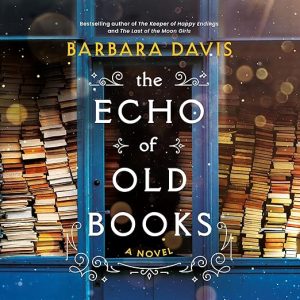
Rare-book dealers as protagonists carry a particular narrative privilege: they are professionally trained to read physical objects for what they conceal as much as what they reveal. Barbara Davis uses that premise with full awareness of what it enables in The Echo of Old Books. Ashlyn Greer can feel the emotional residue of a book's previous owners through touch, an ability the novel frames as unusual without overexplaining it, and when she encounters two unpublished volumes that appear to be private correspondence disguised as narrative, her gift becomes something close to compulsion. I came to this audiobook through Davis's earlier novels and found this one the most formally inventive of what I have read from her so far.
The structure is dual-timeline in the way that contemporary literary fiction has made familiar over the last decade, alternating between Ashlyn's present-day investigation and the voices of Hemi and Belle, the two authors of those mysterious volumes, whose accounts of a doomed romance in the mid-twentieth century contradict each other in ways that Ashlyn must reconcile. This audiobook runs just over thirteen hours, and Davis uses most of that time to build the historical sections with as much care as the contemporary frame. The result is a novel about books that earns its literary conceits rather than merely gesturing at them.
The formal premise, two first-person accounts of the same events that do not quite agree, is one that literary fiction has worked hard across from Akira Kurosawa's films to novels like Kate Atkinson's early work. Davis is not trying to match those ambitions, but she executes her version of the premise with sufficient care that the unreliable structure generates genuine tension rather than feeling like a trick. One reviewer noted that 'the author did a masterful job of putting us in each character's shoes' and that the multiple storylines, despite initial hesitation, 'work well together.' That reader trust is earned through the consistency of Hemi and Belle's voices, which feel distinct enough that their contradictions register as character rather than confusion.
Vanessa Johansson's narration handles the tonal shifts between timelines effectively. The contemporary sections carry a quieter urgency, the pace of someone following evidence rather than action. The historical sections require more emotional range, tracking a romance from promise through betrayal and loss. Johansson distinguishes between them through register rather than obvious voice-acting, which is the right approach for a novel that trusts its structure to do the signaling work and does not need heavy performance to mark the transitions.
Why It Works in Audio
For listeners who love books about books, Davis delivers something more than a premise in search of plot. The detail around Ashlyn's work, the specific feel and smell of old paper, the history embedded in inscription and marginalia, is handled with the sensory richness that earns the word 'bibliophilic' without reducing it to nostalgia. One reviewer described the novel as a 'literary gem that effortlessly weaves a rich tapestry of characters, plot, and history,' and the historical sections in particular demonstrate Davis's investment in the period she is writing about.
The audiobook also works as a vehicle for a theme that Davis has explored across her career: the unfinished chapters of a life, and whether understanding someone else's unfinished story can illuminate your own. Ashlyn's personal life, her own reluctance around intimacy and closure, runs parallel to the historical mystery without the connection being labored. Davis trusts the structural rhyme to do the work without overexplaining it, which is a sign of a writer confident enough in her material to resist the impulse to spell everything out.
Before You Commit to The Echo of Old Books
One reviewer noted that Ashlyn's contemporary storyline felt 'rushed' relative to the attention given to Hemi and Belle. That observation is accurate and worth weighing before you begin. The historical romance is the novel's primary emotional investment, and Ashlyn's framing narrative sometimes functions more as scaffold than substance. If you come to this audiobook primarily for the contemporary protagonist rather than the historical mystery, you may find the balance uneven in the final act when the two timelines converge.
The psychometric ability that allows Ashlyn to read books' emotional histories is handled with deliberate restraint by Davis. It is not explained or systematized in ways that would tip the novel toward fantasy. That restraint is an artistic choice, but listeners who want a clear understanding of the rules governing Ashlyn's gift will find the book leaves more ambiguous than they might prefer. Davis is more interested in the emotional truth the device enables than in the mechanics of the device itself, and the ambiguity is never fully resolved.
Who Will Get the Most From It
Readers who appreciate dual-timeline historical fiction with a literary sensibility, who are drawn to books about the physical and emotional lives of books themselves, or who have enjoyed Davis's previous novels like The Keeper of Happy Endings will find this audiobook a satisfying experience across thirteen hours. Vanessa Johansson's narration suits the material's tonal range well. Listeners who prefer a single contemporary protagonist with a tightly resolved mystery arc may find the balance between timelines slightly frustrating. Those who come for the historical romance between Hemi and Belle will likely find that the novel delivers on that investment fully and honestly.
Quick Take
- Read by: Vanessa Johansson distinguishes between the contemporary and historical timelines through register rather than overt voice-acting, which serves the novel's structural ambitions.
- At its heart: Books as emotional artifacts, unreliable dual narration, historical romance, unfinished stories and closure
- Vibe: Quiet and accumulative, with bibliophilic atmosphere and genuine dual-timeline tension
- Short version: A well-constructed audiobook for literary fiction readers who like books about books, with the caveat that the historical romance outweighs the contemporary frame.
Questions Listeners Ask
Does this audiobook require prior familiarity with Barbara Davis's earlier novels like The Keeper of Happy Endings?
No. The Echo of Old Books stands alone. Familiarity with Davis's earlier work may set expectations about her tone and thematic preoccupations, but the novel introduces its world and characters independently.
How does Vanessa Johansson handle the dual-narrator structure in this audiobook?
Johansson differentiates between the contemporary Ashlyn sections and the historical Hemi and Belle sections through tonal register rather than distinct voice performances, which suits the novel's literary approach to multiple perspectives.
Is the psychometric ability that lets Ashlyn feel a book's emotional history central to the plot of this audiobook?
It is the inciting device that sets the mystery in motion, but Davis handles it with deliberate ambiguity. It is not systematized or explained, and the novel is more interested in what the ability reveals than in how it works.
Is The Echo of Old Books part of a series or a standalone audiobook?
It is a standalone novel. Davis's books often share thematic territory around women reclaiming their stories, but they are not connected by plot or shared characters.