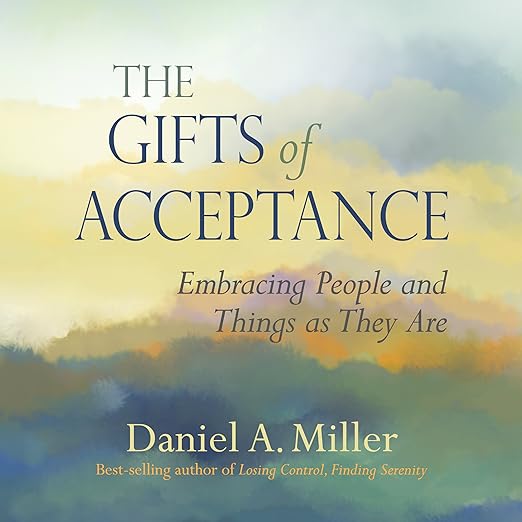
Daniel Miller's The Gifts of Acceptance won the 2018 Silver Medal in Non-Fiction Audio from the Independent Book Publishers Association, which is a useful starting point for understanding what this audiobook accomplishes. The recognition is for the audio edition specifically, which reflects something real about how Doug McDonald's narration and Miller's material work together. Miller describes himself as a former compulsive controller, and that self-identification as someone who has personally failed at acceptance repeatedly gives the audiobook a credibility that pure clinical advice-giving cannot achieve. This is a book written from inside the problem as much as from outside it, and McDonald's delivery preserves that quality throughout the nearly six hours of listening.
Suffering Comes From Resisting What Already Is
The book's central argument is simple to state and genuinely hard to live: most of human suffering in close relationships comes not from what happens to us but from our resistance to what is. Miller's title promises gifts, plural, from acceptance, and he delivers on that structure with specificity. Greater trust and openness with loved ones, reduced stress and self-imposed obligation, new options visible in previously discouraging situations, and a path toward self-acceptance: these are not abstractions in Miller's account. He grounds each benefit in specific situations and specific people, which keeps the book from becoming the kind of wellness text that promises transformation without bothering to explain the mechanism.
What Miller offers is something more immediately practical than philosophical: specific categories of relationship in which acceptance is most difficult and most necessary. The book works through acceptance of parents, a significant other, children, siblings, extended family, coworkers, friends, and foes, then moves to life's adversities and the limitations of aging. This categorical organization prevents the book from becoming a general meditation on acceptance as a value. Each chapter addresses a specific relationship type with its specific challenges. The section on accepting children, particularly children whose paths have diverged sharply from parental hopes or who are struggling with addiction, is among the most emotionally honest in the book. Miller does not suggest that acceptance means approval or indifference. He makes a careful and important distinction between accepting a situation and endorsing it, which is where many readers' resistance to the concept begins.
One reviewer described the true life stories as gut-wrenching and heart-warming in the same breath, which captures the tone Miller is working in. The material is emotionally real without being clinically detached. Miller's own experience with compulsive controlling is present as a through-line rather than as a confessional arc, which keeps it from becoming self-indulgent while still giving the advice the authority of personal testing. He has failed at acceptance and learned from that failure, and the book benefits from that honest grounding.
McDonald's Warmth Skips the False Reassurance
Doug McDonald's narration is precisely calibrated for this material. The book asks a lot of its listeners emotionally: it invites them to recognize patterns of control and resistance in their own relationships, which is the kind of self-examination that can produce discomfort or defensiveness if the delivery doesn't maintain the right quality of gentleness. McDonald reads with warmth but not with false reassurance. He doesn't perform the material as though every insight is a revelation or every story a triumph. The stories of people facing job loss, a child's addiction, illness, and betrayal are narrated with enough gravity to respect what those experiences actually cost the people who lived them, and with enough care to make those stories legible as sources of practical wisdom rather than merely as emotional testimony.
The practical strategies and intentions scattered throughout the book work particularly well in the audio format. They function as discrete, memorable formulations that listeners can hold onto and return to, and hearing them stated aloud gives them a different kind of weight than reading them silently. One reviewer described starting to write a review halfway through the book because the invitation to accept what is had already brought genuine relief. That kind of in-progress impact speaks to the effectiveness of both the material and the delivery. The audiobook earns its IBPA recognition through exactly this quality: the audio form amplifies what the text does rather than merely conveying it.
Self-Acceptance Is Ongoing, Never Fully Achieved
The book operates squarely within a self-help framework, and listeners who are skeptical of the genre's premises should know that Miller is working within those conventions rather than challenging them. The argument proceeds through story and insight rather than through empirical research, and the evidence for the benefits of acceptance is anecdotal and experiential rather than clinical. Listeners who want research-based validation for acceptance practices should look at the literature on acceptance and commitment therapy, which provides a scientific foundation for what Miller explores through personal and narrative means.
The sections on accepting yourself are, as Miller promises, the most challenging in the book, and they are also the most honest. He does not present self-acceptance as a condition you achieve once and then maintain effortlessly. He describes it as an ongoing practice that requires returning to repeatedly, which is more accurate and more useful than the self-help genre's typical arc of transformation-to-completion. This honesty about the nature of the practice is one of the reasons the audiobook has maintained strong reviews across a substantial listener base of more than 350 ratings.
Most Useful When the Person Can't Change
Anyone who recognizes patterns of control-seeking in their relationships and wants practical language and frameworks for working with them differently will find this audiobook directly useful. The book is particularly valuable for listeners navigating relationships with family members whose behavior or circumstances they cannot change: a child with addiction, a parent with dementia, a sibling who can't be reconciled with. Miller's acceptance framework is most concretely developed in exactly these situations, where the gap between what is and what the listener wants it to be is both widest and most painful. Listeners in acute crisis should treat this as a supplement to professional support rather than a substitute for it. The audiobook is also a strong choice for anyone who processes new ideas better through listening than reading, since McDonald's narration makes the nearly six-hour runtime feel active and engaged rather than passive or rote.
At a Glance
- Performance: Doug McDonald delivers a warm, grounded reading that matches the book's emphasis on practical compassion over abstract philosophy.
- What it covers: Radical acceptance, relationship repair, self-compassion
- Feel: Steady and genuinely encouraging
- Our call: A Silver Medal winner from the Independent Book Publishers Association that earns its recognition through specific, honest case studies rather than platitudes about letting go.
Is The Gifts of Acceptance audiobook useful alongside therapy or as a replacement for it?
Miller is clear that the book supplements rather than replaces professional support. The audiobook provides a framework and specific strategies for practicing acceptance across different relationship types, but listeners dealing with serious addiction, grief, or mental health challenges will benefit most from using it alongside professional guidance rather than in isolation.
How does the audiobook handle the self-acceptance chapters compared to the relationship-focused ones?
The self-acceptance sections are the most emotionally demanding in the audiobook and also the most honest. Miller does not offer self-acceptance as a destination you reach once but as a practice you return to continuously, which is a more accurate and more useful frame than the typical self-help presentation of transformation as a completed arc.
Is the audiobook appropriate for people who are skeptical of self-help books?
The book works within self-help conventions and proceeds through story and personal experience rather than empirical research. Skeptical listeners who want clinical validation for acceptance-based approaches should supplement this with reading on acceptance and commitment therapy, which provides a research foundation that Miller's book does not attempt to establish independently.