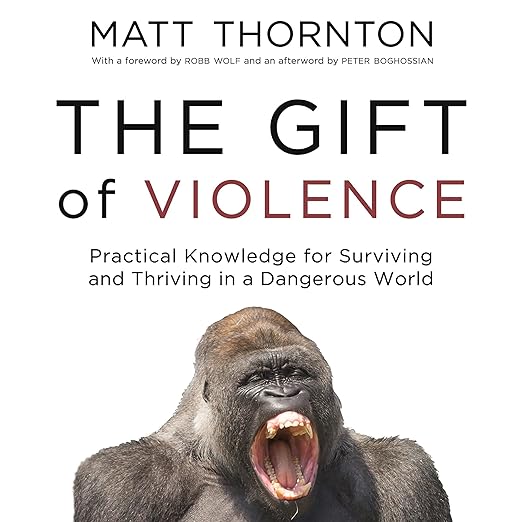
Quick Take
- Narration: Matt Thornton self-narrating his own work is the right call for a book built on decades of personal teaching experience. The delivery carries the authority of the mat without sounding like a coaching seminar recording.
- Themes: Evidence-based self-defense over traditional martial arts mythology, violence as evolutionary inheritance rather than pathology, empowering ordinary people through honest threat education
- Mood: Measured and confident, intellectually serious without being academic
- Verdict: The most honest and scientifically grounded civilian self-defense education currently available in audio form, separating functional threat preparedness from theatrical martial arts tradition with genuine rigor.
I have a complicated relationship with martial arts. I trained in two traditional systems for several years and found them genuinely valuable for discipline, community, and fitness. What I became less certain about, over time, was whether what I was learning would do anything useful if I were actually threatened. The techniques drilled in the dojo, the patterns and kata, did not look much like anything I saw in accounts of actual violence. I could not reconcile that gap through training harder. The Gift of Violence by Matt Thornton is the first book I have encountered that addresses that gap directly and without apology.
Thornton is the founder of Straight Blast Gym International and has spent decades teaching self-defense to civilians, military, and law enforcement. His framework is rooted in what he calls aliveness, the principle that skills developed without resistance testing against an actively resisting opponent are not actually self-defense skills regardless of how impressive they look in isolation. This is a critique of most traditional martial arts at the technique level, and it will produce discomfort in practitioners who have invested years in kata-based systems. Reviewer Lynda Roy’s account of years spent searching traditional systems for effective fighting and consistently finding that the successful fighters were not using the trained patterns resonates with my own experience, and Thornton explains exactly why that observation is correct.
The Evolutionary and Scientific Grounding
What separates this book from most self-defense writing is the seriousness with which it engages data before recommending response. The opening chapters on how violence evolved as part of human biology, and how our behavioral responses to threat were shaped by environments fundamentally different from modern urban life, establish a framework that makes the subsequent practical guidance more coherent. Thornton is not anti-science in the way much self-defense culture is. He cites criminological data on actual patterns of violent crime, distinguishing statistically common threat scenarios from the exotic scenarios that occupy most martial arts fantasy.
Reviewer Rob’s description of the book as putting data before ideology to give sound advice on preparation is precise. The sections on what violent encounters actually look like, how long they last, what physical capacities matter under real assault conditions as opposed to controlled training conditions, and how victims of violence differ in outcome based on preparation and response, are grounded in observable evidence rather than anecdote and lineage. This is unusual in a field where authority is typically established by reference to tradition rather than outcome data.
The Critique of Traditional Martial Arts
Thornton does not spare the traditional martial arts community, and some of what he writes will be genuinely uncomfortable for longtime practitioners. The central criticism is not that traditional systems are useless. It is that they have been structurally disconnected from feedback about what actually works under resistance. Without sparring against someone trying to genuinely stop you, without stress inoculation that resembles real threat conditions, the skills developed may feel profound and may produce real physical benefits, while remaining essentially ceremonial as self-defense. The distinction matters most when someone actually needs the skills to function.
This is the territory that reviewer Lynda Roy was circling for years before encountering Thornton’s work. The search for the one true system is a reasonable response to the marketing of traditional martial arts, and Thornton explains specifically why that search tends to end in frustration: most systems were not designed to be evaluated, they were designed to be transmitted. The two functions produce different epistemological standards.
What the Book Gives Ordinary People
Despite the sophistication of the theoretical framework, The Gift of Violence is explicitly written for ordinary people across all ages and abilities. The sections on reducing the likelihood of becoming a victim address the behavioral and situational factors that most determine whether a person ends up in a violent confrontation, not the physical skills that determine what happens during one. Thornton’s observation that the best outcome is one you avoid is not generic advice: it is the organizing principle for the first third of the book, which covers threat recognition, environmental awareness, and the social dynamics that precede most violent encounters.
The self-narration at nine and a half hours is appropriately paced. Thornton does not over-explain, and his familiarity with the audience he has been teaching for decades produces a delivery that assumes intelligence without assuming prior knowledge. The format works well for the mindset content, which constitutes the majority of the book. Technique instruction, where present, is necessarily more limited in audio format, but Thornton largely keeps technique secondary to framework, which makes this a strong audio choice.
Who Should Listen and Who Should Skip
Listen if you have ever wondered whether your self-defense training would actually work when it needed to, if you want an honest evidence-based account of how violence works and what preparedness actually requires, or if you are entirely new to the subject and want to start with a foundation grounded in data rather than tradition. Also recommended for martial arts practitioners who want a serious critical framework to apply to their own training.
Skip if you are looking for specific technique instruction that you can deploy immediately, or if you want a text that validates existing training without challenging the assumptions behind it. Thornton is direct about what does not work, and readers firmly attached to traditional systems may find this confrontational.
Frequently Asked Questions
Does The Gift of Violence recommend a specific martial art or self-defense system?
Thornton is the founder of Straight Blast Gym and his framework draws on grappling, wrestling, and what he calls alive training against resisting opponents. He does not prescribe a specific style but argues that any system should be evaluated on whether it uses resistance-based testing. Brazilian jiu-jitsu and wrestling are implicitly endorsed as having built-in feedback mechanisms that many traditional systems lack.
Is this book appropriate for women interested in personal safety?
Yes, and the book explicitly addresses the ways in which the threat landscape for women differs statistically from men in terms of the contexts and types of violence most likely to occur. Thornton’s data-before-ideology framework is deliberately inclusive across demographics, and several sections address how people of different ages and physical capacities can apply the core principles.
How does the evolutionary framing at the beginning of the book connect to the practical content?
The evolutionary opening is not decorative. Thornton uses it to establish that our instinctive responses to threat were calibrated for environments that no longer exist, which means some default responses work against us in modern violent encounters. Understanding where our threat responses came from is part of learning to override the ones that are counterproductive and reinforce the ones that remain functional.
Does Matt Thornton address self-defense tools like firearms or only unarmed techniques?
The book primarily addresses the mindset, awareness, and physical self-defense domain rather than weapons. It is not a firearms text, though Thornton does not treat unarmed skills as a substitute for armed defense in appropriate contexts. The core contribution is the framework for thinking about violence honestly, which applies regardless of whether a person ultimately incorporates weapons into their preparedness.