Quick Take
- Voice: Nathaniel Parker performs Eoin Colfer's middle-grade chaos with the kind of committed deadpan that the material demands - he handles the genre and tonal collisions between fairy magic, clones, and assassination plots without missing a beat.
- Big ideas: Loyalty and betrayal, identity and belonging, comedy and consequence
- Atmosphere: Absurdist and propulsive
- Worth it?: The Fowl Twins Get What They Deserve wraps the series with maximum ridiculousness and genuine stakes, and Nathaniel Parker's narration makes the 9-hour runtime feel considerably shorter than it is.
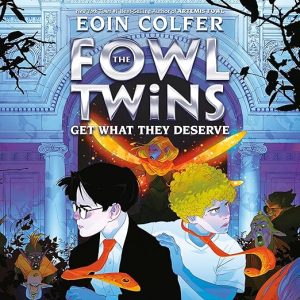
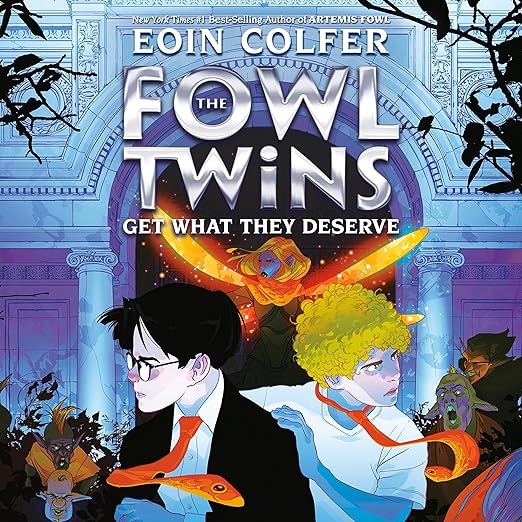
Eoin Colfer has spent three books in the Fowl Twins series establishing that Myles and Beckett Fowl, younger brothers of the original Artemis, are the kind of middle-grade protagonists who generate chaos as naturally as other children generate homework. The Fowl Twins, Book Three: The Fowl Twins Get What They Deserve arrives with Kirkus's starred-review characterization already on the cover: "a nonstop spinoff afroth with high-tech, spectacular magic, and silly business." This audiobook, narrated by Nathaniel Parker and running just over nine hours, is the third and reportedly most elaborate installment, and it delivers precisely what readers of the first two volumes have been promised. It also features the return of Lord Teddy Bleedham-Drye, the Duke of Scilly, who has spent almost two years in the narrative planning revenge, and whose plans involve ghosts, clones, and a weaponized jet.
Colfer's craft in this series has always rested on a specific tonal balance: the comedy must be genuinely funny rather than merely labored, and the stakes must feel real enough that the humor doesn't drain all the tension. The Fowl Twins series manages that balance more consistently than most middle-grade adventure fiction because Colfer understands something about his protagonists - Myles's hyperrational overconfidence and Beckett's cheerful physical recklessness are not just character traits, they are the engine of every plot complication. You can always see exactly how the twins have caused whatever catastrophe they are now trying to escape, and that clarity of cause and effect gives the absurdity a structural backbone.
What the third book does particularly well is escalate the Teddy plot without betraying the comic tone. Lord Teddy has been waiting since Book One to deliver his revenge, and Colfer uses that delay productively: by the time Teddy acts, the reader (or listener) knows enough about his particular brand of upper-class villainy to appreciate both the threat he poses and the specific comedy of his methods. The introduction of Specialist Lazuli as an active participant in disarming Teddy's aircraft - rather than simply a companion to the twins - is a narrative development that pays off the character work of the earlier volumes. A reviewer who has followed all three books describes this as "a complete joy" and notes that "this world could only make sense to Beckett," which is as precise a description of Colfer's worldbuilding philosophy as you could ask for.
The ghosts and clones that appear in the third act push the book into genuinely unusual territory for middle-grade fiction. Colfer is not cautious about structural experimentation; he introduces these elements late enough that they feel like escalation rather than confusion, and he resolves them with the same logic-that-isn't-really-logic that governs the rest of the series. Whether Teddy is actually dead after the aircraft incident is a question the book answers in the most Colfer-appropriate way possible: by making the answer both surprising and in retrospect completely inevitable.
Parker's Pomposity and Menace for Lord Teddy
Nathaniel Parker's narration is one of the better casting decisions in middle-grade audiobooks. He performs the tonal gap between Myles's clinical precision and Beckett's exuberant chaos with distinct voice work rather than merely different pitches, and his handling of Teddy's aristocratic villainy carries exactly the right combination of pomposity and menace. At nine hours and twenty-two minutes, the book is long enough that the narration needs to sustain energy through the quieter connective passages as well as the set pieces, and Parker does. Young listeners who discover this series through audio rather than print will have a particularly complete experience.
One parent reviewer notes that their son rereads the series weekly, which speaks to the book's replay value. Audio facilitates that kind of repetition in a low-friction way, and Colfer's plotting is dense enough with callbacks and planted details that second listens genuinely reward attention. The recommendation list at the end of the synopsis places the Fowl Twins alongside Percy Jackson as a companion read, and that comparison is apt: both series understand that young readers are willing to track complex magical-world logic if the characters are vivid enough to hold their attention through the complexity.
What It Means to Be a Fowl, Finally
The Artemis Fowl connections that surface in this volume deserve attention from listeners who know the original series. Colfer places the twins in a universe that has already been elaborately constructed, and the third book leans more heavily into that history than its predecessors. New listeners can follow the plot without prior knowledge, but they will miss several layers of context that longtime Fowl readers will catch. The series is in some ways an extended meditation on what it means to be a Fowl - a name that carries enormous weight in Colfer's universe - and Book Three is where that weight is most directly addressed.
The resolution of the Teddy arc is also worth close listening; Colfer plants the pieces of his solution earlier than you expect, and the satisfaction of the ending depends on noticing those plants when they appear. The "ghosts and clones" framing in the synopsis suggests something wilder than what actually arrives, and that gap between expectation and delivery is itself a Colfer signature.
Parker Makes This the Best of the Three
Readers who have followed the Fowl Twins from Book One will find this a satisfying conclusion to the Teddy arc, and Parker's narration makes it the best audio experience of the three. New listeners to the Colfer universe should start with Book One rather than here, since the character investments that make this volume's stakes land have been built over two previous books. Adults reading with children aged 8-12 will find the material accessible without being condescending, and the humor operates on enough levels that it holds attention across a wide age range.
Questions Listeners Ask
Do I need to have listened to the first two Fowl Twins audiobooks before starting Book Three?
Yes, strongly recommended. The Fowl Twins Get What They Deserve resolves plot threads that began in Book One, particularly the Lord Teddy Bleedham-Drye revenge arc, and many of the character relationships carry weight that only makes sense with the earlier context. New listeners to the series should start at the beginning.
Is this audiobook suitable for younger children, or is it pitched at older middle-grade readers?
The content is appropriate for ages 8-12, but the plotting complexity and vocabulary are pitched toward the upper end of that range and toward attentive younger readers. Colfer does not simplify for his audience; he trusts them with a genuinely layered narrative. Parent listeners report that children find it highly re-listenable.
How does Nathaniel Parker's narration handle the different character voices in this audiobook?
Parker gives distinct voice work to the main characters rather than relying on pitch variations alone. His Myles carries clinical precision, his Beckett an energetic guilelessness, and his Lord Teddy the right mixture of pomposity and genuine menace. The differentiation holds even in ensemble scenes with multiple speakers.
Is The Fowl Twins series connected to the original Artemis Fowl books, and does this audiobook require knowledge of that series?
The series is set in the same universe as Artemis Fowl and features his younger brothers, but prior knowledge of the original series is not required to follow the plot. Listeners who know the Artemis books will catch additional layers of reference and context, but Colfer builds enough world context into the Fowl Twins books to stand on their own.