Quick Take
- Narration: Gabrielle Lyon self-narrates with clinical precision and visible conviction, bringing her muscle-centric medicine philosophy directly to the listener without an intermediary.
- Themes: Muscle health across the lifespan, protein-forward nutrition, mindset as a training variable
- Mood: Energetic and protocol-driven, with the focused intensity of someone who has thought very carefully about what they want you to do
- Verdict: A well-organized companion to Lyon’s original Forever Strong, strong on practical protocols but genuinely challenged by the format since much of its value lives in the illustrated exercises and interactive prompts that audio cannot replicate.
I listened to this one early on a Monday morning while I was getting ready for work, which is about as close as I get to feeling like I’m preparing for the day the way Lyon would probably recommend. The self-narration matters here in a specific way: Lyon’s voice carries the same authority and urgency she projects in interviews and on her podcast, and that quality translates cleanly into audio even when the content is fundamentally about movement and nutrition rather than ideas.
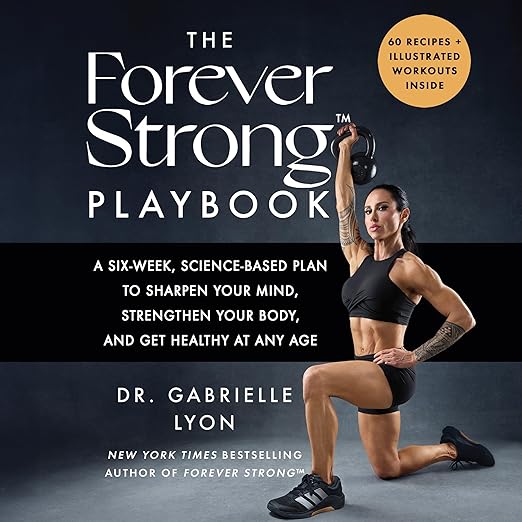
The Forever Strong Playbook is positioned as a companion to Lyon’s original Forever Strong, which established her muscle-centric medicine framework and became an instant New York Times bestseller. Where that book made the argument for why muscle health is central to longevity and disease prevention, this one is explicitly a doing book: 60-plus protein-packed recipes, 100-plus illustrated exercises, a six-week program, mindset prompts, and sleep and recovery protocols. The breadth is impressive and genuinely reflects the New York Times and USA Today bestseller status the book carries.
The Six-Week Program and Its Audio Limitations
This is where I need to be direct with you about the format. A playbook built around illustrated exercises and interactive prompts is not a natural fit for audio. The 100-plus illustrated at-home and gym-friendly exercises are, by definition, visual. The 30-plus interactive exercises, reflections, and prompts are, by design, things you write down and engage with physically rather than passively absorb. Lyon’s narration is clear and competent, but she is describing things that need to be seen and held rather than heard.
This is not a fatal flaw if you approach the audiobook as a companion to the print edition or as an orientation to the framework. Reviewer arlenenathan described it as clear, motivating, and incredibly practical, noting that Lyon makes complex topics easy to understand. That experience is real. But the full six-week program, including the exercise library and the interactive mindset work, genuinely requires the print or PDF companion to be actionable.
What Carries Well in Audio
The nutrition philosophy translates better to audio than the exercise content. Lyon’s emphasis on protein adequacy, the argument that most adults, especially women, chronically undereat protein relative to what muscle maintenance requires, is presented with enough clinical detail to be persuasive and enough practical context to be applicable. Her framing around discernment, which reviewer Desmond specifically praised as the often-overlooked mindset needed to stay focused amid unproven trends, is the kind of conceptual content that audio handles well.
The mindset sections are also genuinely useful in audio form. Lyon’s argument that discipline is a skill to be developed rather than a trait to be possessed, and her practical strategies for managing stress in ways that don’t undermine training adaptation, are the parts of the book that benefit most from being heard in the author’s own voice with her own emphasis and pacing.
Lyon’s Science and Its Place in the Current Landscape
Dr. Gabrielle Lyon sits in a specific position in the nutrition and fitness conversation. Her muscle-first framework represents a meaningful pushback against the fat-loss-first orientation that dominated fitness culture for decades, and her argument that preserving muscle mass into old age is one of the most important health interventions available to anyone over forty is increasingly supported by the geroscience literature. She cites this research carefully and with appropriate specificity, which is what separates her framework from lifestyle influencer content in the same space.
Who Should Listen / Who Should Skip
Listen if you have already read or plan to read the print edition of Forever Strong or this Playbook and want audio reinforcement of the framework and mindset content. Listen if Lyon’s muscle-centric medicine approach resonates with you and you want to hear her present the protocols in her own voice. Skip if you expect to follow the exercise program and recipes without the print companion; the visual components are genuinely essential for that use case. Skip if you are looking for conceptual health reading rather than an applied program.
Frequently Asked Questions
Is the Forever Strong Playbook a standalone resource or does it require reading the original Forever Strong first?
Lyon frames this as a standalone companion with its own complete six-week program, and the protocols are self-contained. That said, listeners who have already read Forever Strong will have more context for the muscle-centric medicine philosophy that underpins the recommendations.
Can the six-week program in this audiobook be followed without the print or PDF version?
Not fully. The program includes 100-plus illustrated exercises and 30-plus interactive written prompts that require visual reference to use properly. The audio alone provides the framework and motivation but not the complete practical toolkit.
How does the protein-forward nutrition approach in this book differ from standard dietary advice?
Lyon argues that most dietary guidance significantly underestimates protein requirements, particularly for women and older adults trying to maintain or build muscle. She provides specific targets based on body weight and training status rather than general recommendations.
Is this appropriate for someone who is not already exercising regularly, or is it pitched at more advanced athletes?
Lyon specifically designs the program to be customizable from beginners to advanced athletes. The beginner tracks are genuine rather than token, and the progressive structure means someone starting from a low fitness base can follow the program without feeling it was designed for someone else.