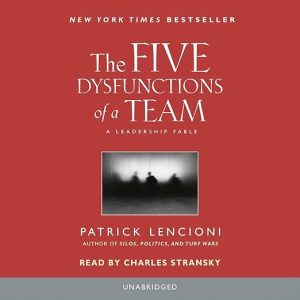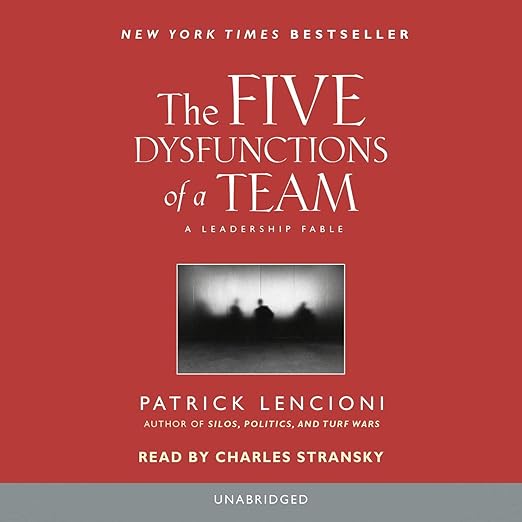
Kathryn Petersen takes over as CEO of DecisionTech after two weeks of watching her new executive team function about as badly as a group of talented people possibly could, and Patrick Lencioni's The Five Dysfunctions of a Team builds its entire framework around watching her fix it. This audiobook is the third in Lencioni's run of leadership fables, following The Five Temptations of a CEO and The Four Obsessions of an Extraordinary Executive, and it applies the same storytelling-first approach to what might be his most widely cited subject: why smart, capable teams still fail each other.
Trust Has to Exist Before Conflict Gets Safe
The fable format draws occasional skepticism from readers who want their leadership frameworks delivered as bullet points rather than narrative, but Lencioni's choice holds up well specifically because DecisionTech's dysfunction is genuinely recognizable rather than a strawman built to prove a predetermined point. Reviewer Carlan Wendler calls the book 'engaging and captivating', crediting Lencioni's ability to sneak 'lessons on teamwork and ego into a tale of a tech company that needed a big turnaround', and that sneaking-in effect is precisely the mechanism that makes the underlying five-part framework stick with a listener far better than a dry consulting report would.
At just under four hours, this covers an enormous amount of organizational ground without ever feeling rushed, largely because Lencioni resists the urge to pad the story with subplots that do not serve the central argument. Every scene, every piece of dialogue between Kathryn and her resistant executives, is doing direct work toward illustrating one of the five dysfunctions, which is a tight, disciplined piece of business writing regardless of format.
Lencioni's five dysfunctions, absence of trust, fear of conflict, lack of commitment, avoidance of accountability, inattention to results, are structured as a pyramid rather than a flat checklist, with each layer building directly on the one beneath it. Trust has to exist before real conflict becomes safe, real conflict has to happen before genuine commitment follows, and so on up the stack. That pyramid logic is the actual intellectual contribution underneath the fable, and it holds up as a genuinely useful diagnostic tool independent of the story built around it.
DecisionTech Can't Make a Single Good Decision
DecisionTech's name is a small, pointed joke worth noticing: a company built around making decisions, undone by a leadership team that cannot function together long enough to make good ones. Lencioni is not subtle about this irony, and it is exactly the kind of detail that rewards listeners paying close attention to the fable's construction rather than just following the plot beats toward the inevitable turnaround.
Reviewer Kyle's own review title, 'Great book... if the boss will listen!', is a small, knowing joke that only fully lands once you read the body of the review underneath it. That gap between an enthusiastic five-star title and a more complicated story underneath is worth noticing on its own: readers do not always resolve their mixed feelings about a book into one uncomplicated rating, and Kyle's title captures that honestly rather than papering over it.
Stransky's Restraint Lets Recognition Do the Work
Charles Stransky narrates with a clean, measured delivery that lets the fable's own momentum carry the material rather than imposing dramatic weight the story does not need. That restraint is exactly right for Lencioni's format, the power of this book comes from recognition, seeing your own team's dynamics reflected in DecisionTech's dysfunction, and a narrator who overplayed the emotional beats would work against that recognition rather than for it.
The short runtime makes this one of the more genuinely practical audiobooks in the business and leadership category for group listening. Reviewer Kyle mentions reading it as a team in their own office, and a book built to be consumed and discussed collectively benefits enormously from a format that does not demand a multi-week commitment before the conversation can even start.
Kathryn Petersen's specific introduction, retired and restless, drawn back to work by the promise of a real challenge rather than financial necessity, gives the fable's central figure a believable motivation from page one. She is not a rookie overwhelmed by her first leadership role, she is an experienced executive choosing to walk into a mess deliberately, and that framing shapes how her early missteps and gradual authority land across the rest of the story.
Understanding the Framework Isn't the Same as Using It
Kyle's review also includes an honest, useful caveat: the team read this together, found it genuinely worthwhile, and still ran into the gap between understanding a framework and a leader actually following through on it. That is not a flaw in the book itself so much as an inherent limitation of any leadership text, Lencioni can diagnose the five dysfunctions with real clarity, but implementing the fix still depends entirely on whether the people in the room, especially whoever is actually in charge, choose to act on what they have just heard.
Because the entire book is structured as a single continuous fable rather than discrete, skippable chapters, this works best listened to in order and in reasonably close sessions rather than picked up and abandoned across long gaps, since the narrative momentum is part of how the argument builds.
One Book Launched an Entire Consulting Practice
This book effectively launched a broader body of consulting work; Lencioni built an entire practice and additional fable-driven titles around the same core insight, that organizational dysfunction is usually a people problem wearing a strategy costume. Listeners who find this framework genuinely useful have a substantial further catalog to explore once they finish this specific entry.
At under four hours, this is short enough to finish across a single round-trip commute or two, a real practical advantage for busy managers deciding whether a new leadership book is worth the time before they even start it.
This Runs on Storytelling, Never on Statistics
This is a strong fit for managers and executives dealing with a specific, recognizable team dysfunction, whether that is unresolved conflict avoidance, unclear accountability, or a general sense that talented people are somehow adding up to less than the sum of their parts. Reviewer HARI's description of it as 'a pleasure to listen to' and 'insightful for all leaders' reflects how accessible the framework remains even for listeners without a business degree or formal management training.
Skip this one if you want a data-heavy, research-cited management text rather than a narrative business fable, Lencioni's whole method here is storytelling over statistics, and readers who find that approach frustrating rather than illuminating will not have their minds changed by this particular entry. For everyone else, especially teams willing to listen together, this remains one of the more genuinely useful short business audiobooks available.
Key Details
- Performance: Charles Stransky's clean, measured delivery lets Lencioni's leadership fable carry its own quiet weight.
- What it covers: Trust, conflict avoidance, accountability, and results, dramatized through one dysfunctional executive team.
- Feel: Brisk, accessible, and built for group discussion rather than solitary deep study.
- Our call: A short, genuinely useful business fable that earns its reputation as a team-listening staple.