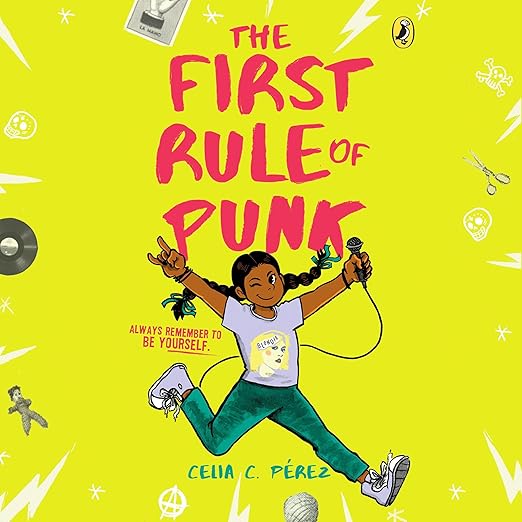
Quick Take
- Narration: Victoria Villarreal’s performance captures Malú’s defiant, funny, occasionally panicked voice without overselling the emotional beats.
- Themes: bicultural identity, self-expression vs. conformity, making community through music
- Mood: Energetic and warm, with an undercurrent of real cultural specificity that rewards attentive listening
- Verdict: A 2018 Pura Belpré Honor Book that lives up to its reputation on audio, Victoria Villarreal is the right narrator for Malú’s particular frequency.
I listened to the first chapter of The First Rule of Punk on a Thursday morning and finished it by Sunday afternoon. That is not a pace I usually maintain for middle-grade fiction, but Celia C. Pérez’s Malú has a quality I do not encounter often enough: she is funny and specific and clearly a real person, not a composite of middle school novel protagonists assembled for instructive purposes.
Twelve-year-old Malú, María Luisa, if you want to annoy her, arrives at Posada Middle School in a new city having already committed to the wrong aesthetic. Her punk rock wardrobe violates the dress code. Her personality upsets the queen bee. Her mother, a Mexican-American college professor who wants Malú to embrace her heritage more fully, is disappointed by Day One’s fallout. And her father, a thousand miles away, tells her to remember the first rule of punk: be yourself. The comedy and tenderness of the novel come from the gap between that rule and how difficult it actually is to follow when you are twelve and friendless.
Zines, Soyrizo, and the Specificity That Makes Fiction True
What distinguishes The First Rule of Punk from generic middle school identity narratives is how thoroughly Pérez commits to Malú’s specific cultural context. Malú loves rock music, skateboarding, and making zines, and the audiobook includes a How to Make a Zine guide read by the author at the end, which is a genuinely useful bonus for kids who want to make something after finishing the story. But the cultural detail goes deeper than these surface markers.
Malú’s bicultural tension is not resolved by the book choosing a side; it is resolved by Malú finding a way to hold both her Mexican heritage and her punk identity simultaneously, which turns out to require the same fundamental quality: the refusal to be performed at. The scenes with her mother, who represents a relationship to Mexican identity that Malú initially resists, are the book’s most emotionally complex and its best. Pérez does not make the mother wrong or Malú wrong, she makes the tension between them true, which is much harder.
Victoria Villarreal and Malú’s Frequency
Victoria Villarreal’s narration is a strong match for Malú’s register. Malú is a first-person narrator with a dry, rapid-fire quality, she processes the social disasters of her first weeks at Posada through a running internal commentary that would tip into exhausting in the wrong voice. Villarreal keeps the energy up without sacrificing the quieter moments, particularly the scenes with her mother and with her new bandmates, where the humor drops slightly and the emotional honesty comes through.
The Pura Belpré Honor citation is relevant here because the narration carries cultural specificity as well as storytelling energy. A reviewer specifically named Malú’s half-Mexican identity as central to why the book resonated, a story of identity as much as it is about family and fighting for what you believe in. Villarreal’s voice does not flatten that specificity into generic middle school protagonist energy; she maintains Malú’s particular frequency throughout the 6-hour and 18-minute runtime.
The Band as Narrative Engine
The formation of Malú’s band, assembled from the school misfits who do not fit the dominant Posada social order, is where the novel’s themes consolidate into plot. Music becomes the vehicle for Malú’s self-expression, the zine becomes the vehicle for the band’s community identity, and the conflict with the school administration over both becomes the narrative climax. Pérez structures this so that Malú’s fight for the right to be herself is also a fight for the people around her, which transforms the first rule of punk from a personal manifesto into something collective.
Victoria Jamieson’s blurb that Malú rocks is not the kind of endorsement that tells you much, but the Pura Belpré citation and the starred reviews speak to what the book accomplishes at a literary level. For the age group, roughly 9 to 13, this is one of the more culturally specific and emotionally honest middle-grade novels of the past decade.
Who Should Listen and Who Should Skip
This is ideal for kids who feel like outsiders, for families with bicultural experience, and for anyone aged 9-13 who is working out what it means to be themselves in an environment that rewards performance over authenticity. The zine-making guide at the end makes it interactive for craft-oriented kids. Skip if you are looking for plot-heavy adventure fiction, this is a school story driven by character and identity rather than external action. But for the right listener, it is the kind of book that matters.
Frequently Asked Questions
Does the How to Make a Zine guide at the end of the audiobook work in audio format?
The author reads it aloud, which means it functions as an introduction and inspiration rather than a step-by-step visual tutorial. Kids who want to actually make a zine after listening will benefit from looking up additional visual resources, but the audio guide communicates the spirit and the basic concept well.
Is the Mexican-American cultural content accessible to kids from different backgrounds?
Yes. Pérez builds the cultural context into the story in ways that explain rather than assume prior knowledge, and Malú’s own ambivalence about her heritage means that readers are introduced to it through her process of discovery rather than as established fact.
How does this book handle the tension between Malú’s punk identity and her Mexican heritage?
With real nuance. The book’s resolution does not ask Malú to choose one identity over the other. Instead, Malú finds a way to hold both, which the novel frames as the actual punk move, refusing to be told which version of yourself is acceptable.
Victoria Villarreal is listed as the narrator, is this a professional audiobook narrator or a celebrity casting?
Victoria Villarreal is a professional audiobook narrator with experience in bilingual and Latinx-authored fiction. The casting is appropriate to the material rather than a celebrity tie-in, which serves the story well. Her performance is consistent throughout the 6-hour runtime.