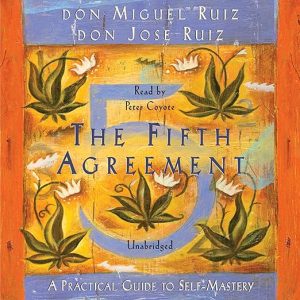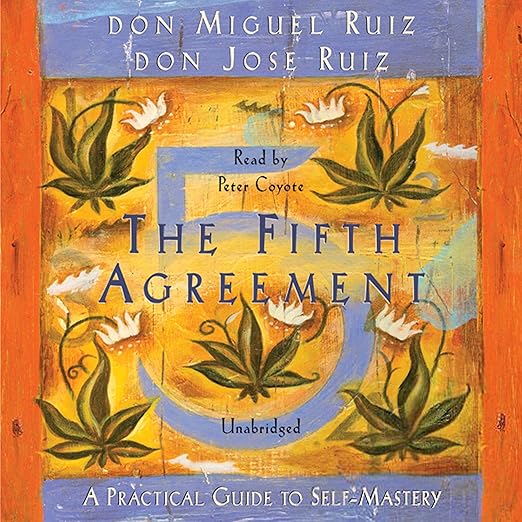
Order matters more here than it does with most sequels, and the first response on the page opens with exactly that instruction: read the fourth agreement first. The description agrees in its own fashion, spending its opening third on The Four Agreements before it gets anywhere near the new one. don Miguel Ruiz built a framework out of four commitments people make against themselves, then returned years later with his son to add one more to the set. Four hours and twenty-five minutes of audiobook is all it takes to hear the whole thing, and whether that brevity reads as distilled or as thin depends almost entirely on whether you arrived with the earlier book already inside you.
A Co-Author Missing From the Credits
Ruiz states the core idea plainly and never dresses it up. The argument runs like this: education, which the description puts in quotation marks as domestication, teaches us to make agreements that work against ourselves, and that undoing them returns us to something we were born already holding. The Four Agreements broke the self-limiting ones. The fifth, per the publisher's copy, carries the whole framework to a deeper level of awareness of the power of the Self and hands back an authenticity that growing up quietly confiscated. Nothing in the reasoning is complicated. Whatever difficulty you meet will be in accepting the premise rather than in following the argument built on top of it. The numbers the description leans on are worth registering too: The Four Agreements held a New York Times bestseller position for more than seven years, and this volume is pitched as the sequel to a book credited with changing millions of lives. A sequel to that inherits a burden.
Two things about this listing need saying before anything else. The byline reads don Miguel Ruiz alone, while the description states that he joins his son don Jose Ruiz for this book, so a co-author who shaped it does not appear in the credits at all. And the whole thing is filed under business and careers, tagged Career Success, which is a category error rather than a stretch. Nothing in a Toltec wisdom sequel about self-limiting agreements is aimed at a promotion or a salary band. Anyone browsing career titles will find it baffling, and anyone browsing spirituality may never find it at all.
One Voice Belonging to Neither of Them
Peter Coyote reads it, and the interesting thing about that credit is the arithmetic behind it. Two authors wrote this book, a father and a son, and one voice belonging to neither of them delivers the result. That is a defensible production decision for wisdom literature, where a single steady register keeps the material from turning into a conversation between generations, and it is still worth knowing in advance if you expected to hear either Ruiz. What the choice buys is continuity across a text with two hands on it. What it costs is any sense of where one author stops and the other starts.
Only one person in this pool describes the listening experience, and that account predates every other by five years. The report is worth having. This listener finished the recorded version, liked it enough to start again immediately, and sets the book against a lifetime of other self-help reading before landing on the reason it stuck: the Toltec framing is easy to understand and easy to fold into a life. The restart behavior tells you something about the shape of the thing. At this length it functions as a repeatable object rather than a single pass, closer to a set of instructions you return to than to an argument you complete once and shelve.
Forty-Three Points Out of a Possible Forty-Five
Look closely at the evidence before trusting the 4.8. Nine ratings support it, and nine ratings averaging 4.8 can add up only one way, to forty-three points out of a possible forty-five, which means two stars' worth of reservation sits somewhere in that nine with no written explanation attached to it. Of the five written responses, one is a purchase note about a gift for a daughter and says nothing whatever about the content, and another runs to two words under its headline. That leaves three accounts of any substance standing behind a very confident-looking score.
Dependency is the bigger caution. This book assumes The Four Agreements, and it spends real time recapping rather than replacing it, a compromise that satisfies nobody completely. If you have read the first one, the recap is filler. If you have not, the recap is too compressed to substitute for it. The reviewer who told everyone to start with the earlier book was giving accurate advice. Note too that the series line reads A Toltec Wisdom Book with no number attached, so a buyer gets no indication of where this volume falls in the sequence, which is the single piece of information the pool keeps insisting matters most.
A Framework Free of Doctrine or Religion
Come back to this if the first book did something for you and you want the extension, which is most of the audience it was written for. Two accounts describe returning to Ruiz rather than discovering him: one names this as a third book from the same author with more purchases already planned, and one is a two-word body sitting under a headline calling the whole series fire. Repeat business is what this material generates, and at four and a half hours the barrier to a second pass is close to nothing.
A second audience is anyone looking for a framework with no doctrine attached. One notice draws that line explicitly, saying the material is not religion and can be carried into whatever spiritual path you already walk, and the Toltec framing on the listing stays practical rather than devotional. People who have bounced off self-help that arrives as commandments may find these easier to sit with, since the agreements are phrased as commitments you choose to make rather than as rules you are failing to keep.
Method is the one thing this does not supply. The description promises orientation rather than practice and lists no exercises, no program and no measurable outcome anywhere in its pitch, so the career shelving will actively mislead anyone who takes it at face value. Listeners who need ideas argued rather than asserted will struggle too, because Ruiz sets down his premises and moves on from them. What is left, for the right listener, is a short, calm, unfussy extension of a framework that has held an audience for a very long time, and it fits in a single sitting.
Can I start with The Fifth Agreement audiobook, or do I need The Four Agreements?
Start with the earlier book. The description devotes its opening to summarizing the original framework, which signals dependency rather than independence, and the most recent reviewer on the page opens by telling buyers to read that one first. The recap here is a bridge, not a substitute.
What actually is the fifth agreement?
The description withholds it, which is a deliberate sales choice rather than an oversight. What it promises is a new commitment added to the original four, aimed at a deeper level of self-knowledge and at recovering the authenticity that growing up quietly removes from most people.
Is The Fifth Agreement audiobook religious?
One reviewer answers directly, describing it as not religion and as compatible with any path a listener already follows. The Toltec framing is presented as a wisdom tradition rather than as a faith, and the description asks for no belief, no practice and no allegiance in return.
Why is a Toltec wisdom book filed under business and careers?
No good reason appears anywhere on the listing. The genre reads business and careers and the tag reads Career Success, while the content concerns self-limiting agreements and personal freedom. Treat the classification as a filing error and judge the book by its actual description instead.