Quick Take
- Narration: Greg Tremblay handles Buss’s dense scientific prose cleanly, keeping the 12-hour runtime moving without inflating the academic material or flattening its nuance.
- Themes: Evolutionary psychology of mating, sex differences in desire, conflict within intimate relationships
- Mood: Intellectually provocative and clinically rigorous, occasionally unsettling
- Verdict: The most systematically researched book on human mating behavior available in audio, essential for anyone interested in evolutionary psychology, and genuinely challenging for everyone else.
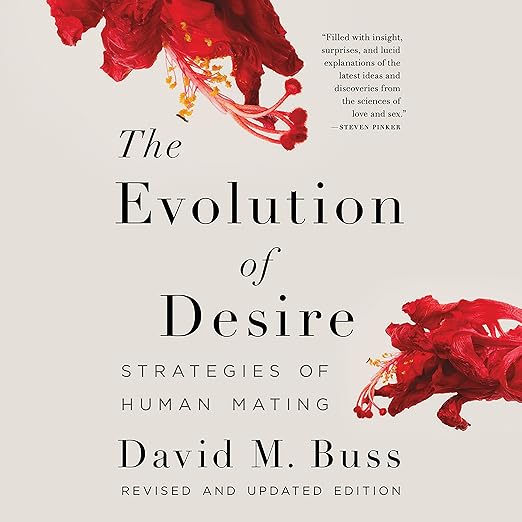
I came to The Evolution of Desire through a circuitous route. I had been reading Helen Fisher’s work on attachment and wanted something with a broader empirical base. David Buss delivers that, and then some. Based on a study of more than ten thousand people across thirty-seven cultures, this is one of the few books in the human sexuality genre that earns the word definitive without embarrassment. It is also, as one Audible listener put it, probably the most depressing book they had ever read. That observation is not a flaw exactly, but it is worth knowing before you start a twelve-hour commitment to evolutionary psychology.
Greg Tremblay narrates, and his steady, precise delivery suits the material well. Buss writes like a scientist, not a storyteller. The prose is clear and organized but does not reach for literary effect. Tremblay does not try to compensate for this with performance. He reads the material as written, letting the arguments carry the weight. For twelve hours of evolutionary psychology, that restraint is the right call. A more theatrical narrator would create an uncomfortable tension between the dispassionate science and the genuinely charged subject matter it is analyzing.
The Thirty-Seven-Culture Study and Its Weight
The empirical foundation is the first thing worth understanding about this book. Buss did not derive his conclusions from clinical observation of a few dozen American undergraduates, which is the limitation that undermines a substantial portion of psychology research. He coordinated researchers across dozens of countries and cultures to examine what men and women report wanting in mates, how their desires are expressed in behavior, and where those desires come from. The scope gives his findings unusual durability. When patterns appear consistently across cultures as different as Venezuela, Japan, Sweden, and Zambia, the evolutionary explanation becomes meaningfully harder to dismiss as a product of Western cultural norms.
What Buss finds, broadly, is that men and women evolved different mating strategies because they face different reproductive challenges. Women’s greater obligatory parental investment, pregnancy, nursing, primary caregiving, selects for preferences around resource acquisition and commitment in potential partners. Men’s lower obligatory investment selects for preferences around fertility signals. These are not absolute differences, and Buss is careful about how he presents them, but he does not soften them to the point of meaninglessness either. This is where some listeners find the book uncomfortable, and where others find it genuinely revelatory.
Conflict, Manipulation, and What Love Cannot Neutralize
The section that most listeners find either bracing or discouraging is the extended treatment of conflict within intimate relationships. Buss argues that love is real and central to human psychology, but that deception, manipulation, jealousy, and competition are equally real and equally the products of evolutionary selection pressure over millions of years. The book documents these mechanisms with the same empirical rigor it applies to attraction and desire. One reviewer described it as validating unfortunate life experiences, and while that is a painful outcome, it is probably an honest assessment of what careful reading of this material does.
What distinguishes this from more popular treatments of the same material is that Buss does not moralize. He describes what the research shows, not what he thinks people ought to do about it. There is a section toward the end on how understanding these mechanisms can help individuals make more intentional choices about their mating behavior, but it is relatively brief. The book is primarily an analysis, not a program, and listeners who come expecting a guide to better relationships will find it more diagnostic than prescriptive. That is a feature, not a limitation, for the right reader.
The Updated Edition and Its Scope
The note about updates to reflect recent scientific research is important for prospective listeners. The core findings date from the original 1994 edition, but Buss has revised the book to incorporate subsequent work, including research on online dating, which fits naturally into the evolutionary framework. The comparisons he draws, from lovebugs to elephant seals to the Yanomamo tribe to Tinder, are not cheap analogies but genuine cross-species and cross-cultural data points that strengthen the unified theory he is building across twelve carefully structured hours.
A few readers may find that the book’s framework has a deterministic feel that sits uncomfortably with their views on gender. The evolution of desire does not mean the inevitability of those desires, and Buss makes this distinction, but it requires careful reading rather than casual listening. The science is sound. The application is contested, and Buss is candid about the ethical dimensions of using evolutionary explanations to understand and potentially redirect mating behavior.
Who Should Listen / Who Should Skip
Listeners interested in evolutionary biology, behavioral psychology, or the empirical study of human sexuality will find this essential. It pairs well with Robert Wright’s The Moral Animal and Fisher’s Why We Love. Listeners who want a prescriptive, self-help oriented approach to relationships, or who find evolutionary frameworks reductive when applied to gender, may find this a frustrating twelve hours. That reviewer who called it depressing was being honest, not dismissive. The book does not end on a note of easy reassurance, and it is not designed to.
Frequently Asked Questions
Does Buss’s evolutionary framework account for LGBTQ+ mating preferences?
The original study and much of the analysis focuses on heterosexual mating strategies. Buss discusses same-sex desire in the context of the broader framework, but the book is not primarily focused on LGBTQ+ experiences, and listeners looking for that specificity will need to supplement it with other sources.
Is this the revised edition and does it address online dating?
Yes, this is the updated definitive edition, which Buss revised to include research on contemporary mating contexts including dating apps. The evolutionary framework maps onto digital mating behavior with some interesting results.
How technical is the language, is this accessible to non-scientists?
Buss writes for an educated general audience, not specialists. The research is presented clearly without assuming prior knowledge of evolutionary biology or psychology. Technical terms are explained when introduced.
Does the book imply that men and women’s desires are fixed and unchangeable?
Buss distinguishes between evolved predispositions and deterministic outcomes. He argues that understanding these tendencies can actually increase individual agency by making unconscious drives more visible and subject to conscious reflection.