Quick Take
- Narration: Vox Tinnean Media delivers a clean, competent read that handles medical terminology well without becoming cold in tone.
- Themes: EDS management, self-advocacy, the POTS/MCAS comorbidity cluster
- Mood: Validating and practical, genuinely oriented toward the reader’s lived experience
- Verdict: One of the more grounded EDS patient guides in audio, particularly strong on the comorbidity landscape and doctor-patient communication.
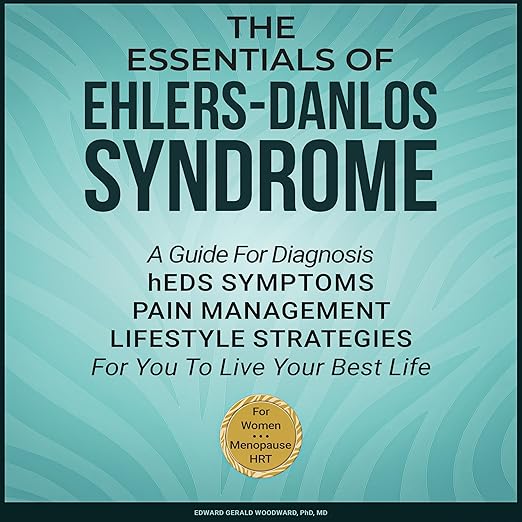
I finished this one on a Tuesday evening after spending the afternoon reading listener feedback on connective tissue disorder communities online. The emotional register of EDS forums is distinctive: a mixture of exhausted frustration at diagnostic delays, relief when someone uses the right vocabulary, and acute sensitivity to whether a resource actually understands what living with this condition costs. The Essentials of Ehlers-Danlos Syndrome by Edward Gerald Woodward reads like it was written by someone who has spent time in those communities, or at minimum has listened carefully to the people in them.
The book carries a 4.9 rating across 114 reviews, which is a meaningful signal in the EDS resource space where listeners are not generous with praise for content that feels generic or clinician-distant. The reviews describe it as approachable, compassionate, and useful for daily symptom management, and those are specifically the qualities that EDS literature tends to lack when written at an academic register.
Getting the Comorbidity Picture Right
The most practically valuable section of this audiobook is its handling of the comorbidity landscape. Ehlers-Danlos Syndrome rarely arrives alone. The triad of EDS, POTS (postural orthostatic tachycardia syndrome), and MCAS (mast cell activation syndrome) appears repeatedly in patient presentations, yet many resources treat EDS in isolation as though the connective tissue dysfunction were the only relevant system. Woodward addresses this cluster directly and explains how these conditions interact rather than simply listing them as separate diagnoses.
This matters enormously to listeners who have spent years being evaluated for individual symptoms in separate clinical silos. Understanding that the autonomic dysfunction, the immune dysregulation, and the connective tissue laxity may be manifestations of the same underlying hypermobility spectrum can reframe years of fragmented medical experience. For newly diagnosed patients and for family members trying to make sense of a loved one’s history, that reframing is often the most significant thing a resource can provide.
Advocacy as a Learned Skill
Woodward treats self-advocacy not as an inspirational add-on but as a practical clinical skill requiring specific preparation. The guidance on preparing for medical appointments, communicating symptoms accurately under time pressure, and navigating the specific skepticism that EDS patients often encounter from providers unfamiliar with hypermobility disorders is concrete rather than aspirational. Knowing which specialists to prioritize, how to document symptom patterns over time, and which phrases open rather than close conversations with skeptical clinicians are all addressed with real specificity.
This section also handles the emotional dimension of medical gaslighting without becoming polemical. Woodward acknowledges that EDS is frequently missed or dismissed, particularly in women and younger patients, without framing every clinician encounter as adversarial. The balance is appropriate and, judging by the review responses, resonates with the target readership.
Rest, Nutrition, and the Energy Economy of Chronic Illness
The practical daily management sections on rest, nutrition, and gentle movement are handled with the kind of specificity that separates genuine patient resources from general wellness content. The energy envelope framework, familiar to those who have engaged with ME/CFS communities but applicable across connective tissue disorders, appears in a form adapted for EDS-specific limitations. The guidance on pacing, on distinguishing productive movement from harmful overexertion, and on building routines that accommodate rather than fight the condition is practically oriented throughout.
The accompanying PDF, available in the Audible library alongside the audio, extends the value of the audiobook considerably. Charts, visual aids, and assessment tools are not recoverable from audio alone, and Woodward has built enough supplementary material to make the print companion worth downloading. That transparency in the product description is worth noting as a meaningful signal of editorial integrity.
Who This Is For and Who Should Keep Looking
Listeners newly diagnosed with EDS or hypermobility spectrum disorder, parents seeking language and frameworks for a child’s diagnosis, and healthcare professionals wanting a patient-centered overview will all find genuine value here. The 3.7-hour runtime keeps it accessible rather than overwhelming, which is itself a meaningful design choice for an audience that frequently deals with cognitive fatigue. Those seeking clinical depth on specific EDS subtypes or current genetic research will need additional resources. The focus is on living with EDS rather than understanding its molecular mechanisms, and for most of its intended audience, that is exactly the right emphasis.
Frequently Asked Questions
Does this book differentiate between the different types of EDS, or does it address hypermobile EDS specifically?
The book addresses EDS broadly with particular emphasis on hypermobile EDS, the most common type. It discusses the condition’s variable presentations but is not a type-by-type clinical comparison. Most practical management guidance is most directly applicable to hEDS.
How detailed is the coverage of POTS and MCAS as comorbidities?
Woodward addresses both POTS and MCAS as part of the comorbidity cluster rather than as separate tangents, explaining how they interact with EDS symptoms. The coverage is orientation-level rather than comprehensive for either condition, but sufficient to help listeners understand why they often appear together.
Is the accompanying PDF essential, or is the audio sufficient on its own?
The audio stands alone for the narrative and guidance content. The PDF adds value through assessment tools and visual charts referenced in the text, which are not recoverable from audio. For listeners who want to actively use the self-assessment components, downloading the PDF from the Audible library is recommended.
Does the book address the mental and emotional health dimension of living with EDS?
Yes, explicitly. Woodward includes sections on emotional wellbeing, the psychological weight of a chronic and frequently misunderstood condition, and strategies for managing the mental health dimension alongside physical symptoms. Multiple reviewers specifically cite this as a distinguishing strength.