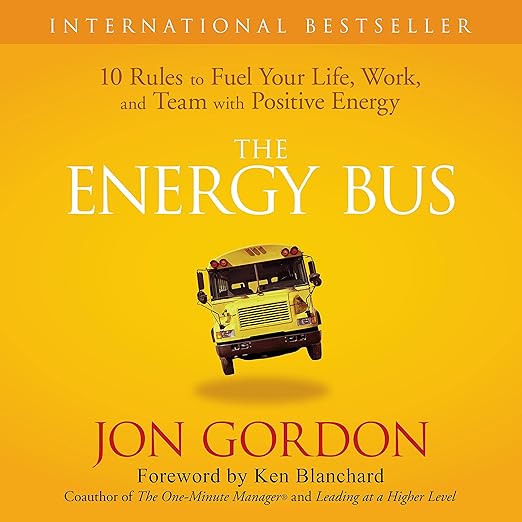
In Brief
- Narration: Jon Gordon reads his own fable with genuine warmth, the self-narration giving the motivational material an intimate, workshop-like quality.
- Themes: Mindset ownership, team culture, positive leadership
- Mood: Upbeat and conversational, with the gentle pressure of a keynote speaker who genuinely means it
- Verdict: A compact business parable that delivers its ten principles clearly enough to stick, best absorbed by listeners open to fable as a teaching format.
Jon Gordon's The Energy Bus operates in a specific literary tradition: the business fable, a form that uses narrative to deliver leadership principles in a way that makes them emotionally memorable rather than merely conceptually understood. Whether the form works for you depends largely on how you feel about parables as a vehicle for workplace wisdom. If you've spent years dismissing allegory in professional development reading, Gordon won't convert you in this audiobook. But if you're willing to meet a story about a man with a flat tire and two weeks to save his job and marriage with some degree of openness, the audiobook rewards that willingness across a compact two hours and thirty-nine minutes that's designed to move efficiently toward its purpose.
George, the story's protagonist, is a deliberately everyman construct: home life in shambles, team in disarray, a product launch looming for the NRG-2000 with no plan for success. The bus driver he meets on his enforced commute, and the passengers who deliver his education across two weeks, are equally archetypal. Gordon is not trying to obscure the didactic structure. The ten rules are the point, and the narrative exists to make them land in a way that sticks beyond the closing credits.
Gordon's Keynote Voice Replaces a Narrator
Gordon narrates his own work, and that choice matters more here than it would for most books. The Energy Bus is, at its core, a motivational tool, and hearing the author's voice rather than a professional narrator adds a quality of direct address that suits the material's intent. It sounds less like listening to a novel and more like sitting in on the author's keynote, which is precisely the effect Gordon seems designed to produce. One reviewer noted it as a quick, upbeat read that reminds you how much your mindset drives everything you do, and the self-narration amplifies that quality considerably.
The principles themselves, which include fueling your ride with positive energy, loving your passengers, and eliminating energy vampires from your team, are presented without irony and without apology. Gordon's framework draws on his work with thousands of leaders, teams, athletes, and organizations, and the applied experience grounds what might otherwise feel like pure optimism in something more operational. The Energy Bus is not arguing that positive thinking alone drives results; it's arguing that positive energy properly channeled through specific practices shapes team performance in measurable and consistent ways.
Built for Commutes and Team Onboarding
The audiobook format is arguably the best way to consume this material for working professionals. At under three hours, it fits into a single morning of commuting, an afternoon of household tasks, or a long run, and the fable structure makes it easy to absorb without note-taking. The principles are designed to be memorable after a single listen, which is unusual for business content and reflects Gordon's years of delivering this material in live settings where handouts weren't available to reinforce the learning afterward.
Teams have adopted this book in group listening contexts, book clubs, and onboarding programs, and the audio version works well for those purposes because Gordon's reading feels like a shared experience rather than a private one. If you're a manager looking for a compact framework to introduce around team culture, this audiobook gives you something concrete enough to recommend and discuss in a single session. The vocabulary around energy vampires and fuel versus drain gives teams a shared language that's surprisingly actionable in practice.
Framing Tool, Not a Full Manual
The brevity that makes this audiobook accessible also limits its depth. The ten rules are introduced and illustrated through George's story, but the real work of applying them is left to the listener. Anyone hoping for detailed implementation guidance, case studies with organizational specificity, or frameworks for measuring cultural change will need to supplement The Energy Bus with heavier material. It's a catalyst and a framing tool, not an operational manual.
The fable format also requires tolerance for simplification. George's transformation over two weeks is narratively convenient in ways that real organizational change is not. If you find the gap between parable and reality frustrating rather than generative, the story's tidy arc will likely irritate rather than inspire. Gordon knows his audience well, and that audience generally accepts the trade-off between narrative convenience and real-world complexity, but it's worth naming clearly for listeners who approach business books with more skepticism.
Team Leaders Need a Shared Vocabulary
This audiobook fits managers and team leaders looking for a shared vocabulary around energy and culture, individual contributors who want a brief but structured reset on their own mindset, and anyone navigating a period of workplace difficulty who needs something actionable rather than purely philosophical. It's also an efficient entry point for listeners new to Gordon's catalog before moving on to his more detailed works on leadership and team dynamics.
Familiar Fable Logic Worth Revisiting
If you're a veteran of business fable and found similar titles like Who Moved My Cheese or Patrick Lencioni's fables too thin for your tastes, The Energy Bus will likely produce the same reaction. At two hours and thirty-nine minutes, the time cost is low, and listeners who connect with Gordon's voice and approach tend to connect strongly enough to revisit the listen when their teams need a reset.
Gordon's 10 rules function as a portable vocabulary for team leaders who want to diagnose energy problems without requiring everyone to have read the same dense organizational theory. Whether the metaphor of the bus resonates or not, the underlying framework, about who drains versus fuels collective effort and how leaders can actively manage that dynamic, is grounded in observable team behavior. The self-narration makes the framework feel personally endorsed rather than academically proposed.