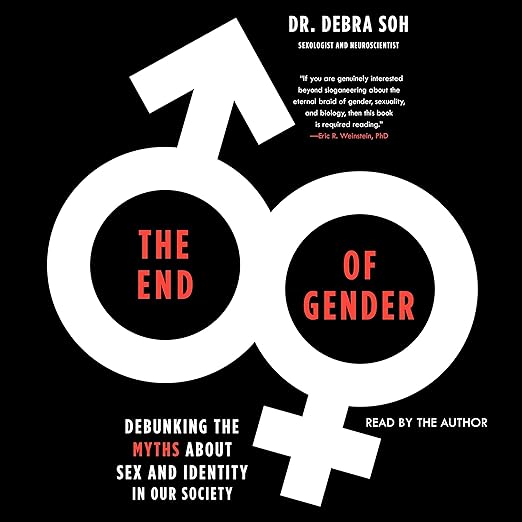
Books about gender and neuroscience have a tendency to polarize before they are even opened, with readers arriving pre-sorted into camps. I want to set that aside here and talk about what The End of Gender actually is as a listening experience: a myth-by-myth examination of gender identity claims, narrated by a sex researcher who clearly expects to be accused of bad faith and argues her case anyway.
Debra Soh holds a PhD in sexual neuroscience and worked as a researcher before becoming a science journalist. She is not writing from outside the field she is criticizing. That professional context matters when evaluating her argument, even if it does not settle every dispute she engages with.
What Debra Soh Delivers
The book is structured around specific myths Soh believes dominate public discourse about gender: that sex and gender are entirely socially constructed, that male and female brains are identical, that gender-neutral parenting produces gender-neutral children, and others. She takes each claim in turn and presents what she argues the peer-reviewed research actually shows.
The result is a book that will discomfort listeners across the political spectrum. Soh explicitly distances herself from conservative positions while also arguing that some progressive gender discourse has outrun the science. One reviewer from a fight sports background found it gave him language for a position he held intuitively. A retired ob/gyn found it consistent with her clinical experience. A younger reader specifically wanted to fact-check what they were reading on social media. These are three very different entry points to the same book.
The Best Parts of The End of Gender
Soh narrating her own work is a clear advantage here. The book's register is accessible without being dumbed down, she is writing for a general audience that does not have a neuroscience background, and her self-narration conveys that intention consistently. At seven hours and thirty-eight minutes, it moves efficiently through substantial material without feeling compressed.
The myth-by-myth structure also works well in audio. You always know what argument she is currently addressing and what evidence she is presenting, which is important for a book that covers ground where listeners are likely to want to track her logic carefully. There is no fog of academic prose to push through.
Before You Commit to The End of Gender
The endorsement on the cover from Ben Shapiro will be a signal to some listeners about the audience the publisher was targeting. Worth noting: the intellectual content of Soh's argument is considerably more measured than that association might suggest. She explicitly argues against several conservative positions in the book. But the framing of the marketing is worth being aware of before you start.
The book also covers gender dysphoria in children and adolescents, which is among the most contested areas of the current debate. Soh presents research findings on desistance rates and cautions about medical interventions. Listeners with personal stakes in those questions should know this material is covered with clinical directness.
Should You Listen to The End of Gender?
This is for listeners who want a research-grounded entry point into questions about sex and gender that they have mostly encountered in political or social media contexts. Soh is not the only voice working in this space, but she is one of the few with the academic credentials to engage the primary literature directly, and her willingness to antagonize multiple camps simultaneously gives the book an intellectual honesty that advocacy-driven writing in this area often lacks. It is not a book for listeners who want either a celebration of gender diversity or a dismissal of transgender experience, Soh's stated project is more specific than either. People who approach it wanting confirmation of an existing strong position will probably feel underserved from whatever direction they approach. People genuinely curious about what the neuroscience literature currently says will find it a reasonable starting point, even if they end up disagreeing with specific conclusions.
- Read by: Debra Soh reads her own book with academic fluency and accessibility, clear, composed, no performative drama, which suits the research-based tone she is going for.
- At its heart: Neuroscience of sex and gender, nature vs. nurture, the gap between scientific consensus and public discourse
- Vibe: Clinical but readable, with a consistent undercurrent of professional conviction
- Short version: Whether or not you agree with every conclusion, Soh presents her research-based case with more nuance than the culture-war context around this topic usually allows.
Questions Listeners Ask
Does Debra Soh argue that transgender identities are not real or valid?
No. Soh states she supports transgender individuals and their right to transition. Her critique is aimed specifically at claims she believes misrepresent the underlying science, not at transgender people themselves.
Is the science in the book current as of its 2020 publication?
The book draws on research available at publication. The field of gender neuroscience has continued to develop since 2020, so listeners interested in the most current data may want to supplement with more recent sources.
Is this book appropriate for teenagers or is it primarily adult nonfiction?
It is written accessibly enough for older teens, but its content, including clinical discussion of gender dysphoria in children and medical interventions, is better suited to adult readers with context to evaluate the arguments.