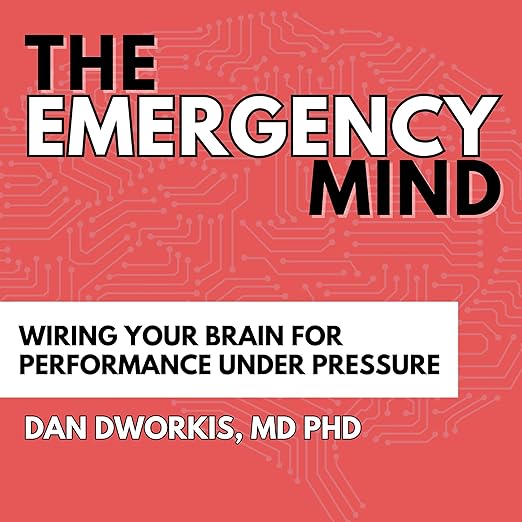
Quick Take
- Narration: Dan Dworkis narrates his own work, and the decision pays off. He reads like someone debriefing a case with colleagues rather than delivering a prepared lecture.
- Themes: High-stakes decision-making, cognitive performance under pressure, mental frameworks for emergency contexts
- Mood: Alert and grounded, with the quiet urgency of someone who has been in the room when things go wrong
- Verdict: A practical mental performance framework drawn from emergency medicine that transfers unexpectedly well to almost any domain where decisions matter under pressure.
I was about forty minutes into The Emergency Mind, somewhere on a walk between my neighborhood and the river, when I realized I had stopped noticing where I was going. That kind of absorption happens with the best narrative nonfiction. It happens less often with what is, at its core, a performance psychology book aimed at medical practitioners. Dan Dworkis, an emergency physician with a PhD, has written something that should not be as compelling as it is, and the self-narration is a significant part of why it works the way it does.
The book’s premise is double-faced. The first face is practical: how do emergency physicians, who must make critical decisions under time pressure with incomplete information and life-or-death consequences, train themselves to do this consistently? The second face is broader: that structure, applied to any domain that requires performance under pressure, turns out to generalize. Dworkis draws on military, business, and athletic contexts alongside medicine, and he is specific enough about each that the book avoids the generic quality that sinks most crossover performance books. He is not abstracting from medicine to a vague theory of excellence. He is showing you how the specific cognitive tools emergency physicians use are applicable precisely because the structure of emergencies is the same whether you are a paramedic, a therapist, an entrepreneur, or an athlete.
Inside the Resuscitation Room
The most absorbing sections of this audiobook are the ones that put you in the resuscitation room. Dworkis writes about the moment a critical patient arrives in the ER with the kind of specificity that could only come from experience being the person running the room. What he reveals is that the cognitive demand in those moments is not primarily about knowledge. The knowledge is there. The challenge is accessing it while managing sensory overload, while tracking multiple team members, while making decisions with half the information you would want, while simultaneously monitoring your own emotional state for signs that fear or fatigue is degrading your reasoning. His description of how emergency physicians mentally prime themselves before a shift, how they practice deliberate exposure to simulated failure, and how they debrief after difficult cases is the most detailed account I have encountered of what elite medical performance actually involves at the cognitive level.
The Tools Themselves
Dworkis presents a set of concrete mental tools for performing under pressure. These include frameworks for managing uncertainty, techniques for preserving cognitive function during high-stress events, and approaches to building what he calls the emergency mind through deliberate practice. What keeps these from feeling like a self-help checklist is the specificity with which he situates each tool in real scenarios from his practice. He is not telling you that it is important to stay calm. He is telling you precisely what happens to your prefrontal cortex under acute stress, what that means for your decision-making capacity, and what specific mental habits counteract those effects. Reviewers from very different professional backgrounds confirm that these tools transfer: one emergency medicine colleague praises the framework for thinking in emergency situations, while a therapist identifies it as the resource they recommend to clients working on emotional regulation. The crossover is genuine, not marketing.
Why Five Hours Is Enough
At five hours and one minute, this audiobook is tightly edited. There is no section that runs past its usefulness. The academic underpinnings are present but not indulged. The personal stories, which Dworkis uses to anchor each concept, are vivid but not extended. He trusts the reader with less rather than more, which is a mark of real editorial confidence. The risk with performance psychology books is always padding: after the core insight, there is a tendency to multiply case studies until the listener has stopped absorbing new information and started waiting for the end. Dworkis mostly resists that tendency.
Who Should Listen, Who Should Skip
Listen if you work in any domain where decisions must be made under time pressure and uncertainty: emergency medicine, nursing, paramedicine, therapy, law, the military, athletics, or leadership. The tools are specific enough to use and transferable enough to reach any of those contexts. Reviewers describe the framework as clear, concise, and immediately applicable.
Skip if you are looking for a clinical manual or a comprehensive review of performance psychology literature. This is a practitioner’s synthesis from one domain. It is rigorous without being academic, and it is personal without being a memoir. That combination will not suit every reader, but for those it suits, it is exactly what it needs to be.
Frequently Asked Questions
Is The Emergency Mind useful for people outside of medical or emergency professions?
Yes, and Dworkis makes this explicit from the opening. The book draws on cases from military, business, and athletic contexts alongside emergency medicine, and reviewers from therapy, EMS, and other fields have confirmed that the mental tools transfer. The underlying structure of high-stakes decision-making is consistent across domains.
Is this more of a clinical manual or a performance psychology book?
It is a performance psychology book grounded in clinical emergency medicine experience. It does not review clinical protocols or diagnostic algorithms. What it reviews is the cognitive and emotional architecture of performing under pressure, using the emergency room as its primary laboratory.
Does Dworkis’s self-narration work for a non-specialist audience?
Yes. He narrates with the accessible authority of someone explaining their practice rather than lecturing from a textbook. The language is specific but not jargon-heavy. The medical cases require no background knowledge to follow; they function as vivid illustrations of the psychological concepts.
At five hours, does the audiobook cover the material in enough depth?
Reviewers consistently describe the content as clear, concise, and complete. Five hours is sufficient for this book because Dworkis edits tightly and does not pad. Each concept is illustrated with a specific example and then allowed to stand without repetition. It is a book that benefits from a second listen once you have absorbed the framework.