Quick Take
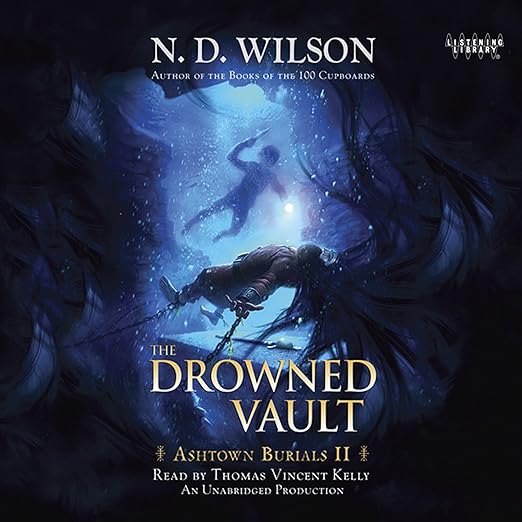
- Narration: Thomas Vincent Kelly handles the Ashtown Burials series with ease, conveying both Cyrus’s kinetic energy and the ancient weariness of the transmortals with genuine range.
- Themes: Mortality as the series’ philosophical spine, loyalty under fire, the weight of artifacts that outlast empires
- Mood: Epic and sprawling, with a darkness that earns rather than borrows its atmosphere
- Verdict: A second installment that surpasses the first in scope and ambition, N.D. Wilson’s lyrical precision and mythological ambition hit their stride here.
I listened to most of The Drowned Vault during an overnight flight from New York to London, which turned out to be the right context for a book that crosses Europe by chapter and descends into the Frankfurt Workshop at its center. Henry H. Neff has a particular gift for making geography feel mythological, and this quality was present in The Hound of Rowan but reaches full power here. Crossing into the Black Forest is not a setting change in this book; it is an act with consequences.
The setup continues directly from book one: Cyrus and Antigone Smith lost the Dragon’s Tooth to Dr. Phoenix, and Phoenix has been using it systematically. The transmortals, figures from human history who have lived beyond their natural span, are dying one by one, and Gilgamesh of Uruk has descended on Ashtown with an army demanding the students answer for the theft. That is a tremendous amount of pressure to start a book with, and Neff does not ease it. The Second Siege is relentlessly paced for its first third before the quest structure takes over and allows the world-building room to breathe.
The Book of Thoth and What It Means to Hold Creation
The central object of The Drowned Vault is the Book of Thoth, whose pages hold the key to creating or unraveling existence itself. Neff is not casual about this. The book’s power is not treated as a plot device but as a philosophical problem: an artifact that ought not to exist, being sought by a figure who absolutely should not have it, protected by two children whose claim to be protecting it rests on very little beyond their willingness to try. That structural humility in the face of overwhelming stakes gives the adventure an unusual seriousness. One reviewer found Neff brilliant with his ability to draw a scene both lyrically and in a literal sense, and the Thoth sequences demonstrate why.
Across Europe, Below the World
The journey through Europe in the book’s second act is where Neff’s research and imagination work together most visibly. The Frankfurt Workshop feels like it was designed by someone who asked: if there were a place where objects from mythological history were stored and studied, what would its organizational logic be? The Black Forest passage draws on German folklore in ways that feel earned rather than borrowed. One reader who praised the first book found this one significantly stronger specifically because the expanded scope suits Neff’s gifts. The more ground the story covers, the more interesting it becomes, which is an unusual property in a series.
Thomas Vincent Kelly and the Long Registers
Thomas Vincent Kelly has narrated the Ashtown Burials series with a consistent register that serves the material’s tonal range. His performance here is notable for how naturally he handles the descriptive passages, the lyrical scene-setting that reviewers repeatedly flag as Neff’s particular strength. The creature introductions, where Neff pauses to give brief descriptions and facts about each new being encountered, land with pedagogical pleasure in audio form, because Kelly delivers them with just enough gravity to make the information feel significant. At 12-plus hours the runtime is substantial, but the pacing justifies it, and Kelly’s steady delivery keeps even the densest expository passages from feeling labored.
That note about darkness deserves a word. The Ashtown Burials series is not tonally light. Death is real and present, characters suffer genuinely, and the philosophical through-line surfaces with more insistence here than in most middle-grade adventure fiction. That is not a disqualifier, but it is something families should know. The series has found a devoted readership among older middle-grade readers who are ready for that weight, and the listener who described staying up all night unable to put book two down captures the experience accurately.
Who should listen: Readers who have completed The Hound of Rowan and want the series to deepen, older middle-grade listeners ages eleven and up who want adventure fiction with genuine mythological reach, and fans of N. D. Wilson’s other work who have not yet tried The Tapestry. Who should skip: Listeners starting the series should begin with book one, and those who found the first volume’s darkness too heavy will find this one more intense rather than lighter.
Frequently Asked Questions
Is The Drowned Vault a good place to start the Tapestry series, or do I need to start with The Hound of Rowan?
Start with The Hound of Rowan. The Drowned Vault picks up directly where the first book ends, and the emotional weight of Cyrus and Antigone’s situation, especially their damaged standing at Ashtown, only registers fully with the first book’s context. Most readers find book two stronger than book one, but the first is essential groundwork.
The synopsis mentions the Book of Thoth, is this the same Book of Thoth from Egyptian mythology?
Yes. Neff draws on the Egyptian mythological tradition in which Thoth was the god of writing and knowledge, and his book was said to contain the secrets of creation. Neff uses this as a genuine mythological anchor rather than a casual name-drop, and the theological weight of the artifact is taken seriously throughout.
How does The Tapestry series handle darkness and violence, is it appropriate for younger middle-grade readers?
The series sits at the heavier end of middle-grade fantasy. The transmortals’ deaths are present and felt, danger is real and consequential, and the philosophical dimensions involve mortality and the meaning of survival. Most recommendations set the floor at ages ten to twelve, with the acknowledgment that emotionally mature younger readers can handle it.
Does Thomas Vincent Kelly narrate the entire Tapestry series consistently?
Kelly narrates The Drowned Vault. Listeners should verify narrator consistency across the full series before committing to the audiobook format, as changes between volumes can affect character voice continuity in ways that are particularly disruptive in long-running series.