The Short Version
- Read by: Anna Gifty Opoku-Agyeman narrates her own book with a direct, data-driven energy that suits the research-heavy text while keeping the personal dimension emotionally legible.
- At its heart: Economic inequality, the compounded costs of race and gender, policy and personal finance
- Vibe: Urgent and rigorously evidenced, with flashes of wit
- Short version: The Double Tax is a sharply argued economics audiobook that will reframe how most listeners understand the financial landscape women navigate, particularly women of color in the United States.
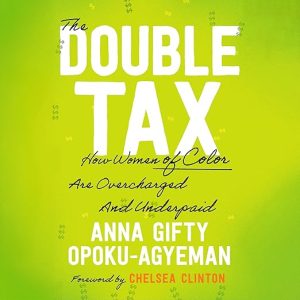
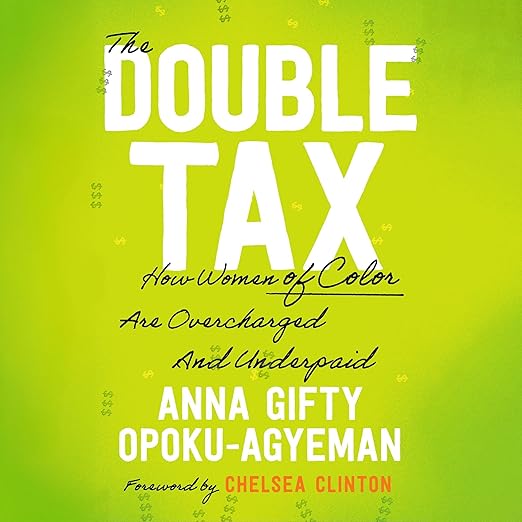
The double tax at the center of Anna Gifty Opoku-Agyeman's audiobook is not a metaphor. It is a measurable, compounded cost that Harvard-trained economist Opoku-Agyeman calculates through rigorous research and interviews with women across the country: the combined economic penalty of being both a woman and a person of color in America. The pink tax, that surcharge on gendered products, has entered mainstream conversation in recent years and generated real public awareness. Opoku-Agyeman's project is significantly larger and more ambitious, tracking the costs women face across every major life stage, from job market entry through housing, childcare, retirement, and the generational wealth that either accumulates or does not.
The book landed on the LA Times Best Science Book of 2025 list and generated coverage across NBC News, CBS Mornings, Forbes, and NPR, which reflects both the rigor of Opoku-Agyeman's data and the genuine public appetite for this kind of economics-made-accessible work. What distinguishes it from adjacent titles in the economic inequality genre is the specificity with which it isolates the racial dimension of the gender penalty. This is not a book about women's economic challenges in the aggregate: it is about the dramatically different economic lives Black and white women lead in the United States, with numbers that make those differences concrete and impossible to dismiss.
Opoku-Agyeman Presenting Findings Rather Than Performing Them
Opoku-Agyeman narrating her own work is an excellent match for this material and for the audiobook format specifically. Her voice carries the cadence of someone who has lived close to this research and who is presenting findings rather than performing them. There is a directness to the delivery that suits the evidence-heavy material: she does not oversell emotional beats or linger on pathos when the data is already doing the work. The self-narration also means that the interview sections, where she incorporates the voices of women from across the country whose experiences ground the statistics, feel authentically framed by someone who sat with those women and conducted those conversations herself.
One reviewer described Opoku-Agyeman as the kind of person you would love to sit next to at dinner and learn from while laughing, crying, and laughing again, and that warmth comes through in the audio format more directly than it might on the page. The balance between personal engagement and analytical precision is what makes this an audiobook worth the full five-plus hours of serious attention it asks for, and the self-narration is a significant part of why that balance holds.
Sequencing From the Wage Gap to Redlined Housing
The structural intelligence of this book lies in how Opoku-Agyeman sequences her evidence. She builds from the most commonly discussed disparities, like the wage gap, outward toward the areas that receive far less public attention: the higher costs of housing in historically redlined neighborhoods, the disproportionate childcare burden that falls on women of color, the retirement savings gap that compounds invisibly across a working lifetime. By the end, the cumulative picture is not just troubling but specific in a way that general conversations about inequality rarely manage to achieve.
The actionable dimension is also real and worth naming explicitly. Opoku-Agyeman does not stop at diagnosis. The final sections of the book address what individuals, communities, and policymakers can actually do, and the solutions are grounded in the same empirical rigor as the problem analysis. One reviewer noted that the questions in the book made them want to take action immediately, and that movement from evidence to genuine agency is the mark of economics writing that functions as more than an academic exercise or a catalogue of grievances.
An Introduction Pointing Toward a Larger Literature
The book is focused tightly on the United States economic and policy context. Listeners outside the US will find the frameworks and policy discussions most relevant when understood as a detailed case study rather than a universal model. The data is drawn from American labor markets, American housing policy, and American institutional history, and while the underlying mechanisms of compounded gender and racial inequality are not uniquely American, the specificity of the evidence is very much anchored in one national context.
At five hours and twenty-seven minutes, this is also a relatively short audiobook for the scope of the argument it makes. Some areas, particularly the generational wealth discussion and the housing cost analysis, will leave genuinely engaged listeners wanting more depth than the runtime allows. This is less a criticism than a useful framing for what you are getting: The Double Tax is a rigorous and well-argued introduction that points toward a larger literature rather than a comprehensive treatment of every dimension it raises.
Unseen Expenses Other People Are Forced to Pay
Anyone working in policy, economics, HR, organizational leadership, or adjacent fields will find this a practically useful audiobook that will almost certainly change the specific data points they cite and the frameworks they use to understand them. The relatively short runtime is a feature for busy professionals who need the argument condensed rather than the evidence exhaustively catalogued. that reframes familiar data through a more precise and more honest lens. Non-specialist listeners curious about the economic mechanics behind gender and racial inequality will find it accessible, evidence-grounded, and ultimately hopeful in its framing of what is possible. One reviewer who described themselves as a non-Black woman wrote that the book opened their eyes to unseen expenses other people are forced to pay, which speaks to the book's genuine capacity to expand a listener's practical understanding of lives and constraints different from their own. Those already deeply versed in the economics literature on racial and gender inequality may find some arguments familiar, but the synthesis and accessibility make it valuable regardless of prior knowledge.
Before You Listen
Does the author narrate this audiobook, and does that affect how the research is presented?
Yes, Anna Gifty Opoku-Agyeman narrates her own audiobook. The self-narration works well: her delivery carries the authority of someone who conducted the research and interviews firsthand, and the balance between analytical rigor and personal warmth comes through more directly in audio than it might with a third-party narrator reading the same text.
Is The Double Tax audiobook appropriate for listeners without an economics background?
Yes. Opoku-Agyeman writes explicitly for a general audience. The data and frameworks are presented accessibly through life-stage experiences most listeners will recognize, without requiring specialist knowledge of economic modeling or academic literature on inequality.