Quick Take
- Narration: Jayne Entwistle has narrated the entire Doll People series and her intimacy with these characters shows, she modulates between the anxious domesticity of the older dolls and the bolder register of the Funcraft family with reliable precision.
- Themes: Home as identity, courage when displacement is involuntary, inter-family solidarity
- Mood: Cozy and adventure-adjacent, with genuine stakes for a child reader and a warm landing
- Verdict: A satisfying fourth entry that uses a ship voyage to give the series new visual scope, best appreciated by readers who already love Annabelle and Tiffany.
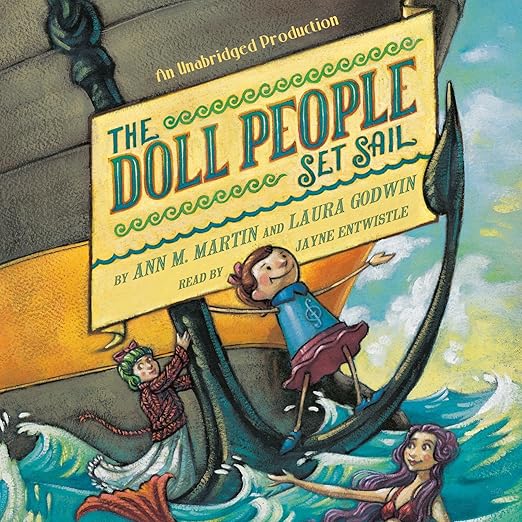
My niece handed me the first Doll People book when she was seven and told me I had to read it immediately. That was eight years ago. When The Doll People Set Sail arrived as the fourth entry in Ann M. Martin and Laura Godwin’s series, I understood immediately why readers who have followed Annabelle Doll across three previous adventures were so invested in this one. This is a series that has built its emotional architecture brick by brick: Annabelle’s complicated relationship with her own porcelain fragility, Tiffany Funcraft’s plastic-bodied confidence, the weight of doll rules against the pull of curiosity. The fourth book places all of that into the most physically precarious situation yet: a charity donation box, a ship, thousands of miles of ocean.
The setup is elegantly simple in the way the best children’s plot engines tend to be. The Palmers accidentally pack Annabelle, Tiffany, and their families into a donation box. The box ends up on a ship. The ship is crossing an ocean. The dolls discover that they are not the only doll people aboard. These elements combine into a story about improvised community, about what it means to be separated from the place you think of as home, and about the degree to which courage is a practice rather than a trait.
The Ship as a Different Kind of Dollhouse
What Martin and Godwin do particularly well in this fourth volume is use the ship’s scale to expose something about how the doll world works that the Palmer family house could not. A house has known rooms, familiar humans, predictable routines. A ship in the middle of an ocean has none of these things, and the doll characters’ response to that exposure tells us a great deal about who they have become across the series. Annabelle, who spent the first book terrified of being seen by the wrong eyes, makes decisions in this volume that would have been unthinkable for her earlier self. Jayne Entwistle has been present for all of that character development, and it shows in the way she voices Annabelle here: there is a quiet confidence in the delivery that wasn’t quite there in volume one.
One reviewer who has worked in elementary schools described reading these books aloud to students repeatedly, finding them rich enough to return to, which is exactly the right way to understand what Martin and Godwin have built. These are books that reward rereading because the character work accumulates meaning backward as well as forward.
On Reading the Fourth Volume Before the Others
The Doll People Set Sail is listed as book four in the series, and the metadata is accurate: this is not the place to begin. The emotional payoffs in this volume depend entirely on familiarity with Annabelle and Tiffany’s relationship, with the tensions between the Doll family’s formal propriety and the Funcraft family’s breezy adaptability, and with the accumulated weight of what has happened across the prior three books. A listener who starts here will understand the plot; they will miss why it matters.
The 4-hour, 31-minute runtime is the longest in the series so far, reflecting genuine narrative complexity. Multiple new doll communities, a full ocean crossing, and the challenge of finding a way home: the book earns its length without padding.
Who Will Get the Most from This
The Doll People Set Sail is designed for readers aged 6 to 10. It works best as a family read-aloud or an independent listen for children who have already moved through the first three volumes. One parent noted that their child graduated to this series from Magic Tree House and the Rainbow Magic fairies, and that the depth and length were a welcome escalation. The Doll People series sits at exactly the right pitch for that transition moment. Adults listening alongside younger children will find Entwistle’s narration genuinely pleasant rather than dutiful, which is a meaningful distinction in the picture book-to-chapter book audiobook category.
Frequently Asked Questions
Is The Doll People Set Sail appropriate to start with, or should I begin at book one?
Begin at book one, The Doll People. The emotional weight of the fourth volume depends on knowing Annabelle and Tiffany’s full history together, the rules of the doll world, and the family dynamics that have developed across three prior books. Starting here would give you the adventure plot without the depth.
Does Jayne Entwistle narrate all four books in the Doll People series?
Yes, Entwistle has narrated the complete series, which matters significantly for audio continuity. Her familiarity with these characters has deepened across volumes, and the vocal differentiation she maintains between the Doll family’s formal register and the Funcraft family’s looser energy is one of the series’ ongoing pleasures.
My daughter is 6 and loves the Magic Tree House series, is this a good next step for her?
It is a particularly strong next step. The Doll People books are roughly three times longer than Magic Tree House entries and have more sustained character development, which makes them a good bridge between early chapter books and more demanding middle-grade fiction. Start with book one and plan to listen over several weeks.
Does the series have a definitive ending after book four, or does it continue beyond this volume?
The Doll People Set Sail is the fourth book in the series as of this writing, but it does not close with an explicit series-ending arc. Each book builds on the previous without requiring a strict finale to feel complete, so further adventures remain possible.