Quick Take
- Narration: Susanna Burney reads with quiet warmth that matches the book’s tone of compassionate pragmatism, never overcooking the emotional weight while still honoring it.
- Themes: Caregiver identity and burnout, dementia progression across stages, the emotional labor of daily care
- Mood: Steadying and practical, with enough emotional honesty to feel like a real companion rather than a clinical handbook
- Verdict: A genuinely useful guide for anyone newly thrust into a dementia caregiving role, structured enough to be practical and human enough to be sustaining.
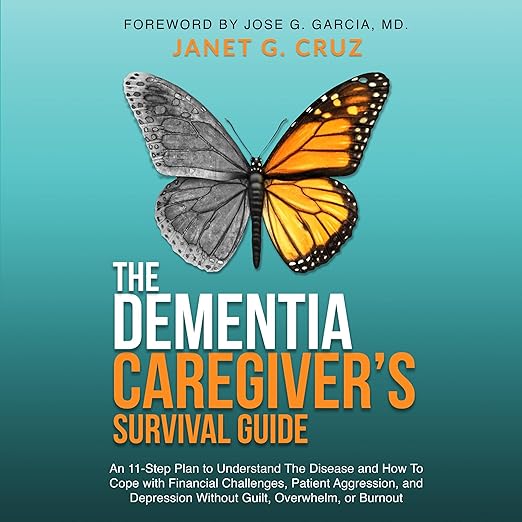
My grandmother spent her last three years with advancing vascular dementia, and my aunt was her primary caregiver. I watched that process from a middle distance, close enough to understand the texture of it but not close enough to have been in the room every day. What I remember most clearly is how alone my aunt felt in the early months, before she found her way to any resources at all. She had no map. The disease was doing things she did not expect, her own emotions were doing things she did not expect, and the healthcare system was essentially leaving her to work it out. A book like Janet G. Cruz’s The Dementia Caregiver’s Survival Guide is aimed exactly at people in that position.
At three hours and fifty-five minutes, this is a short audiobook. That length is a real consideration. The book covers an enormous amount of ground: disease progression, symptom management, communication strategies, financial challenges, patient aggression, caregiver depression, self-care, and the eleven-step framework Cruz uses to organize her guidance. All of it in under four hours. That density means the treatment of each topic is necessarily compressed, but the trade-off is a book that a caregiver can get through in a single afternoon, which given the time pressures most caregivers face, is not a small thing.
The Dual Perspective That Makes This Different
The most specific and defensible claim Cruz makes in this book’s structure is that it considers both the caregiver’s perspective and the patient’s perspective simultaneously. That dual lens is rarer than it should be in caregiver guides. Most such books, reasonably enough, focus on the caregiver’s experience and practical needs. But dementia care is confusing in a particular way: the patient’s behavior, the aggression, the personality changes, the communication breakdown, the apparent rejection of familiar relationships, is often interpreted personally by caregivers until they understand what the disease is actually doing to the person. One reviewer notes that the book helped them be more aware and educated about what is happening to their husband, allowing more patience and tolerance. That transformation from personal wound to diagnostic understanding is one of the most important things a guide like this can achieve.
The Eleven-Step Framework and What It Actually Provides
Cruz organizes her guidance around an eleven-step plan, which sounds more formulaic than it reads. What the steps actually provide is a sequenced path through the chaotic early weeks of a new caregiving role. The sequence covers understanding the disease, anticipating needs, managing difficult behaviors, dealing with financial and legal realities, preventing burnout, and maintaining connection with the person inside the illness. That last point, finding moments of real connection with a loved one who is being systematically altered by disease, is handled with particular care. One reviewer describes discovering moments of joy that strengthen the bond, and Cruz gives this more than the formulaic encouragement most caregiving guides offer.
On the Limits of Under-Four Hours
I want to be honest about what a four-hour guide cannot do. It cannot replace a caregiver support group. It cannot substitute for conversations with a social worker who specializes in elder care. It cannot do the sustained, hard work that an Alzheimer’s Association chapter or a dementia care specialist can provide. What it can do is give a newly overwhelmed caregiver a framework where they previously had none, a vocabulary for what they are experiencing, and the specific reassurance that their exhaustion and grief are not signs of personal inadequacy. One reviewer describes feeling like they were going to die because they had no freedom for four years. This book is not a solution to that burden. But it can be a first handhold.
Burney’s Narration and the Question of Tone
Susanna Burney reads with the composed warmth that this material requires. Caregiver guides live or die by their emotional register. Too clinical, and the listener feels unseen. Too emotional, and the listener feels destabilized rather than supported. Burney holds the center. She reads Cruz’s practical guidance with authority and the more personal passages with presence. The four-hour runtime means she sustains this tone without fatigue, and the listening experience feels consistent from start to finish.
Who Should Listen, Who Should Skip
Listen if a family member has recently been diagnosed with dementia and you are trying to understand what you are getting into. Listen in the first weeks or months of a caregiving role, before the system has fully closed around you. Listen if you are already a caregiver and need to be reminded that self-care is not a luxury.
Skip if you are looking for an in-depth clinical guide to dementia subtypes and treatment options. This is a caregiver guide, not a medical textbook. For more clinical depth, the Alzheimer’s Association and academic medical centers publish resources that go considerably further into the science.
Frequently Asked Questions
Does this book cover all types of dementia, or is it specific to Alzheimer’s?
The guide addresses dementia broadly rather than being exclusive to Alzheimer’s disease. The caregiving principles, communication strategies, and self-care guidance apply across dementia types, though specific treatment considerations will vary by diagnosis.
At under four hours, is there enough depth to be genuinely useful?
Yes, within limits. The compressed format is a real trade-off, but it also means the book is accessible to caregivers who have almost no time. It works best as an orientation and framework guide rather than an exhaustive reference. Use it alongside more detailed resources from organizations like the Alzheimer’s Association for comprehensive support.
Does the PDF companion add significant content to the audio?
The Audible listing notes that a PDF companion is included with purchase. It likely contains the eleven-step framework, checklists, and possibly resource references in visual form. The audio stands alone, but the PDF is worth downloading if you want printed reference material.
Is this book useful if my loved one is in early-stage dementia rather than advanced dementia?
Yes. One reviewer specifically notes using the book while their husband is in early stages, showing mood and personality changes. Cruz covers the arc of the disease from early through advanced stages, so early-stage caregivers get both immediate guidance and preparation for what is ahead.