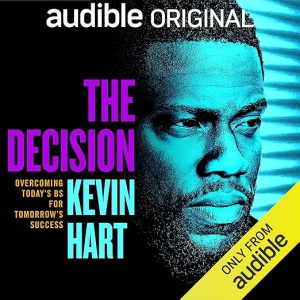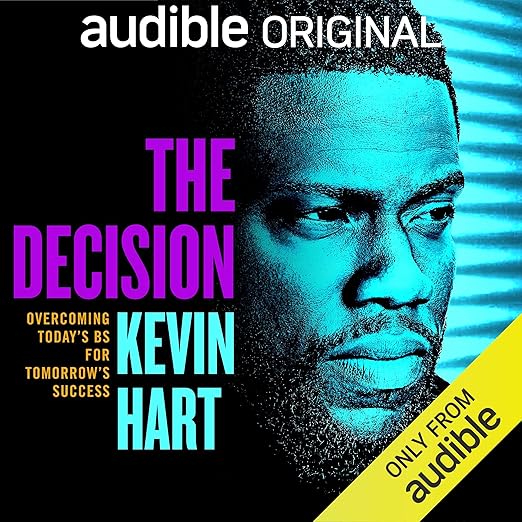
Kevin Hart spends The Decision's five hours and fifty-four minutes doing something his stand-up specials rarely allow: sustained sincerity. Billed as a follow-up to his memoir I Can't Make This Up, this audiobook recasts Hart as "Coach" running listeners through what he calls the Kevin Hart Mental Fitness Bootcamp, complete with his own invented vocabulary for the tools he uses to stay disciplined, terms like What-is-ness and Cowboying up that only really land when heard in his own cadence.
Written and narrated by Kevin Hart, this 5-hour-and-54-minute audiobook holds a 4.6 rating from 145 ratings. Self-narration is doing real work here; Hart is performing his own coaching persona rather than reading someone else's script about him.
A Closer Look at The Decision
The bootcamp structure is the book's real organizing idea, walking listeners through Hart's personal system for tracking and reaching goals rather than offering a loose collection of motivational anecdotes. Terms like Teddy bearing and What-is-ness sound like comedy bits on the page, and to an extent they are, but Hart uses them consistently enough across the runtime that they function as genuine mnemonic devices by the book's second half rather than one-off jokes.
What keeps The Decision from reading as pure comedy is how directly Hart connects the coaching material back to his own documented struggles, discussed more fully in his earlier memoir. He is candid about where the advice comes from personal failure rather than theory, and that grounding gives even the more absurdly named exercises a weight they would not carry from a generic motivational speaker with no comparable track record of public difficulty.
Some of Hart's coined phrases work harder than others, and the strongest ones reframe ordinary insecurities rather than inventing new problems to solve. His riff on keeping a mental filter running so bad advice does not stick, and his insistence that physical self-consciousness, down to a joke about his own feet being a blessing in disguise, is worth taking seriously, both land because they connect back to specific moments of embarrassment he is willing to describe in detail rather than staying abstract.
The comfort-zone chapter is worth flagging specifically, since Hart frames comfort as close to the actual enemy of growth rather than a reward for hard work, a harder-edged position than the more forgiving self-care messaging common in a lot of current wellness content. It is a distinctly hustle-adjacent philosophy, delivered with enough humor and personal vulnerability that it avoids curdling into pure grind culture.
Hart's stand-up timing is the audiobook's biggest structural advantage over the print edition. Jokes and coined terms that could read as gimmicky on a page land as actual comic beats when delivered in his own voice and rhythm, and the practical steps he outlines benefit from hearing exactly which words he stresses, something a silent reader has to guess at entirely on their own.
Reviewer Calisha flagged the audiobook's language directly, warning listeners to expect cussing throughout, and that candor is part of the appeal rather than a flaw: Hart is not performing a sanitized motivational-speaker voice, he sounds like himself, unfiltered, which reviewer JM credited with covering everyday struggles in a way that felt genuinely useful rather than abstract.
Because so much of the material depends on Hart's actual comic delivery rather than the content of the advice alone, this is a rare case where the audiobook is arguably the definitive version of the book rather than an alternate format. A reader working through the print edition silently would have to supply Hart's timing from memory of his other performances; a listener gets it automatically, embedded in every chapter.
The book opens by putting a direct question to the listener rather than to Hart himself, 'are you ready to get your mind right and prepare for the battle of your life,' and that framing device recurs throughout, turning what could be a passive listen into something closer to a conversation Hart expects an answer to, even if that answer only ever happens inside the listener's own head.
Things to Know Before Starting The Decision
The invented vocabulary is a real gamble. Terms like Teddy bearing work well inside the audiobook's own internal logic, built up gradually across the runtime, but listeners who prefer conventional self-help language without a personal jargon system to learn first may find the terminology more distracting than illuminating, at least through the opening chapters before it settles in.
At five hours and fifty-four minutes, this reads more like an extended pep talk and personal framework than a deeply researched system with citations and studies behind every claim, since the material draws almost entirely on Hart's own lived experience. Listeners expecting the structure of a clinical self-help book, with data supporting each strategy, should adjust expectations accordingly before starting.
The branding itself is a useful counterweight to any skepticism about a celebrity comedian repackaging himself as a coach: Coach Kevin and a Mental Fitness Bootcamp are not typical self-help packaging, but the underlying content reads as considered rather than opportunistic once a listener gets past the marketing frame and into the actual chapters.
Unlike I Can't Make This Up, which credited a co-writer alongside Hart, this book's author field carries his name alone, and the audiobook reads accordingly, less like a polished collaborative memoir and more like a direct, occasionally rough transcript of Hart's own coaching voice with fewer smoothed edges.
The title itself gives away almost nothing about the specific coaching system inside, a fairly generic choice next to the vivid, oddball vocabulary Hart actually builds the book around. Listeners should not expect the title to signal content the way the invented terminology inside actually does, and the explicit language reviewer Calisha flagged means this is a poor pick for shared family car listening or any setting where profanity is a genuine problem rather than a minor annoyance.
Who Kevin Hart Is Writing For
Fans of Hart's stand-up and film work who want to hear him in a more reflective register, listeners who found traditional self-help too clinical or too impersonal, and anyone who responds better to humor mixed into hard advice than to straight lecture will get real value here. It also works well for listeners already familiar with I Can't Make This Up, since this functions as a direct continuation of that earlier material.
Listeners already following Hart's more recent public persona as a motivational and fitness-minded figure, beyond his stand-up and film work, will find this audiobook a natural extension of that persona rather than a surprising pivot, since the coaching framing has clearly been building in his public output for some time before this release.
Anyone allergic to comedians moonlighting as life coaches, or who needs citations and studies to trust an argument, will find The Decision light on rigor and heavy on personality, which is precisely the trade Hart is asking listeners to make from the very first chapter onward.