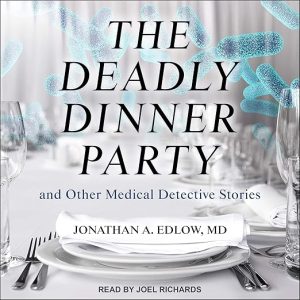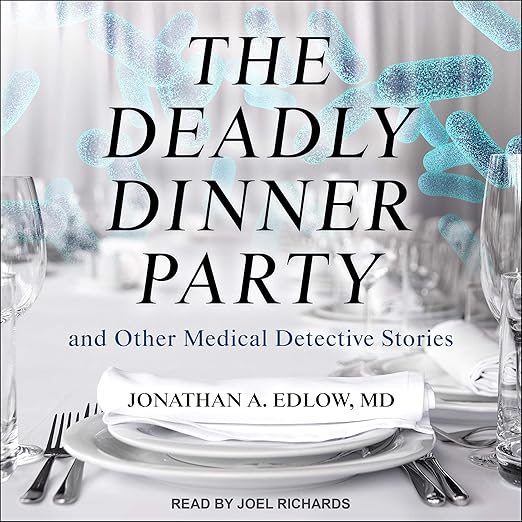
Jonathan Edlow's The Deadly Dinner Party audiobook opens a door that most medical writing keeps firmly shut: the door into the room where a physician stares at a patient, knows something is catastrophically wrong, and cannot yet name it. After a week of more conventional true crime, the shift was startling. Where forensic crime writing tends to work backward from a known death, Edlow's fifteen cases move forward through uncertainty. You experience the fog of diagnosis alongside the doctors, not from the clean vantage point of hindsight.
Edlow acknowledges his debt to Berton Roueche directly, and that comparison is earned rather than promotional. Roueche's The Medical Detectives set the standard for narrative epidemiology for decades, but its cases are now dated in places where science has moved on. Edlow's book updates the form with modern outbreaks, contemporary clinical reasoning, and a practicing physician's inside knowledge. These are not reconstructed from archives. They are stories Edlow knows because he lives in the world where they happen.
What makes these fifteen cases work as audio is their structural tightness. Each one is essentially a locked-room problem: a set of symptoms, a group of patients, an environment that must be interrogated. The suburban dinner party of the title case is perhaps the most effective - a stomach bug that cascades through guests and nearly kills the host, with the source requiring methodical elimination of every dish, every surface, every guest's timeline. Edlow makes the epidemiological process feel like detective work because it is detective work, just conducted with lab results instead of fingerprints.
Other cases reach into stranger territory. A diminutive woman who eats more than her football-playing boyfriend and keeps losing weight. Lung cancer tumors that wax and wane inexplicably in a young executive. These are cases where the diagnosis, once revealed, opens into a much larger lesson about how the human body interacts with pathogens, environment, and circumstance. Edlow never condescends to lay readers - he explains complex immunological and toxicological concepts in passing, embedded in the narrative, rather than pausing the story for a lecture.
Richards Threads Gravity Between Detachment and Drama
Joel Richards narrates with a quality I can only describe as appropriate gravity. He does not perform the urgency - he simply reads with the steady, focused voice of someone who understands what's at stake in these rooms. Medical nonfiction narration can go wrong in two directions: either the narrator sounds too detached, reducing suffering to case numbers, or they oversell the drama with thriller-style emphasis. Richards threads between these cleanly. He renders the physicians' voices with subtle differentiation and handles the medical terminology without stumbling or over-enunciating.
The audiobook format suits this material well. At nine hours and eighteen minutes, the pacing is close to ideal for a collection of fifteen cases - long enough to develop each situation fully, short enough that none outstays its welcome. Listeners who have read the original reviews describing these stories as reading like "thrillers" will find that description holds up in audio; Richards earns it without artificial inflation.
The genre of narrative medical mystery has a small but devoted readership, and this audiobook earns its place alongside the best of it. Where popular crime writing often reduces investigators to detectives pursuing deliberate malice, the epidemiological detective story adds a layer of environmental complexity that crime fiction rarely reaches. The culprit in Edlow's cases is not a person but a pathogen, a toxin, a systemic failure in how humans and their environments interact - which makes the resolution feel like genuine discovery rather than the mere unmasking of a hidden actor.
Fifteen Cases Share One Honest Architecture
The writing rewards attention to structural patterns. Edlow constructs each case with a consistent architecture: the symptom presentation, the initial diagnostic misstep or dead end, the broadening of the investigation, and the resolution that teaches something beyond the individual case. Over fifteen stories, you begin to anticipate that structure, but that anticipation never kills the tension because the specific variables are always different enough to surprise you.
One thing to notice is how Edlow handles the ethical dimensions quietly. He has changed patient identities, as medical narrative requires, but he doesn't pretend the anonymization is invisible. He acknowledges the gap between the real person and the narrative subject, which gives the book a minor but meaningful layer of intellectual honesty. This isn't drama manufactured from real lives without acknowledgment. It is drama shaped from real lives with care.
The occasional nod to medical history adds depth without becoming a sidebar. A case might mention the history of a pathogen, or the evolution of a diagnostic test, but these asides are brief and genuinely clarifying rather than padding. Edlow's background as a physician who also writes for general audiences is evident throughout - he knows when to stop explaining and let the story move.
Roueche Readers Get a Modern Continuation Here
This audiobook rewards listeners who love procedural thinking, whether they come from true crime, clinical medicine, public health, or simply good narrative nonfiction. If you have already read Roueche and want a modern continuation, this is the closest available equivalent. If you have an interest in epidemiology or hospital medicine but find academic writing impenetrable, Edlow's accessible, character-driven approach makes the science land. Listeners looking for a traditional thriller will find the pacing more measured than they might expect, but the genuine uncertainty of each case provides its own form of tension. Skip if you want emotional devastation or personal memoir - Edlow keeps his clinical lens in place throughout, which is a choice, not a flaw.