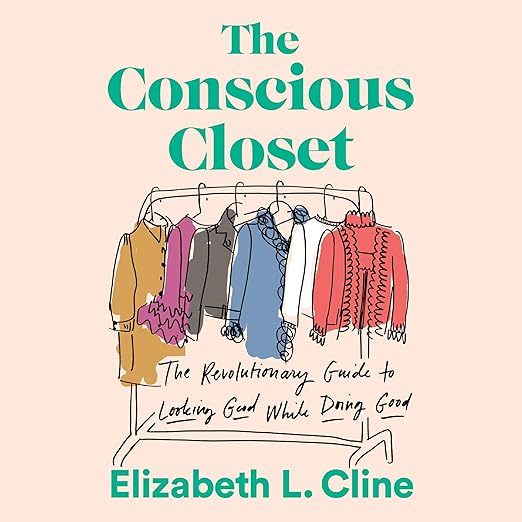
Standing in front of a closet full of clothes and feeling like you have nothing to wear is one of the minor miseries of modern consumer life, and Elizabeth L. Cline’s audiobook The Conscious Closet opens with the recognition that this experience is not personal failure but the predictable outcome of a fashion industry engineered to produce exactly that feeling. Cline, the journalist who previously wrote Overdressed: The Shockingly High Cost of Cheap Fashion, has spent years investigating where our clothes come from and what the true cost of cheap garments actually is. At nine hours and eleven minutes, this audiobook is the guide that follows that investigation: not a catalog of horrors but a concrete program for getting off the fast-fashion treadmill and building a wardrobe you actually understand and want to keep.
Cline Narrates Her Own Closet Clean-Out Method
Cline narrates her own book, and this choice matters considerably. Her voice carries the practiced frankness of someone who has reported extensively on the fashion industry’s environmental and labor practices and who has also personally navigated the transition she is asking her listeners to make. She is not lecturing from a position of perfect virtue; she is sharing the process she went through, which gives the audiobook a quality of genuine companionship rather than finger-wagging. The comparison her publisher uses, calling her the Michael Pollan of fashion, is apt in ways that are both flattering and cautionary, but it captures the essential approach: investigative journalism converted into a guide for individual action.
The book begins with what Cline calls the mindful closet clean-out, and she is specific enough about the process to be actually useful. This is not simply an instruction to get rid of things you do not love. It is a method for evaluating what you have, where it came from, and what to do with the pieces you are releasing, whether selling through resale platforms, swapping with friends, donating strategically, or mending what can be saved. Listeners who work through the early chapters with an actual wardrobe audit in progress have reported finding the experience energizing rather than overwhelming, which is exactly the tone Cline sustains throughout the recording.
Fabric Quality by Touch Beats a Statistics Litany
The audiobook’s research sections, which cover fashion’s environmental impact, the realities of garment manufacturing, and the mechanics of the clothing resale economy, are handled with the precision of good journalism without becoming a litany of statistics. Cline draws on fresh research and integrates it into the practical guidance rather than front-loading the book with data that arrives before the listener has reason to care about it. One reviewer noted that some information is repeated across chapters, which is accurate, but the repetition tends to function as reinforcement for listeners absorbing the material across multiple sessions rather than reading continuously.
The audiobook format suits this material particularly well. Many of the book’s practical suggestions, how to evaluate fabric quality by touch, how to care for clothes to extend their life, how to identify ethical brands and ask the right questions of retailers, can be absorbed during everyday activities and returned to mentally as you move through your actual wardrobe decisions in the days following. Cline is especially vivid when describing the supply chain conditions behind the cheapest garments, and hearing those passages in her own voice adds a quality of firsthand testimony that a professional narrator would struggle to replicate with the same authenticity and emotional directness.
Personal Sections Outshine the Inspirational Closing Chapters
The audiobook is strongest in its personal sections, where Cline describes specific decisions and discoveries from her own experience getting off the fast-fashion cycle, and somewhat less focused in its more generalized calls to connect with fashion activist communities. The guidance on identifying sustainable brands is necessarily somewhat dated by the time any listener encounters the recording, since brand practices and certifications change, and Cline acknowledges this limitation by framing the brand-selection sections as frameworks for asking the right questions rather than as permanent endorsements of specific companies.
The closing chapters, which paint a picture of the fashion industry transformed by conscious consumer pressure, are more inspiring as vision than useful as instruction. This is not unique to Cline; the gap between individual consumer choices and systemic industry change is one that no single author has convincingly closed in audio or print form. But the closet-audit chapters, the quality-evaluation guidance, and the treatment of the resale economy are genuinely practical in the way that good how-to content needs to be. Those sections alone justify the listening time for anyone at an early stage of rethinking their relationship with clothing and the industry that produces it at extraordinary cost.
Built for Listeners Wanting More Than Guilt
This audiobook is built for listeners who have already felt uncomfortable about fast fashion and want something more specific than guilt to work with. Cline meets them where they are without assuming any prior knowledge of fashion manufacturing or sustainability policy, and she keeps the tone inclusive and practical rather than moralistic. It is not the right listen for someone who wants a purely technical breakdown of supply-chain ethics or a policy-focused examination of the industry; Cline stays at the level of individual consumer decision-making throughout. But for anyone who wants to understand their wardrobe better, shop more deliberately, and stop funding a system they find troubling, Cline’s self-narrated audiobook offers the clearest and most practical guidance currently available in audio form on the subject.
Questions Listeners Ask
Does Elizabeth L. Cline narrating her own audiobook add or detract from the experience?
It adds considerably. Cline’s delivery is warm and conversational rather than performed, and hearing the author describe her own evolving relationship with fast fashion gives the research sections a personal grounding that a professional narrator would struggle to replicate. Listeners who find author-narration uneven in other books tend to respond positively to hers specifically.
Is The Conscious Closet audiobook practical enough to actually change someone’s shopping habits?
The closet-audit chapters and quality-evaluation guidance are specific and actionable. The brand-recommendation sections are useful as a framework for asking the right questions, though individual brand details may have changed since publication. Most listeners report using the audiobook as a starting point rather than a permanent reference.
How does this audiobook compare to Cline’s earlier book Overdressed as a companion or follow-up?
Overdressed is the investigation into fast fashion’s costs; The Conscious Closet is the practical response to it. You do not need to have listened to Overdressed first, though knowing the diagnosis Cline made there gives the solutions she proposes in this book additional context and urgency for listeners already familiar with the issues.