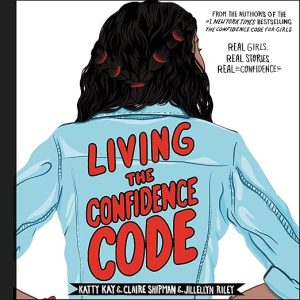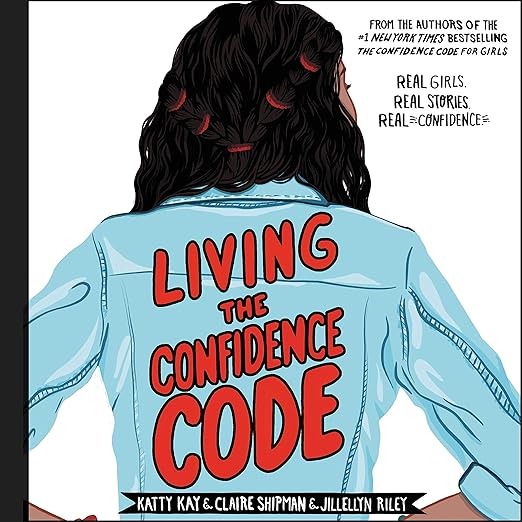
The Confidence Code title on this listing doesn't match the audiobook actually inside. What's here isn't Katty Kay and Claire Shipman's well-known 2014 research book on the psychology of confidence; it's Living the Confidence Code, a companion volume built around thirty true stories of real girls building their own confidence, co-written with JillEllyn Riley. That's worth stating plainly before anything else, since a listener expecting the original career-focused research book will find something different: a collection of real, first-person-adjacent stories rather than a research-driven argument.
Eleven Minutes per Profile Across Five Hours
The thirty stories span an intentionally global range, girls from Bali to Brazil, South Africa to Seattle, Australia to Afghanistan, each pursuing something specific: protesting contaminated water, championing more inclusive books, pushing for accessible girls' basketball shoes. What connects them isn't a shared cause but a shared pattern of doubt, struggle, and persistence, the book's actual thesis: confidence looks different depending on what a given girl is fighting for, but the underlying mechanics repeat.
This positions the book as a direct companion to Kay and Shipman's The Confidence Code for Girls rather than a sequel to the original adult-focused Confidence Code; reviewers treat it that way too, several explicitly frame it as an extension of that girls'-edition franchise rather than the more career-advice-oriented original.
One story detail is worth sitting with specifically: among the thirty profiled girls is one campaigning for more accessible girls' basketball shoes, a small, almost mundane-sounding cause next to water contamination or literary representation elsewhere in the collection. That range is deliberate. The book's actual argument isn't that confidence only matters for grand political causes; it's that the same internal mechanics, doubt, persistence, learning to act despite uncertainty, apply whether a girl is organizing a protest or pushing her own school to stock better athletic gear for its girls' teams.
From Bali to Afghanistan, One Pattern of Doubt
This companion volume extends a franchise that started with Kay and Shipman's original adult-focused Confidence Code in 2014 and continued with The Confidence Code for Girls in 2018; Living the Confidence Code sits downstream of both, translating the earlier books' research into lived example rather than adding new theoretical ground. Listeners who've worked through the earlier two books will recognize the underlying framework here, now illustrated through real girls rather than laid out as argument.
Geography does real work across the thirty profiles too. Six vastly different regions anchor the collection, and that spread resists any single cultural assumption about what confidence looks like or what obstacles girls actually face; a story rooted in one country's specific constraints sits beside one rooted in an entirely different social context, and the book trusts its reader to hold both as equally real rather than ranking hardship.
The listing notes this arrived as an instant number-one New York Times bestseller, a commercially significant detail for a companion volume rather than a flagship title in its own franchise. That reception suggests the built-in audience for the Confidence Code brand carried over directly to this true-stories spinoff; readers already invested in Kay and Shipman's earlier research were clearly eager for a version built around real girls' lived experience rather than more abstract findings.
Divided across five and a half hours, thirty stories works out to roughly eleven minutes per profile on average, longer and more developed than the two-minute entries in some other anthology-style children's audiobooks, giving each girl's story genuine narrative shape, a beginning, an obstacle, a resolution, rather than a compressed highlight reel. That extra runtime per entry is part of why reviewers describe individual stories as memorable rather than interchangeable.
Rustin's Warm Energy Skips the Singsong Register
Sandy Rustin narrates with a natural, warm energy well suited to material aimed at younger readers without ever tipping into the singsong register that can mar audiobooks pitched at teens. Maintaining engaging, distinct energy across thirty separate short stories without over-differentiating each one into its own performance is a real skill, and Rustin stays on the right side of that line throughout.
At five hours and twenty-nine minutes, the audiobook moves through its thirty stories briskly, closer to a well-paced anthology than a dense research text, matching its actual audience. A supplemental enhancement PDF accompanies the audiobook for listeners wanting print-adjacent material alongside the listening experience.
A third reviewer's assessment stays useful specifically because of its brevity: girls from many cultures, stories told well, easy to take in. That plainness is itself informative; this isn't a book demanding heavy analytical engagement from its listener, and the ease that reviewer describes matches Rustin's unfussy narration well.
The book's structure as thirty distinct, self-contained profiles means it tolerates interrupted listening especially well; a parent or teacher can play a single story, pause for discussion, and return later without losing narrative momentum the way a continuous argument-driven book would demand. That structural flexibility is worth naming as a real practical advantage for the specific way this book is likely to be used, shared aloud in short sessions rather than consumed start to finish in one sitting.
Attached to Career Content, Written for Teen Girls
The genre tag attached to this listing skews toward general business and women-in-career content, which will mislead some browsers; this is a book for and largely about teenage girls, closer to young-adult nonfiction than a career-advancement title for working women. Reviewers confirm this directly: one calls it 'the book that every teenage girl needs,' another specifically shared it with a daughter rather than reading it for personal career development.
Anyone who already owns or has listened to the original Confidence Code and is looking for more of that book's specific research-and-strategy approach should know this is a genuinely different book in tone and audience, not a second volume of the same material; the true-stories format trades data-driven argument for narrative and example.
The book closes on a direct, personal question to its reader, essentially asking what a listener would do once she taps into her own confidence, and that address-the-listener-directly device runs throughout rather than appearing only at the end. Listeners who prefer nonfiction that stays in reported, third-person mode throughout should know this book regularly breaks that frame to speak straight to its intended teenage reader.
For Parents, Their Girls, and the Teachers Who Coach
Parents of teenage and preteen girls, and the girls themselves, are the built-for audience here, per reviewer after reviewer describing it as shared reading or listening across a parent-daughter relationship. Anyone who works with teenage girls directly, teachers, coaches, mentors, will also find genuine practical value in the range of real stories.
Skip it if you're specifically looking for the original Kay and Shipman adult-career Confidence Code and its research-driven approach to workplace confidence; this companion volume, whatever its own real merits, is a different book aimed at a younger audience.
Common Questions
Is this audiobook the same as the original Confidence Code by Katty Kay and Claire Shipman?
No. This listing's actual content is Living the Confidence Code, a true-stories companion volume co-written with JillEllyn Riley, distinct from the original 2014 research book despite the shared series name.
Is this Confidence Code audiobook meant for teenage girls or working professionals?
It's built for teenage girls specifically, functioning as a companion to The Confidence Code for Girls rather than career-advancement content for adult professionals.
How does narrator Sandy Rustin's delivery suit thirty separate short stories in one audiobook?
She maintains warm, natural energy throughout without over-differentiating each story into its own distinct performance, which keeps the collection feeling cohesive rather than fragmented.