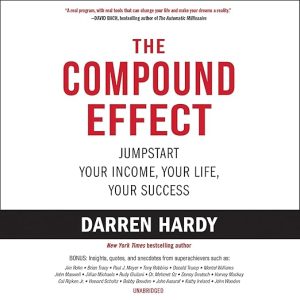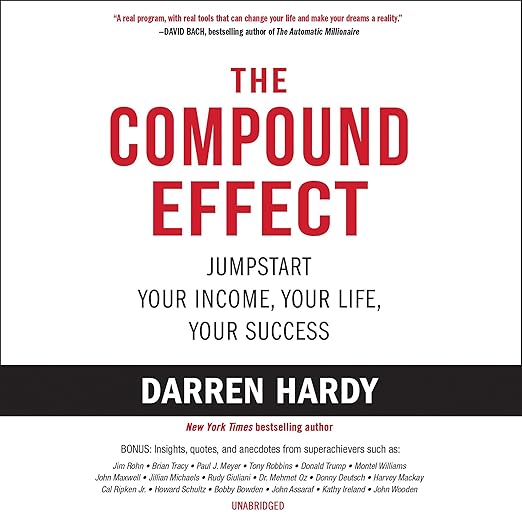
Darren Hardy built his public profile as the longtime editor of Success Magazine, and The Compound Effect audiobook distills the pattern he says he observed across thousands of high-performing individuals: extraordinary results do not come from extraordinary actions but from ordinary actions repeated consistently over time. That idea is not new. Hardy does not claim it is. What he offers is a framework for applying it that is specific enough to act on, and at four hours and forty-four minutes, an audiobook short enough that the framework does not get buried under its own exposition.
Context matters for understanding why this book resonates where similar titles fall flat. Hardy was writing for an audience already exposed to productivity literature, people who had read the books and heard the talks but had not translated the ideas into durable behavioral change. Reviewer Deon Freeman noted that the book "provides actionable tools and insights to help readers analyze and improve their habits, establish discipline," while reviewer Daniel Murphy observed that Hardy "teaches how small efforts practiced consistently over time pay off in large dividends." Both descriptions are accurate, and both point to the book's practical orientation over its theoretical ambitions.
The Same Mechanism Builds Success and Slow Disasters
The framework Hardy builds covers habit identification, elimination of behaviors that are quietly derailing progress, installation of what he calls "key disciplines," and the mechanics of momentum, what happens when enough small actions have accumulated to create a self-reinforcing cycle rather than a grinding daily effort. The acceleration section is the most interesting, because it addresses a question most habit books ignore: once the compounding starts, how do you keep it from collapsing when disruption arrives?
Hardy draws on his own career and his observations from running Success Magazine rather than on behavioral science literature. This is practitioner knowledge rather than academic synthesis. Readers who want the research behind habit formation, the neuroscience of reward loops, the evolutionary psychology of consistency, should look elsewhere. Hardy's contribution is not to explain why compounding works; it is to give you an operating procedure for making it work in your life. That distinction between explanation and application is worth keeping in mind when assessing whether this audiobook fills a gap in your existing library.
One of the more underrated elements of the framework is Hardy's treatment of negative compounding. He is as interested in how bad habits accumulate into serious damage as he is in how good ones build toward success, and his examples of how small daily deficits compound into major problems over five or ten years are often more persuasive than the positive examples. The symmetry of the principle is what gives it its real power: the same mechanism that builds extraordinary outcomes also builds slow disasters.
Hardy Delivers Callback Phrases and Escalating Emphasis
Hardy self-narrating is the right call for this material. He has delivered versions of these ideas from stages and in keynotes, and you can hear that in the way he emphasizes key points and paces the examples. The narration has the directness of someone sharing a hard-won system rather than the performed authority of someone hired to make a manuscript sound credible. At under five hours, the audiobook works well as a single-session listen, the kind of thing you can absorb in a long drive or an extended walk and emerge from with a clear sense of what you are supposed to do differently.
The self-narration does occasionally tip into motivational-speaker register, which some listeners find energizing and others find grating. If you have sat in an audience while someone works the room with callback phrases and escalating emphasis, you will recognize the cadence. It is not a dealbreaker, and it is not constant, but it surfaces enough in the acceleration and momentum sections that it is worth knowing in advance so it does not pull you out of the content.
Visible Results Can Take Months to Arrive
The book's treatment of momentum deserves specific attention because it is where the practical framework gets most interesting and also most demanding. Hardy's argument is that most people fail at habit change not because the habit is too hard but because they give up before the compounding has had enough time to produce visible results. The interval before visible results is real, and Hardy is honest that it can last months. That honesty about the timeline is useful, but it also means this is a framework for patients rather than people expecting rapid transformation.
Listeners with an existing background in habit literature, whether James Clear's work, Charles Duhigg's writing on the habit loop, or earlier popular treatments, will recognize Hardy's terrain. His vocabulary differs from theirs, but the underlying mechanics are related. The added value here is Hardy's emphasis on momentum and acceleration rather than on the formation mechanics, which gives experienced readers something to work with even if the foundation is familiar.
Self-Narrated Urgency Beats a Dry Synopsis
This audiobook works best for listeners who want a direct, prescriptive productivity framework from a practitioner with decades of relevant experience, who prefer an energetic self-narrator over a produced performance, and who are willing to accept anecdotal evidence and practitioner observation over behavioral science citations. The short runtime is a genuine advantage: you will not forget what you listened to before you have had a chance to apply it.
Skip it if you need academic rigor, want research citations rather than practitioner claims, or if the motivational-speaker register is a friction point for you. And if you have already deeply internalized the compounding principle and are looking for more granular implementation detail, Hardy's level of specificity may feel insufficient for where you currently are in the productivity literature. But for listeners encountering the framework seriously for the first time, the self-narrated urgency Hardy brings to the material makes this a more effective delivery mechanism than a dry synopsis would be.
Before You Press Play
- Read by: Darren Hardy self-narrates with the cadence of someone who has delivered this material from a stage; energetic and direct, occasionally veering toward the motivational-speaker register.
- At its heart: Small consistent actions and long-term results, habit design, momentum and acceleration
- Vibe: Driven and prescriptive, built for listeners who want a clear framework rather than nuanced theory
- Short version: Hardy's central insight about compounding small daily choices is real and useful, and self-narration gives this audiobook an authority that a hired voice could not replicate.
Is The Compound Effect audiobook backed by scientific research or primarily by anecdotal experience?
Primarily anecdotal and practitioner-based. Hardy draws on his years running Success Magazine and his observations of high performers, not on behavioral science literature. Listeners who want the neuroscience or psychology of habit formation should look to James Clear or Charles Duhigg for that layer.
At under five hours, does this audiobook cover enough ground to be genuinely useful?
Yes, and the compact runtime is a feature rather than a limitation. Hardy focuses on a single core mechanism, compounding consistent small actions, and builds the framework around it rather than padding with tangential material. You can absorb and begin applying the framework in a single sitting.
How does Darren Hardy self-narrating affect the audiobook experience?
It gives the material an authenticity and energy that a hired narrator could not match. Hardy sounds like someone who has lived this framework. The delivery occasionally tips into motivational-speaker cadence, which some listeners find energizing and others find slightly formulaic, but it is consistent throughout and never undermines the content.
Does The Compound Effect audiobook overlap significantly with other popular productivity books?
The core compounding insight is shared with other habit books. Hardy's distinct emphasis on momentum, acceleration, and the period before compounding becomes visible is where this audiobook adds something those titles do not foreground as explicitly. His treatment of negative compounding as a mirror of positive compounding is also underrepresented in comparable titles.