Quick Take
- Read by: Cardone reads his own material with the relentless, high-energy delivery that is his signature; the intensity works for the motivational sections but can become overwhelming across the denser closing-technique catalogs.
- At its heart: closing as a universal life skill, responding to objections without defensive retreat, the psychology of buyer resistance
- Vibe: Urgent and combative, with an underlying premise that friction is opportunity
- Short version: Cardone self-narrating 120-plus closing techniques in five and a half hours is both the book's greatest asset and its most demanding quality; listeners who match his energy will find the content dense with usable material.
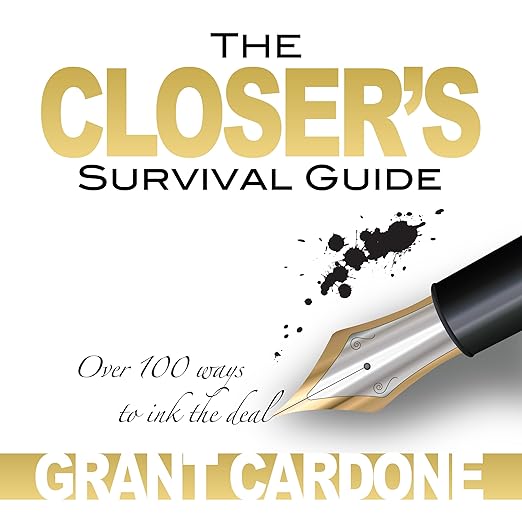
Grant Cardone narrates The Closer's Survival Guide - Third Edition himself, and the first thing to understand about that choice is that Cardone's narration is not a neutral vessel for the content. His voice, the relentless forward pressure, the slight impatience with hesitation, the quality of someone who has already decided the answer and is waiting for the question to catch up, is itself a demonstration of the closing philosophy the book contains. At five hours and thirty-three minutes, this is an audiobook that asks you to sit with an extended argument about why closing, defined here not merely as a sales technique but as the fundamental act of converting intention into reality, is the skill that separates those who achieve things from those who do not. Whether you find that argument compelling or exhausting will depend significantly on your tolerance for Cardone's particular style of intensity.
The book's structure is the closest thing to a technical manual that the self-help genre produces. Cardone organizes the content around the 20 major rules of closing followed by more than 120 specific closes, which he categorizes by type: 31 Money Closes, 17 Time Related Closes, 3 Pressure Closes, 3 Agreement Closes, 8 Decision Closes, and 64 additional creative variations. For listeners approaching it as a reference, this is genuinely useful: the closes are discrete, named, and explained in enough detail to practice. For listeners approaching it as a narrative, the catalog sections require patience that the earlier philosophical sections do not.
What Grant Cardone Delivers
The philosophical claim Cardone makes early and returns to consistently is that closing is not a sales-specific skill but a life skill, the mechanism by which any goal that requires other people's involvement, funding, support, or consent gets converted from an idea into an outcome. His examples range from professional sales scenarios to personal requests to entrepreneurial pitch situations, and the breadth is intentional: he wants the listener to understand closing as a universal competency rather than a specialty of car salespeople and telemarketers. That reframe is the book's most interesting contribution to the genre, and it is the part that experienced salespeople who already know most of the individual techniques will find most worth engaging with.
The Third Edition designation suggests this is a refined version of an earlier text, and the content reflects a body of knowledge that Cardone has been developing across decades of sales training. The reviewer who describes the material as fresh and original strategies for completing the exchange of valuables in the marketplace, pushing back on the conventional sales management wisdom that closes are outdated, is representing a genuine tension in the sales training world: the question of whether direct, technique-based closing is manipulation or service. Cardone comes down firmly on the side of service, arguing that the person who can close is the person who actually delivers on their promises, because an unclosed deal helps no one.
What Grant Cardone Gets Right
The self-narration is a specific asset here. Cardone performing the close techniques, not just describing them, gives the audiobook a demonstrative quality that print cannot replicate. When he models the Money Close or the Time Close, the delivery conveys the pacing and energy that makes a close work in practice rather than just the script that makes it work on paper. Salespeople who learn better through hearing than reading, particularly those in phone-based or high-contact sales environments, will find the audio format directly useful as a training resource in a way that the text edition is not.
The reviewer who describes the book's focus on turning no into maybe or yes captures the practical utility accurately. Most of the 120-plus closes are responses to specific objections: the listener who says it costs too much, the buyer who says they need more time, the decision-maker who says they need to think about it. Cardone's approach to each of these is to treat the objection not as a stop sign but as a request for more engagement, and the variety of closes available for any given objection is the point of having more than a hundred of them. Different situations, different personalities, different industries require different approaches, and the catalog is designed to provide options rather than a single script.
Where Grant Cardone Loses Some Ground
The intensity is consistent throughout the audiobook, which means listeners who find it motivating in the first hour will find it motivating in the fifth, but listeners who find it too pressured in the first hour should probably acknowledge that the register does not soften. Cardone's philosophy requires a specific orientation toward friction: he reads buyer hesitation as a request for more persuasion rather than a signal to back off, and that reading will align with some sales cultures and conflict sharply with others. Listeners in customer-service-oriented or relationship-first sales environments may find the close-heavy framework in productive tension with their own approach, which can be useful, or in unproductive conflict with it, which requires judgment.
The book does not address closing ethics explicitly, though the framing consistently positions the closer as someone providing a service rather than extracting value. Listeners who want a framework for distinguishing high-pressure closing from legitimate persuasion will need to bring their own ethical criteria, as Cardone is focused on technique rather than on the question of when a given technique is appropriate to use.
Who Should Pick Up The Closer's Survival Guide - Third Edition
Sales professionals who want a dense, practical catalog of closing techniques delivered by someone who clearly believes in what he is teaching will find significant value in this audiobook. Entrepreneurs who need to close investors, partners, or customers and who have not had formal sales training will get the philosophical foundation here that transforms ad hoc persuasion into structured skill. Managers who have been told that closes are outdated will find Cardone's pushback worth hearing, even if they ultimately disagree. Listeners who are sensitive to high-pressure sales culture, or who work in environments where relationship-building precedes any closing conversation by months or years, should be prepared for a framework that does not share their assumptions.
Common Questions
Does the Closer's Survival Guide audiobook include all 120-plus closes in the catalog sections, and how are they presented?
Yes, the full catalog is included. Cardone narrates each close by name, explains its application and the specific objection or situation it addresses, and in many cases models the delivery. The catalog sections are organized by type, which helps listeners navigate to the closes most relevant to their situations.
How does Grant Cardone's self-narration compare to a professional narrator for this kind of instructional audiobook?
Cardone's narration is a demonstrative asset for technique-based content: his delivery models the energy and pacing the closes require in practice. The intensity is consistent at a high level throughout, which works as motivational fuel but can be fatiguing across extended sessions. There is no neutral alternative here; his voice is the book's voice.
Is The Closer's Survival Guide - Third Edition significantly different from earlier editions, and does it matter for audiobook listeners?
The Third Edition designation indicates the content has been refined and updated, but the book does not provide an explicit changelog between editions. Listeners who have not read earlier versions will not notice gaps. Those upgrading from a previous edition primarily get additional closes and a refined philosophical framework around the 20 major rules.