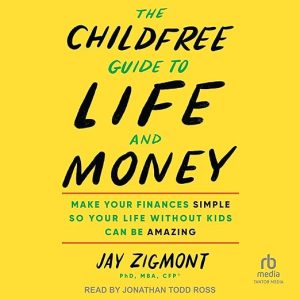
Financial planning for people without children has historically been an afterthought appended to mainstream advice: a footnote acknowledging that some readers might not have dependents, followed by a quick redirect to the standard framework with minor adjustments. Jay Zigmont, who holds a PhD, MBA, and CFP credential and describes himself as a Childfree Wealth Specialist, identified that gap and filled it with systematic attention it had never received before. At eight hours and ten minutes, Jonathan Todd Ross narrates this audiobook with the easy authority of someone comfortable with both the practical and the personal dimensions of the subject, and the result is a resource that listeners without children have been waiting for without necessarily knowing it was possible.
FILE Reframes FIRE for People Without Kids
Zigmont's central structural innovation is the FILE framework: Financial Independence, Live Early, a deliberate reorientation of the FIRE movement (Financial Independence, Retire Early) for people whose absence of child-related costs and obligations opens up different possibilities. The distinction matters more than it initially seems. FIRE assumes a particular accumulation trajectory, a particular relationship to work and leisure, and a retirement endpoint that functions as the finish line. FILE asks a different set of questions: what do you actually want your life to look like right now, and how do you build a financial plan around that vision rather than retrofitting a life into a standard financial template designed for people with children?
Eight No-Baby Steps Rewrite the Standard LifeScript
The eight No-Baby Steps Zigmont introduces provide the actionable structure that makes the framework usable rather than merely conceptual. The coverage is comprehensive in ways that earlier childfree-adjacent content never managed. Career decisions, housing choices spanning ownership to renting to digital nomadism, tax planning specifically for DINKs (dual-income, no kids) and SINKs (single-income, no kids), retirement without the assumption that adult children will be part of the support picture, and estate planning for people whose primary beneficiaries are not their kids. Each domain is treated as genuinely different for the childfree rather than as a minor variation on parenting-centric advice.
A reviewer who describes this as a self-help and spiritual book as much as a financial one is responding to the life-design dimension Zigmont integrates throughout. The Standard LifeScript framing, going to college, getting married, buying a house, and having kids as the default sequence, gives listeners a shared vocabulary for what they have consciously opted out of, and treating that opt-out as a positive foundation rather than a deviation creates an emotional register that mainstream financial content never achieves for this audience.
Ross Makes Estate Planning Sound Like Conversation
Jonathan Todd Ross is a practiced audiobook narrator with the particular skill of making dense informational content sound like conversation rather than documentation. Personal finance audiobooks can tip into textbook monotony, especially when the content involves tax structures, investment strategies, and estate planning. Ross prevents that slide with a reading style that stays engaged with the material, which makes the eight-hour runtime feel less like a course requirement and more like an extended consultation with an unusually knowledgeable advisor who has thought carefully about your specific situation.
The validation function of this audiobook is also not to be underestimated. Multiple reviewers describe finding it refreshing, thoughtful, and even moving to encounter financial guidance that centers their life choices rather than treating those choices as complications to work around. Zigmont's approach of using the Golden Girls living arrangement as a legitimate planning scenario alongside conventional coupling options is an example of how far the book extends the frame: unconventional life structures are presented as real options that merit serious financial planning, not as edge cases that barely qualify for a footnote. That tone sustains across eight hours and does not become hollow affirmation; Zigmont backs the validation with actual guidance.
FILE Assumes a Baseline of Financial Stability
One reviewer notes that the book is occasionally out of touch for listeners at lower income levels, observing that the flexibility the FILE framework describes requires a baseline of financial stability that not everyone has achieved. That is a fair and honest observation. The book is most immediately useful for listeners who have already secured some financial footing and want to optimize their situation for their specific circumstances rather than for those still in early-stage financial recovery or dealing with significant debt.
The tax planning sections, while genuinely useful for US-based readers at the time of publication, are time-sensitive. Tax law changes, and specific guidance around deductions and retirement vehicles may shift with legislative developments. Listeners outside the United States will find the life-design and philosophical framing universally applicable but should treat the specific financial advice as a framework for finding jurisdiction-specific equivalents rather than as directly actionable guidance for their own tax situation. Zigmont is explicit about his US focus, which is responsible framing, but it does limit the book's cross-border utility for the practical chapters.
Designed for DINKs and SINKs Ready to Plan
People who have made a deliberate choice not to have children and feel consistently poorly served by mainstream financial planning content will find this the most directly addressed resource available in audiobook form. DINKs and SINKs in their thirties and forties who have some financial stability and want to design a genuinely customized life and financial plan around the FILE framework rather than following the default roadmap will benefit most from Zigmont's specific guidance. Listeners who are still making decisions about children may find the framework clarifying for what the childfree path actually enables financially, though the book is clearly most directly useful for those who have already made or are firmly moving toward that choice. Those outside the US will find the life-design content valuable but should verify jurisdiction-specific financial details independently.
Before You Listen
Is this audiobook useful for people who are childfree by circumstance rather than by deliberate choice?
Zigmont's framework addresses childfree people broadly, and much of the life-design content applies regardless of how one arrived at that status. The financial planning specifics around retirement without adult children as a potential later-life resource, estate planning without obvious heirs, and optimizing financial goals for personal rather than family milestones are relevant to anyone navigating those practical realities.
How does this audiobook handle retirement planning without the assumption of children as a later-life safety net?
Zigmont treats this as one of the central planning challenges for childfree people rather than a footnote. He addresses both the psychological and the financial dimensions of planning a later life without the structural support that children often provide, offering a framework for building alternative networks, community structures, and financial buffers appropriate to that reality.
Is this audiobook primarily a financial planning resource or does it address broader life design questions?
Both, and that dual focus is one of its central strengths. Zigmont's argument is that childfree financial planning cannot be separated from life design, because the same life choices that make you childfree also shape every major financial decision you make. The FILE framework integrates both dimensions throughout, and the audiobook treats them as inseparable rather than as separate chapters addressing different concerns.