Quick Take
- Narration: Mark Smeby brings a measured, clear delivery suited to the apologetics register of the material, he reads like someone who wants the argument to land rather than the performance.
- Themes: Evidential faith and Christian apologetics for children, daily devotional habit, the historical case for the Resurrection
- Mood: Thoughtful and slightly investigative in tone, more analytical than emotional despite the daily format
- Verdict: Lee Strobel’s 365-day adaptation of his landmark apologetics title offers something genuinely different from standard faith devotionals, equipping children with reasons for belief rather than only encouragement to believe.
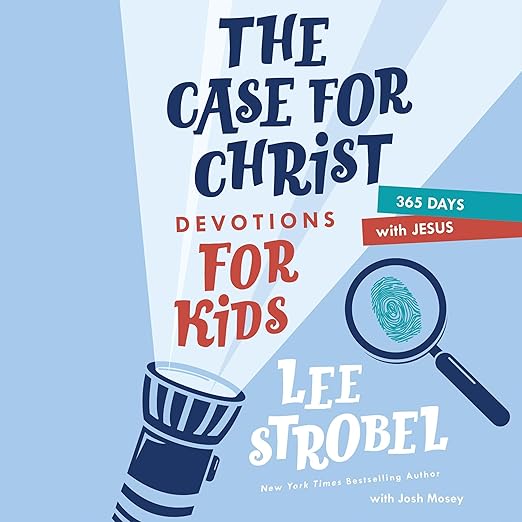
There is a category of children’s faith audiobook that essentially says: God is real, Jesus loves you, here is a Bible verse. Those books have value, and I review them regularly. But The Case for Christ Devotions for Kids is doing something different, and the difference is worth pausing on. Lee Strobel’s original The Case for Christ was a former legal journalist’s systematic investigation of the historical evidence for Jesus’s life, death, and resurrection. That is the book this daily devotional adapts for children ages 8 to 12. The result is, as far as I can determine, the only children’s daily devotional organized primarily around apologetic argument rather than spiritual encouragement.
I listened to the first several weeks of entries during a long Sunday drive, and what struck me was how much the format had absorbed Strobel’s legal journalist instincts. Each entry opens with something to examine, a historical claim, a piece of evidence, a question a skeptical child might ask. It then investigates. The language is kid-friendly, but the logical structure underneath is adult. Children reading this are not being told what to believe. They are being shown why someone might believe it and invited to evaluate the evidence themselves.
Apologetics Translated for an 8-to-12 Audience
The stated audience of ages 8 to 12 is, frankly, ambitious. Reviewer RMOM notes it is mostly for fourth grade and up, which aligns roughly with ages 9 to 10 as a practical floor. The arguments about manuscript reliability, eyewitness testimony, and the empty tomb are simplified but not simplified out of substance. A child who has genuinely read or listened through a significant portion of this devotional will have encountered the core claims of evidential Christian apologetics in language they can understand and repeat.
That is a pedagogical choice worth examining honestly. Some parents will find it exactly what they wanted: a tool for raising children who can articulate why they believe what they believe when asked by classmates or curious relatives. Others may prefer devotional content that focuses on relationship and experience rather than argument. Both are legitimate approaches to children’s faith formation, and this audiobook is very clearly the first kind.
Mark Smeby and the Investigative Register
Mark Smeby narrates with a quality I would describe as purposeful clarity. He is not performing enthusiasm or manufacturing warmth. He reads the material as though it is information worth taking seriously, which for apologetics content is exactly the right approach. A narrator who sounded cheerful and encouraging during a discussion of Roman crucifixion practices or manuscript authentication would be tonally bizarre. Smeby gives the material the gravity it requests without making it feel heavy or inaccessible.
The 365-day structure at 10 hours and 17 minutes means each entry runs approximately one and a half to two minutes. That is a short unit. The reflection questions at each entry’s end, which reviewers Megan and TiffanyY both highlight as generating genuine family discussion, are designed to extend that short listening unit into something longer. Megan describes reading each day and producing great questions for discussions, with her daughter joining in despite not being the primary target audience. That kind of generational spillover is a quality marker.
Group and Family Use Cases
The publisher describes the book as usable for family devotion time, Sunday schools, or youth ministry. The audio format is less convenient for Sunday school use than a print edition, but the daily structure is well-suited to co-listening contexts. Each entry is short enough that a youth group could listen together and have fifteen minutes of discussion in a thirty-minute session. The apologetics content is, if anything, more valuable in a group setting than in solitary listening, because the questions it raises benefit from collective wrestling.
Who Should Listen / Who Should Skip
Listen if: you want to equip children ages 9 to 12 with evidential reasons for Christian belief rather than primarily emotional encouragement; you are comfortable with an apologetics-forward devotional framework; you plan to engage with the reflection questions rather than treating the audio as passive content.
Skip if: you want a warm, encouraging daily devotional focused on relationship with Jesus rather than historical argument; your child is under 9 and may struggle with the conceptual complexity; or you are looking for a primarily narrative Bible storytelling format.
Frequently Asked Questions
Is this a simplified version of The Case for Christ for Young Readers, or is it a separate work?
It is a separate work adapted in daily devotional format from Strobel’s apologetics framework. The Case for Christ for Young Readers is a narrative adaptation telling the investigation story; this 365-day devotional breaks the evidential arguments into daily entries with reflection questions. The publisher recommends reading them alongside each other for a fuller investigation.
Does the audiobook include the reflection questions after each entry, or are those print-only?
Mark Smeby reads the reflection questions as part of each entry. They function as discussion prompts in the audio just as they do in print, though obviously a child listening alone cannot write responses. Families who use the audio will find the questions work best when someone is present to discuss them.
What specific topics does the apologetics content cover across the 365 entries?
The entries cover why Christians believe Jesus existed historically, why the Gospels are considered reliable, what the evidence for the Resurrection is, how to talk to others about faith, and core elements of Christian theology presented through an evidential framework. The tone is investigative rather than systematic, it builds a case rather than presenting a catechism.
Is this appropriate for children who have questions or doubts about faith, or is it designed for children who are already believers?
Strobel designed the original Case for Christ for skeptics, and the children’s adaptation retains some of that questioning spirit. Children with genuine doubts or questions about Christianity will find this more useful than most devotionals, which assume belief rather than addressing uncertainty. It is designed to be honest about the questions and then show why believers find the evidence compelling.