Quick Take
- Narration: Rebecca Soler navigates the dual sibling perspectives of Jessie and Evan with clear differentiation and the right balance of humor and warmth.
- Themes: Privacy versus transparency, sibling rivalry and understanding, the ethics of journalism
- Mood: Bright and warm, with genuine emotional intelligence running beneath the Valentine’s Day premise
- Verdict: A satisfying fourth entry in the Lemonade War series that uses its holiday premise to explore something more interesting than candy hearts, and earns genuine affection for both of its leads.
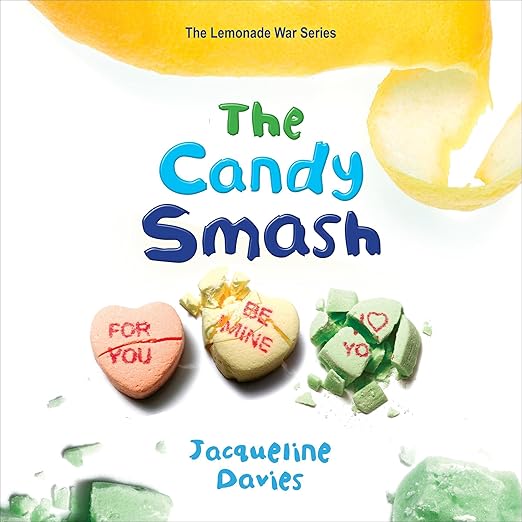
I listened to the first chapter of The Candy Smash on a February morning, the kind where the light comes in flat and cold and someone has put up a few paper hearts on the office bulletin board in a way that feels more obligatory than festive. Jacqueline Davies has written something that understands this ambivalence about Valentine’s Day: it is a holiday that requires public declaration of private feeling, and some people find that liberating and some people find it excruciating, and in a fourth-grade classroom both of those responses can exist within the same sibling pair.
Jessie and Evan Treski are the center of the Lemonade War series, and by Book 4 Davies has built enough history with them that the book can take on something genuinely complex: the conflict between Evan’s belief that some things are private and Jessie’s conviction that scandal makes good news. Anonymous candy hearts are appearing in their classroom. Jessie, self-appointed ace reporter, wants the story. Evan, a quiet poet who guards his interior life fiercely, wants her to leave it alone. This is a real ethical dispute about real competing values, and Davies handles it with the specificity it deserves.
The Classroom Newspaper as Ethical Engine
The classroom newspaper that Jessie pursues in this volume is one of the more inventive structural choices in the Lemonade War series. It gives Jessie a project, a purpose, and a conflict of interest simultaneously. Her role as reporter requires her to report what she knows; her role as sister requires her to protect someone she loves. Davies does not resolve this tension by making one position wrong. Both Jessie and Evan are defending something legitimate, and the book takes enough time with both perspectives that a child reader can inhabit each without feeling told which one to agree with.
Rebecca Soler handles this dual perspective well. The Lemonade War series alternates chapters between the siblings, and Soler differentiates them clearly enough that the shifts never cause confusion while keeping enough tonal consistency that the two voices belong to the same family. This is subtle work; sibling narration in a single-voice audiobook requires the narrator to carry two interior lives that share some emotional DNA without becoming identical.
Valentine’s Day as the Perfect Container for This Conflict
The choice of Valentine’s Day as the holiday framing for this particular conflict is precise. Anonymous candy hearts sent to a classroom full of fourth graders create exactly the intersection of public and private that the Jessie-Evan conflict is about. Who sent the hearts? Jessie wants to know. Does it matter? Evan thinks not. The anonymous survey Jessie creates to identify class crushes is both a logical extension of her reporter instincts and a perfect escalation of the ethical problem.
One young reviewer, writing in their own voice with cheerful candor, noted that there was too much love stuff in the book, including an anonymous survey to find out who had a crush on whom, and that they were considering starting a newspaper for their classroom. Both reactions are exactly right and represent the book working as intended: the emotional content of the Valentine’s theme is present enough to feel real, and the institutional ambition it inspires is a sign that Davies has made journalism feel genuinely exciting to a nine-year-old.
The Beverly Cleary Comparison
The synopsis compares Jacqueline Davies to Beverly Cleary, describing her as a modern-day Cleary who writes with heart, humor, and honesty about family and school life. This is a meaningful comparison because Cleary’s great gift was the specific texture of ordinary childhood, the way school and family and social dynamics feel real rather than symbolic. Davies has some of that quality. The Treski household feels inhabited rather than constructed. Jessie’s compulsive information-gathering is both a character trait and a real kind of intelligence that the book never pathologizes. Evan’s poetry is never used as a punchline.
At 3 hours and 40 minutes, this is a proper chapter book runtime, long enough to develop both characters fully while maintaining the holiday premise as a narrative driver rather than mere backdrop. Soler’s pacing keeps the story moving without rushing the emotional moments.
Who Should Listen and Who Should Skip
This is ideally read in publication order, as the characters’ relationship has depth that accumulates across the series, but Davies writes with enough contextual generosity that a new listener in Book 4 will understand the dynamic. The target age is roughly seven to eleven. Anyone who likes Ramona Quimby or the Clementine series will find the Treski household familiar in its specificity. February is the obvious time for this one, but the sibling-and-ethics core plays in any season.
Frequently Asked Questions
Do you need to have read the first three Lemonade War books before starting The Candy Smash?
Davies builds in enough context that a new listener can follow the story without prior knowledge. The Jessie and Evan dynamic is established clearly within this book. That said, the series rewards reading in order because the siblings’ relationship has layers that accumulate across books. If a child is new to the series, starting with The Lemonade War and working forward will give them the fullest experience.
Is the Valentine’s Day content appropriate for children who find crushes embarrassing?
One young reviewer specifically noted that there was too much love stuff in the book. The Valentine’s themes are handled age-appropriately, but they are present. Anonymous crushes, a survey about who likes whom in class, and some poem writing are all part of the plot. For children who are deeply resistant to anything romance-adjacent, this may feel uncomfortable. For most kids in the target range of seven to eleven, it will feel accurate to school life.
Is Rebecca Soler’s narration consistent with the earlier books in the series?
Rebecca Soler narrates multiple entries in the Lemonade War series, which means listeners who have followed the audiobooks will find her Jessie and Evan voices familiar and consistent. She has built a strong interpretation of these characters across the series.
The synopsis mentions a Beverly Cleary comparison. How accurate is that?
It is a meaningful comparison rather than mere marketing language. Davies shares Cleary’s commitment to the specific texture of ordinary childhood, the realness of sibling dynamics, school social hierarchies, and the emotional weight of everyday situations. She does not imitate Cleary’s mid-century American setting, but the underlying approach to character and daily life in both writers comes from the same tradition of treating children’s experiences as fully real.