Quick Take
- Narration: Nick Podehl delivers a confident, varied performance that handles the book’s tonal shifts between adventure-thriller momentum and quieter character moments without losing pace.
- Themes: Courage under pressure, trust and betrayal, the wonder of a continent still being mapped
- Mood: Steampunk-adjacent, propulsive, and richly atmospheric
- Verdict: One of Kenneth Oppel’s most inventive standalone novels lands well in audio, eight hours that move faster than they have any right to.
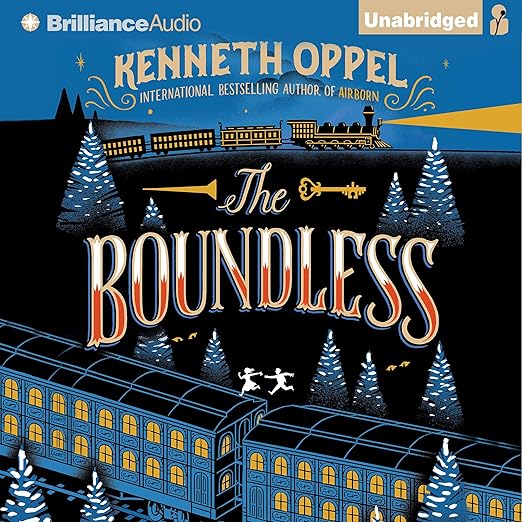
I read Kenneth Oppel’s Airborn trilogy years before I reviewed audiobooks professionally, and I remember thinking the airship sequences moved with a physicality most adventure novels couldn’t sustain, you felt altitude, wind resistance, the particular danger of being high above everything. When The Boundless arrived in audio form, narrated by Nick Podehl, I queued it for a long drive from Lyon to Paris, which turned out to be the right choice. Eight hours and seven minutes, one of the most under-discussed middle-grade novels of the last decade, and a narrator who knows how to make a moving vehicle feel like a character.
Will Everett has spent his young life wishing for adventure. He boards the Boundless, the longest train in the world, pulling hundreds of cars across a vast and only partly tamed Canada, and gets considerably more than he wished for. There’s a murder in the early chapters, a key that unlocks the train’s hidden treasures, and a pair of companions: Maren, a circus escape artist whose abilities edge toward the genuinely inexplicable, and Mr. Dorian, a ringmaster with his own agenda. The setup sounds like a collection of adventure tropes, and it is, but Oppel assembles them with a craftsman’s precision. The train’s geography becomes as important as any character, which car is which, what’s hidden in the cremation car, how many levels of class separate Will from the people hunting him.
The Train as the World
What distinguishes The Boundless from most children’s adventure fiction is that the setting isn’t decorative. The train is the entire world of the novel, a self-contained society with its own hierarchy, its own secrets, its own rules about who belongs where. Will starts in the front cars, where wealth and privilege insulate passengers from reality, and spends the novel working toward the back, where the world is grittier and the people are less polished but considerably more capable. That journey through the train’s social geography gives the adventure plot a dimension it wouldn’t otherwise have. A reviewer who had read Airborn noted that The Boundless felt like it had less narrative heft by comparison, a fair observation if you’re measuring complexity, but slightly unfair to what the novel is actually doing, which is building a complete world in a smaller compass.
Nick Podehl’s Performance
Podehl is one of the more reliable narrators working in the children’s and YA space, and his work here demonstrates why. He distinguishes clearly between Will’s uncertainty, Maren’s quiet competence, and Mr. Dorian’s theatrical authority without making each voice a caricature. The circus scenes, and there are several, as the Boundless carries an entire circus among its cars, require him to shift between spectacle and menace within the same sequence, and he manages that without losing the listener’s orientation. His pacing through the action sequences is particularly good; he doesn’t rush when Oppel is building tension, and he doesn’t slow when the narrative needs to move. For a long listen, consistent pacing is the difference between absorption and attention drift, and Podehl keeps the absorption rate high throughout.
What the Comparison to Airborn Is Really About
The recurring critical observation, that The Boundless is good but not quite Airborn, is worth examining rather than dismissing. Oppel’s Airborn trilogy gave Will’s counterpart Matt Cruse a three-book arc to develop, relationships with recurring characters that deepened over hundreds of pages, and a villain with genuine menace. The Boundless is a standalone, which means the character development has to move faster and the resolution has to be complete in one volume. What it trades in depth it compensates for in invention: a sasquatch encounter on the wilderness tracks, a locked gold car that multiple factions want open, a circus that exists in a moral gray zone. If you’re new to Oppel, this is a perfectly satisfying entry point. If you’ve already read Airborn, know going in that they’re doing different things and let The Boundless be what it is.
Frequently Asked Questions
Is The Boundless part of a series, or can I listen to it without reading anything else by Kenneth Oppel?
It’s a complete standalone novel with no sequel and no required prior reading. It exists in the same steampunk-adjacent sensibility as Oppel’s Airborn trilogy but is entirely separate, different characters, different world, no connecting threads.
The synopsis mentions strange creatures lurking outside the windows. How fantastical does the novel actually get?
There are elements that sit at the edge of the fantastical, a sasquatch encounter on the wilderness route, and Maren’s abilities as an escape artist that are slightly inexplicable. It’s not full fantasy; the world is grounded in an alt-historical Canada. But the book doesn’t commit to pure realism either. Readers comfortable with Oppel’s tonal range in Airborn will know what to expect.
How does Nick Podehl handle the circus characters specifically, is there a risk of those voices becoming cartoonish?
Podehl keeps the circus characters distinctly voiced without tipping into caricature. Mr. Dorian in particular benefits from a measured, theatrical quality in the narration that matches the character’s position as a showman with hidden depths. The circus scenes are some of the best-performed sequences in the recording.
At 4.4 stars with 410 ratings, this seems well-regarded but not overwhelmingly so. Why isn’t it better known?
The Boundless occupies an awkward marketing position, it’s not a series opener, so there’s no sequel to drive readers back. It’s also often overshadowed by Oppel’s Airborn trilogy and his Frankenstein prequel This Dark Endeavor. It tends to be discovered rather than recommended, which explains both the genuine enthusiasm in its reviews and the relatively modest visibility.