Quick Take
- Narration: Lucy Pollock narrates her own book, and the effect is immediately apparent, a geriatrician speaking about her patients carries weight and intimacy that no hired narrator could replicate.
- Themes: End-of-life conversations, the ethics of medical intervention, caring for aging parents
- Mood: Warm, serious, and occasionally funny, grief is present throughout but never paralyzing
- Verdict: Anyone with aging parents, anyone working in eldercare, or anyone who has avoided thinking seriously about how they want to die should listen to this carefully.
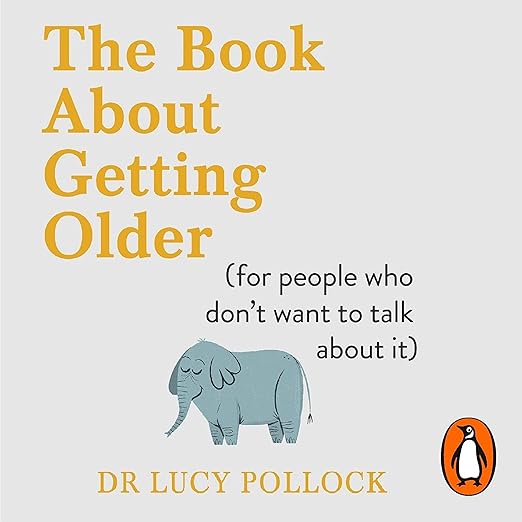
I finished the last two hours of this one sitting in my car outside a grocery store, not quite ready to go inside. That’s the kind of book The Book About Getting Older is, not because it’s bleak, but because Dr. Lucy Pollock asks questions that don’t resolve tidily, and she asks them in the kind of voice that makes evasion feel ungracious. She is a geriatrician. She has had the conversations that most of us desperately avoid, and she has spent a career watching what happens when those conversations don’t happen at all.
The premise is deceptively simple: we are living longer, and we are failing, systemically and individually, to think clearly about what that means. The questions Pollock poses, should Dad be driving, who can stop him, is it normal to fall out of love with someone as they disappear into dementia, how do you navigate resuscitation decisions, are not rhetorical. She has answers, or at least frameworks, and she delivers them with the kind of directness that comes from having watched what happens in their absence.
The Conversations We Keep Not Having
The most distinctive thing about this book is its insistence that difficulty doesn’t excuse avoidance. Pollock is not sentimental about aging. She knows what dementia looks like from the inside of a geriatric ward, and she doesn’t soften it. But she is equally unsentimental about the medical system’s habit of intervention for its own sake, keeping patients alive in technical terms while doing nothing to preserve the quality of that life. The chapter on care homes is worth the admission price alone. Pollock identifies what separates genuinely good facilities from merely adequate ones, and the criteria are not the ones most families think to check. She is equally strong on the question of when fierce independence tips into behavior that puts a person at genuine risk, a distinction that adult children and geriatricians navigate constantly, often without the vocabulary to do it well.
The section on medicines is particularly illuminating. Pollock addresses the question her synopsis raises directly: is it worth taking seven different medicines? The answer is specific and honest, drawing on the clinical evidence about polypharmacy in older adults and the systemic pressures that lead to over-prescription. These are not abstract policy questions, they are the questions families face in hospital corridors with no preparation.
Funny, Kind, and Unflinching in Equal Measure
Several reviewers used the word “funny” in describing this book, which may seem incongruous for a nine-hour meditation on dying well. But Pollock has the dry humor of someone who has worked in high-stakes situations long enough to know that laughter and grief are not opposites. The anecdotes from her clinical practice, anonymized, obviously, but vivid, often have a dark absurdity that she lets breathe without forcing it toward easy sentiment. This tonal range makes a long listen on a difficult subject bearable without feeling disrespectful.
One reviewer noted some incompleteness, “there is more I need to know”, and I think that reflects a genuine limitation. This book does not attempt to cover every possible situation or provide a comprehensive legal guide to advance care planning. What it provides is a conceptual framework and a set of questions that open doors rather than close them. Those wanting a more procedural manual should pair this with something like Atul Gawande’s Being Mortal, which covers some of the same territory from a slightly more policy-oriented angle. But for the emotional and conversational dimension of getting older and helping others do so with dignity, Pollock’s book is harder to beat.
Self-Narration That Earns Its Keep
Pollock’s narration is assured without being performative. At nearly ten hours, the listening experience is consistent, she doesn’t tire, and her clinical composure gives the more difficult passages a steadiness that earns trust. There are moments when you hear the weight behind specific anecdotes, a slight shift in cadence, that remind you this is not an actor reading a script but a doctor who has witnessed most of what she’s describing. That distinction accumulates across the runtime and is one of this audiobook’s genuine strengths.
Frequently Asked Questions
Is The Book About Getting Older primarily for people dealing with aging parents, or does it also address one’s own aging?
Both, though the book’s immediate practical application tends to tilt toward navigating the aging of people you love. The questions about driving, care homes, dementia, and resuscitation decisions are framed partly through the lens of an adult child and partly through Pollock’s clinical perspective. But the underlying argument, that we need to develop a relationship with these questions before they become urgent, applies to readers at any age.
Does Lucy Pollock advocate against medical intervention, or is her position more nuanced than that?
Her position is genuinely nuanced. She is not anti-medicine, she is a physician, but she is critical of intervention for its own sake, particularly when it prolongs technical life without preserving the quality of experience that makes living meaningful to the individual patient. She draws careful distinctions between situations where aggressive intervention is appropriate and where it constitutes what she calls a failure of care.
How does this compare to Atul Gawande’s Being Mortal, which covers similar territory?
The overlap is real, and readers who found Being Mortal valuable will likely find Pollock’s book a useful companion. Gawande approaches end-of-life medicine with more policy breadth and historical depth; Pollock is closer to the ground, more focused on the specific conversations families and patients need to have. Her tone is warmer and less formally academic than Gawande’s, and her humor is more present. The two books complement rather than duplicate each other.
Is the book useful for healthcare workers, or is it written primarily for a lay audience?
Pollock writes for a general audience, but the clinical precision of her language and the specificity of her observations about how healthcare systems work mean that medical and care professionals will find it resonant rather than simplistic. Several reviewers with clinical backgrounds have praised it for capturing institutional realities accurately alongside the human dimensions.