Quick Take
- Narration: Kris Wilder narrates his own co-authored text, which produces the right register for a book rooted in personal martial arts and self-defense experience, though the self-narration occasionally feels more instructional seminar than polished audiobook.
- Themes: Violence as social phenomenon, personal safety as lifestyle rather than technique, crowd and domestic violence beyond individual confrontation
- Mood: Direct and unsentimental, more sociological than tactical
- Verdict: A broader and more intellectually ambitious safety book than the provocative title suggests, covering institutional violence, riots, and domestic dynamics alongside personal self-defense in ways few comparable titles attempt.
I picked this up expecting a tactical martial arts manual with a provocative title. What I found instead was something considerably harder to categorize: a book that uses personal safety as the organizing principle for a sweeping examination of how violence actually operates across modern society. By the end of the first hour I had stopped waiting for the fighting techniques and started taking notes on things like why witnesses fail to intervene and how crowd dynamics transform normally rational people into participants in collective violence. It was not what I expected, and it was significantly more interesting.
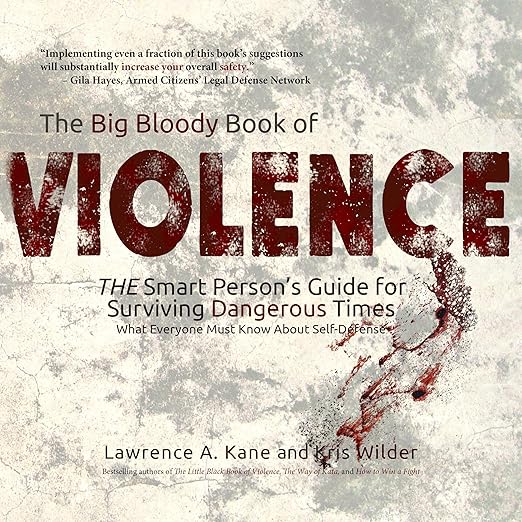
Kris Wilder and Lawrence Kane have collaborated on multiple self-defense books, and The Big Bloody Book of Violence represents their most expansive scope. The title is designed to get attention, and the Gila Hayes endorsement from the Armed Citizens’ Legal Defense Network signals the primary audience: people serious about personal safety who are willing to engage with the full complexity of what they are preparing for. Hayes’ observation that implementing even a fraction of the suggestions will substantially increase overall safety is characteristically restrained praise from a community that does not traffic in empty superlatives.
The Sociological Frame That Sets This Apart
What distinguishes this book from most personal safety literature is the insistence on understanding violence as a social and psychological phenomenon before addressing it as a tactical problem. The sections on riots and crowd safety are particularly unusual. Most self-defense content ignores crowd dynamics entirely, treating violence as a one-on-one encounter that occurs in a vacuum. Wilder and Kane spend significant time on how ordinary people become participants in collective violence, what warning signs precede crowd events, and what specific behaviors protect an individual in a crowd that is beginning to turn. This content has no counterpart in most comparable books and reflects a broader conception of what safety literacy actually requires.
Similarly, the chapter on domestic violence is treated with more seriousness than I have seen in any martial arts or self-defense context. Rather than addressing it as a personal protection problem for the victim, they examine the dynamics that create and sustain abusive relationships, the institutional failures that allow them to persist, and what specific factors determine whether a victim successfully exits a dangerous situation. The Becky Blanton endorsement, describing this as an insider’s bible to violence, points at this quality: the book is as concerned with recognition and prevention as with response.
Where the Political Tangents Appear and Resolve
Reviewer Choki_Wukong flagged what they experienced as odd political tangents in the early sections of the book, and that observation is worth addressing. The opening material does venture into territory that reads as more ideologically colored than the later content, particularly in discussions of media and institutional accountability. My experience was that this settles considerably once the book moves into the substantive content on specific violence categories. The sections on gangs, home invasions, and talisman thinking, the tendency to assume that a concealed carry permit or a security system provides protection without the behavioral practices that make those tools effective, are considerably more focused and less susceptible to that reading.
Wilder’s self-narration carries the texture of someone who has taught these ideas across a career. The delivery is conversational in a way that professionally produced narration sometimes is not, and it works for a book that is explicitly grounded in personal experience and accumulated observation. Reviewer Dale B. Mortimer, MD, noting the relative absence of misspellings and grammar errors, reflects a broader quality of the underlying text: this is more carefully written than the genre average.
The Talisman Thinking Chapter as the Book’s Most Portable Idea
If I were to identify the single most valuable section for the widest audience, it would be the chapters on talisman thinking and on interacting with law enforcement. The talisman thinking concept, the psychological tendency to treat possession of a protective object or credential as a substitute for the preparedness practices that object is meant to support, is one of the more honest analyses of how people actually use self-defense resources versus how they tell themselves they use them. It applies as much to alarm systems as to firearms as to this book itself.
At nearly thirteen hours, this is a substantial commitment. Listeners who want tactical technique sequences will find this frustrating. Those who want to understand the full ecology of violence and to develop a genuine lifestyle-level safety orientation will find it rewarding.
Who Should Listen and Who Should Skip
Listen if you want a comprehensive understanding of how violence operates across different social contexts, if the gap between knowing how to fight and knowing how to recognize and avoid threatening situations is one you take seriously, or if the sociological and psychological dimensions of personal safety interest you as much as the tactical ones.
Skip if you want a focused tactical manual with specific techniques, clear skill progressions, or a tight scope. This book is not a substitute for training and is not structured as one. It is a companion to physical training that contextualizes what that training is for.
Frequently Asked Questions
Is The Big Bloody Book of Violence primarily a martial arts book or a broader safety guide?
It is substantially broader than martial arts. The book explicitly addresses riots, crowd safety, terrorism, domestic violence, home invasions, gangs, and law enforcement interactions alongside the more conventional personal defense content. The martial arts and fighting background of the authors is evident, but the scope is sociological as much as tactical.
Does the book require any existing self-defense training to be useful?
No prior training is required. The book’s value is primarily conceptual and attitudinal rather than technique-dependent, and the sections on recognition, avoidance, and understanding how violence develops are accessible without any physical training background. Readers with existing training will get more from the tactical sections, but the majority of the content stands independently.
Is the content appropriate for women interested in personal safety, or is it primarily written for men?
The book addresses violence categories relevant across demographics, including domestic violence, which disproportionately affects women. The tactical sections carry some martial arts register that skews toward male self-defense applications, but the broader safety content on recognition, awareness, and behavioral practices is not gender-specific. The Gila Hayes endorsement from the Armed Citizens’ Legal Defense Network reflects a credentialing community that is not exclusively male-oriented.
How does the coverage of crowd safety and riot scenarios hold up in the current environment?
The crowd and collective violence content is among the book’s most unusual offerings and remains relevant. The authors describe psychological and social dynamics that produce crowd violence, not specific political events, which means the framework applies across contexts rather than dating to particular incidents. This is one of the areas where the book’s sociological ambition produces the most durable practical value.