Quick Take
- Narration: Kate Hannah delivers a warm, encouraging tone that suits the supportive, step-by-step instruction style of this beginner-focused program.
- Themes: Strength training for aging women, bone density and joint health, progressive fitness routines
- Mood: Encouraging and practical, with a sense of reclaiming physical capability
- Verdict: A genuinely useful starting point for women over 50 who want structured, low-intimidation guidance on getting into resistance training.
I came across this one on a Tuesday afternoon when I was looking for something to listen to during a long walk around my neighborhood. Something about the premise caught my attention: not a general fitness manifesto, not a celebrity transformation story, but a focused, functional guide aimed at a very specific group of people who often get left out of mainstream fitness culture. I kept walking long past when I’d planned to stop.
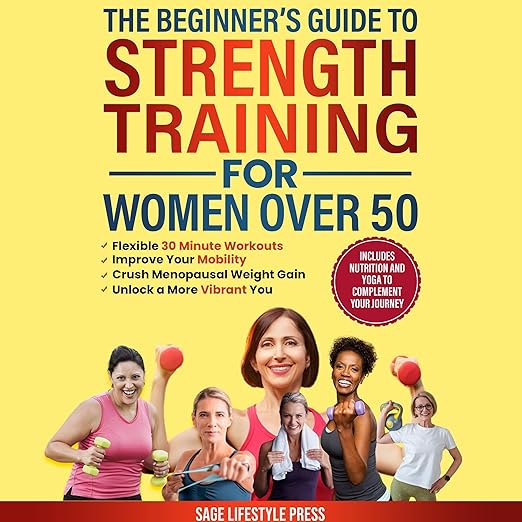
The book’s actual title, revealed in the synopsis, is Weight Training for Women Over 50: Build and Maintain Muscle Mass, Bone Density, and Vitality, and published under the Sage Lifestyle Press imprint, it positions itself squarely as a practical manual rather than an inspirational read. That distinction matters. It means the content is organized around doing, not just understanding, which is either exactly what you need or slightly frustrating depending on what you came for.
What the Eight Workouts Actually Cover
The structure here is careful and deliberate. The program offers eight home-friendly workouts built around a single set of dumbbells, which immediately removes one of the main friction points for beginners: you don’t need a gym membership, you don’t need a rack of equipment, you don’t need to decode a machine. Five of those routines are explicitly designed to progress with you, which reviewer Melanie Pendleton praised directly when she described regaining the physical capacity she’d felt in her twenties and thirties. That kind of progressive scaffolding is what separates a workbook that gets used from one that sits untouched after week two.
The book also addresses conditions that are statistically likely to affect this demographic: arthritis, osteoporosis, lower back pain, and balance concerns. The guidance on six specific lower back modifications and the integration of balance and mobility work alongside resistance training shows an awareness that this isn’t a one-size-fits-all program transplanted from a younger audience. One reviewer, listed only as John, mentioned that the cognition-related benefits were a genuine surprise, noting that the book connected physical training to mental clarity in a way he hadn’t expected.
The PDF Companion and What It Changes
There is a companion PDF included with the Audible purchase, and this matters more here than in some other titles. Strength training programs live and die by their exercise illustrations, their sets-and-reps charts, their visual cues for form. Audio can describe a movement, but it cannot replicate the value of a labeled diagram showing proper knee alignment during a goblet squat. If you listen to this without downloading and consulting the PDF, you’re getting roughly half the product. This isn’t a criticism of the audiobook format per se, but it is something worth flagging before you press play expecting to be guided through everything by ear alone.
Kate Hannah’s narration is well-matched to the material. She reads with the patient clarity of someone giving instructions rather than performing prose, which is exactly right for a how-to title. There’s no theatricality here, and there shouldn’t be. The warmth in her delivery turns what could feel like a dry list of protocols into something that feels more like a conversation with a knowledgeable trainer.
Who Benefits From This Approach
The strongest reader review came from Melanie Pendleton, who described the book as something she wished she’d found years ago. That framing, the sense of arriving at useful information late but not too late, captures what the book is genuinely offering. Another reviewer praised the nutrition guidance as easy to follow, pointing to the protein and muscle-growth advice as a practical complement to the exercise content.
This is not a book for women who already have a structured resistance training practice. It’s not going to tell you anything you don’t already know if you’ve spent time in a gym environment. But for someone who has been told by a doctor to start weight-bearing exercise to protect bone density, or who has watched muscle mass decrease over the past decade and wants specific, non-overwhelming guidance, this delivers exactly what it promises.
Who Should Listen / Who Should Skip
Listen if you are new to strength training, are over 50, and want a structured home program that accounts for common age-related conditions. Listen if you prefer audio guidance to text and are willing to supplement with the included PDF for visual reference. Skip if you already follow an established strength training program or are looking for deeper physiological theory rather than applied protocols. Skip if you need gym-based equipment guidance, since the focus here is exclusively home and dumbbell work.
Frequently Asked Questions
Do I need any equipment beyond dumbbells to follow the workouts in this audiobook?
No. The program is specifically designed around a single set of dumbbells for home use, making it accessible without a gym membership or specialized equipment.
Is the PDF companion included with the Audible version, and how important is it?
Yes, the PDF is included in your Audible library upon purchase. It’s quite important for this type of instructional content, since exercise form and program charts are much easier to follow visually than through audio alone.
Does the book address exercising with conditions like osteoporosis or arthritis?
Yes, the book includes detailed guidance on modifying exercises for common conditions including arthritis, osteoporosis, and lower back pain, which is one of its distinguishing strengths for this audience.
How does the book handle progression for beginners who get stronger over time?
Five of the eight routines are designed to progress alongside the listener’s improving fitness level, so the program is structured to remain useful beyond an initial beginner phase rather than requiring a completely new resource.