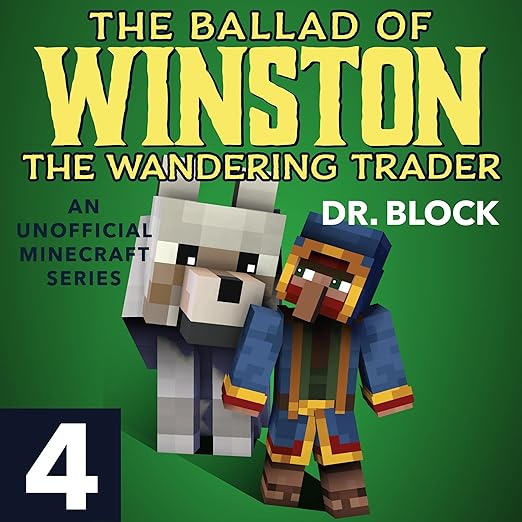
- Narrator: Mark Sanderlin brings the Minecraft-adjacent world to life with the right energy for young listeners, keeping the pace up through the treachery and betrayal plot beats.
- Subjects: loyalty and betrayal, guild politics and power, friendship tested by deception
- Tone: Fast-paced and conspiratorial, with the urgent stakes of a world where trust is the scarcest resource.
- Bottom line: A tight, well-plotted fourth installment for the Ballad of Winston series that fans will consume in under two hours and immediately want followed by book five.
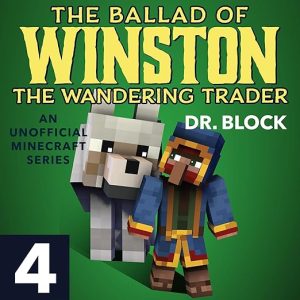
Winston and Wolf are hunting a traitor, and Dr. Block's audiobook The Ballad of Winston the Wandering Trader drops listeners directly into that hunt from the opening minutes. This is book four in the Ballad of Winston series, narrated by Mark Sanderlin and running one hour and fifty-eight minutes, and it is built for an audience that is already invested in the characters - newcomers will want to start at volume one before arriving here. The world is Minecraft-adjacent in its aesthetic and terminology, but the plot is pure adventure serial with an emphasis on loyalty, betrayal, and the mechanics of who you can trust when an organization has been compromised from within.
The structure of Book Four is tighter than a typical middle-series installment tends to be. Dr. Block is working with a compressed runtime and uses it deliberately: the traitor subplot that the book opens on drives every scene, and the recurring characters from earlier volumes - Wolf, Wickham, and Winter among them - are deployed with the economy of a writer who knows his audience has strong existing attachments to these figures. The fan response in reviews makes the emotional stakes clear: listeners who arrived at Book Four are the ones who have read everything prior, who have developed fierce opinions about which characters deserve redemption and which don't, and who are actively composing fan theories about where the series is heading.
The central tension of this volume is the guild itself. Dr. Block has built the Ballad of Winston series around an organization that exercises power over its members in ways that young listeners recognize intuitively as unjust - the guild 'overuses their power,' as one young reviewer puts it with the directness that characterizes the series' fan base, while simultaneously being the structure that keeps the world operating. Book Four advances that critique through the traitor plot, which functions as a referendum on whether loyalty to an unjust institution is a virtue or a failure. This is not lightweight territory for a children's audiobook, and Dr. Block handles it without either preaching or simplifying.
Wickham has emerged as the series' most divisive character by this point, and Book Four does nothing to resolve that division - if anything, it intensifies it. One reviewer's declaration that Wickham is their 'LEAST favorite character' and the companion anxiety about Winter's potential corruption give a sense of how effectively Dr. Block has made these characters matter to his audience. Sanderlin's performance handles the moral complexity of Wickham's role with appropriate ambiguity, giving the character the authoritative tone that makes his actions legible as a genuine threat rather than a cartoon villain. The character work Sanderlin achieves within a compressed runtime is one of the audiobook's overlooked strengths - distinguishing between multiple recurring figures without resorting to caricature takes real craft in a listening format where visual cues are absent.
Sanderlin's Brisk Pacing Suits Short Attention Spans
The under-two-hour runtime makes The Ballad of Winston the Wandering Trader one of the most accessible audio experiences in the children's adventure space, particularly for younger listeners who are building their audiobook attention spans. Dr. Block writes in complete sentences that scan well aloud, and Sanderlin's narration takes full advantage of the craft - the pacing is brisk without feeling rushed, and the chapter breaks come at moments of genuine suspense that encourage continued listening rather than natural stopping points.
The Minecraft vocabulary - villagers, wandering traders, the specific geography of the game's world - is integrated into the adventure without requiring active game knowledge to follow. Children who play Minecraft will recognize the texture of the world and find it a comfortable overlay on the narrative. Children who don't play will follow the plot without the reference knowledge, because Dr. Block's storytelling makes the world rules legible through action rather than exposition. The political structure of the guild, the significance of going rogue, the geography of the various locations - all of this is communicated through what characters do rather than through world-building lectures, which is fundamentally good narrative craft regardless of the reader's age.
An Ending Built to Create Appetite for More
This is volume four, and it assumes familiarity with the preceding three books. Listeners arriving at Book Four without having heard volumes one through three will find references to established relationships, past events, and ongoing conflicts that are not explained within this installment. The series is designed to be experienced in order, and the emotional payoffs of the betrayal plot depend on knowing what the loyalty at stake was originally worth.
Dr. Block ends this volume at a point of genuine narrative tension rather than resolution - the traitor question is advanced but not fully settled, and the threat around Winter's loyalty is left deliberately open. Young listeners who have been following the series should be prepared for an ending that generates immediate appetite for book five rather than providing a fully closed chapter. This is good serial craft, but it means the experience of Book Four is substantially enhanced by having Books Five and Six available immediately afterward.
More Substantive Than Its Minecraft-Adjacent Framing Suggests
The series is ideal for young listeners aged roughly eight to twelve who enjoy adventure fiction with political stakes, moral complexity in its characters, and a world with clear visual reference points. Children who have worked through the earlier volumes and are current on the series will find Book Four rewarding and immediate. Parents looking for an entry point to the series should start at volume one rather than here. Teachers or librarians considering the series for recommendation should know that the guild critique running through the books generates genuine discussion among young readers about fairness, loyalty, and legitimate authority, which makes it a more substantive listen than the Minecraft-adjacent framing might initially suggest.
A Few Questions About The Ballad of Winston the Wandering Trader
Does The Ballad of Winston the Wandering Trader Book 4 audiobook work as a standalone?
No. This is volume four of an ongoing series and assumes substantial familiarity with the characters, relationships, and ongoing conflicts established in the first three books. New listeners should start at the beginning of the Ballad of Winston series for the story to be fully coherent.
How does Mark Sanderlin's narration serve the series' young audience?
Well. Sanderlin keeps the energy appropriate for an action-focused children's adventure without tipping into the performative overload that can make audiobook narration feel condescending to older kids. The character distinctions are clear and the pacing is calibrated for listeners who are developing their audiobook stamina.
Do you need to play Minecraft to enjoy The Ballad of Winston audiobooks?
No. While the world draws on Minecraft's aesthetic and terminology, Dr. Block makes the world rules legible through character action and plot rather than through assumed game knowledge. Children who play Minecraft will recognize familiar elements, but children who don't will follow the story without difficulty.
Is The Ballad of Winston the Wandering Trader Book 4 audiobook appropriate for children who are sensitive to conflict and betrayal themes?
The book deals with treachery and internal betrayal within an organization, which creates emotional stakes that some younger or more sensitive listeners may find intense. The threat is to trusted relationships rather than to physical safety, and the tone is adventure serial rather than dark fantasy. Most listeners in the eight-to-twelve range will find the level of stakes exciting rather than distressing.