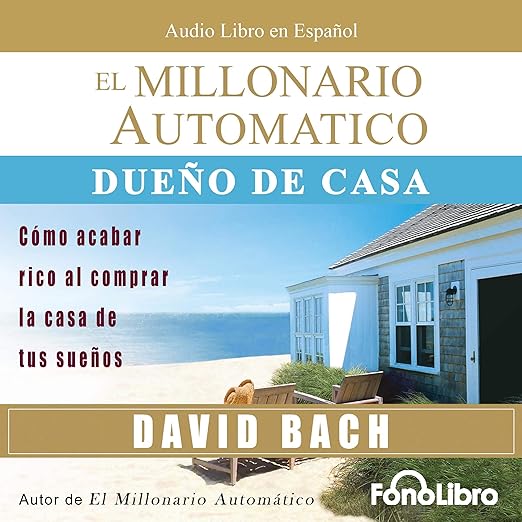
- Read by: Jose Duarte narrates in Spanish throughout. This is a Spanish-language production of David Bach's real estate wealth-building guide.
- At its heart: homeownership as wealth-building, automated savings, real estate investment fundamentals
- Vibe: Optimistic and motivational, with a sales-forward energy characteristic of the personal finance genre
- Short version: A compact Spanish-language introduction to Bach's homeownership wealth framework, useful for Spanish-speaking listeners new to real estate investing, though more experienced readers will find the advice familiar.
Before anything else: this is a Spanish-language audiobook. The full title on the FonoLibro release is El Millonario Automatico: Dueno de Casa, and narrator Jose Duarte performs the entire production in Spanish. If you are searching for David Bach's English-language Automatic Millionaire content, this is not that edition. For Spanish-speaking listeners seeking accessible personal finance guidance on homeownership and real estate wealth-building, this is squarely in that lane.
David Bach has built a substantial career around one central idea: that financial success comes from automating the right behaviors rather than relying on willpower and discipline. The broader Automatic Millionaire franchise applies that philosophy to savings and retirement; this particular installment applies it to real estate, specifically to the question of how to move from renter to owner and then use property to build long-term wealth. The framework is simple, optimistic, and deliberately accessible to listeners who may have assumed homeownership was out of reach.
The Verdict, Briefly
Bach's argument rests on several premises he positions as counterintuitive: you do not need a large down payment, you do not need perfect credit, and you should consider buying even if you carry credit card debt. He argues that owning property is so fundamentally superior to renting as a wealth-building mechanism that the conventional cautions around credit scores and down payments are overstated. He also addresses rental property ownership as a logical next step, arguing that acquiring a second property while still paying off the first is more achievable than most people assume.
At 2 hours and 43 minutes, this is a brief listen, closer to an extended introductory talk than a comprehensive investment manual. That brevity is a feature for listeners who find personal finance books bloated with repetition, but it does mean the advice stays at a level of generality that some will find unsatisfying. One Spanish-language reviewer offered a nuanced critique, noting that Bach's framework does not account for the most practical entry points for small investors, such as negotiating pre-foreclosure properties at below-market prices. That critique points at something real: this is a motivational framework for the general reader, not a tactical guide for investors who already have market knowledge.
The value of this audiobook is primarily in its accessibility and its framing. For a Spanish-speaking listener who has internalized the idea that homeownership is financially out of reach, Bach's confident dismantling of those assumptions has real utility. The automated savings philosophy, setting up systems that move money toward your goals without requiring ongoing conscious effort, is one of the more defensible ideas in popular personal finance, and it translates well to real estate in terms of automatic mortgage payments building equity over time.
Jose Duarte's narration is clean and professional, with the kind of warm authority that suits motivational financial content. The production quality from FonoLibro is consistent. For a 2008 release, the audio holds up well. Where the content occasionally strains is in the market-agnostic framing: Bach's assertion that you can buy in any market condition, whether rising or falling, requires a confidence in real estate as a long-term vehicle that the 2008 crisis complicated in real ways. This audiobook predates that crisis, and listeners aware of that context should factor it in.
Things to Know Before Starting The Automatic Millionaire
The optimism that makes this book accessible is also its main analytical weakness. Bach's examples tend toward the success story, the couple who bought modestly, paid down automatically, and built wealth over decades. The structural risks of real estate ownership, including illiquidity, maintenance costs, market downturns, and leverage, are acknowledged but not dwelt on. This is intentional: Bach is writing for the fence-sitter who needs encouragement, not for the investor who needs to stress-test a thesis. Knowing that going in helps calibrate what you take from the book.
Spanish-language reviews are sparse, but the handful available reflect a range: strong appreciation from first-time buyers who found the framework motivating, and mild frustration from listeners who found the practical depth insufficient for their more advanced needs.
Who Will Get the Most From It
This audiobook is for Spanish-speaking listeners who are considering homeownership for the first time and want an encouraging, jargon-light introduction to the financial logic behind it. It will also appeal to listeners who appreciate Bach's broader philosophy of automating financial decisions. It is not for experienced real estate investors looking for tactical depth, nor for listeners who want a critical examination of when homeownership does and does not make financial sense. Come to it as an introduction, not a complete education.