Quick Take
- Narration: Jim Denison reads the Searses’ warm, conversational prose clearly and accessibly, though a text this intimate might ideally have been narrated by one of its authors.
- Themes: Parent-infant attachment, breastfeeding and babywearing, early responsiveness and later independence
- Mood: Warm and affirming, written for parents who feel drawn to responsive caregiving and want both the language and the research to support it
- Verdict: The foundational text of the attachment parenting movement, still one of the most coherent single-volume introductions to the seven Baby Bs, best for new parents or those early in their parenting journey.
I remember a friend calling me about six weeks into her first baby’s life, at about ten in the evening. She had been told by one group of people that she was spoiling her daughter by picking her up every time she cried, and by another group that she was depriving her of independence by not crying it out. She was trying to reconcile two incompatible parenting philosophies using only sleep-deprived logic. I told her to listen to the Sears book. It did not resolve every question, no book does, but it gave her a framework that matched her instincts and the neuroscience behind it.
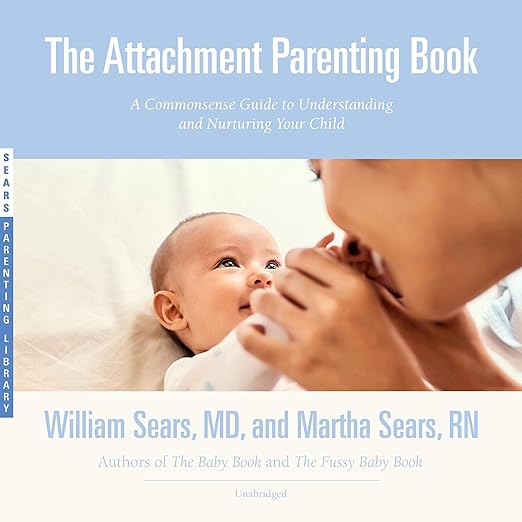
The Attachment Parenting Book is part of the Sears Parenting Library, and it occupies a specific position in that catalog: it is the synthesis volume, the place where William and Martha Sears articulate the principles that run through all their other work. The seven Baby Bs, covering Bonding, Breastfeeding, Babywearing, Belief in the language value of baby’s cry, Bedding close to baby, Balance, and Beware of baby trainers, are not a rigid checklist but a conceptual framework for thinking about the parent-infant relationship during the critical attachment window.
The Neurological Case for Responsiveness
Reviewer Clara Ruth, who studies the neuroscience of early development, describes the book as clearly conveying what is most critical in enabling babies and toddlers to thrive through optimal attachment. That is a meaningful endorsement from someone with scientific background, and it reflects the book’s approach: William Sears draws on attachment theory and developmental neuroscience to explain why early responsiveness is not permissiveness but biological appropriateness. The infant nervous system expects proximity, touch, and contingent response. When those expectations are met, the attachment system functions as it evolved to function. When they are not, the consequences ripple forward.
This is not a polemical position in the way attachment parenting debates are sometimes framed online. The Searses are not arguing that every parent must follow every Baby B or that other approaches are morally deficient. They are making a case, grounded in research and clinical experience, that attachment behaviors have biological foundations and that honoring them during the early window produces measurable developmental benefits.
The Questions Parents Actually Have
One of the book’s structural strengths is that it addresses the questions that actually keep new parents up at night, rather than the questions that academics find interesting. Might co-sleeping benefit both parent and child? How old is too old for breastfeeding? What is the father’s role, not a secondary one but a genuine and defining one, in building attachment? How does early responsiveness eventually produce the independence parents hope for rather than undermining it?
Reviewer Jonny K describes the book making him feel less alone and providing guidance for how he wanted to be a great dad. That emotional dimension is real. Attachment parenting literature sometimes gets framed as maternal-only content, and the Searses deliberately resist that framing. William Sears writes about his own experience as a father with a specificity that makes the book feel relevant to all caregivers.
Jim Denison’s Narration and the Book’s Intimacy
Jim Denison handles the material professionally, and at ten hours the book moves through its seven principles with enough depth to be genuinely useful rather than just introductory. The Searses write with a warmth and conversational ease that makes for pleasant listening. My only mild reservation is that a book this personal, one that speaks so directly to the intimate experience of new parenthood, might carry additional weight if narrated by one of the authors. Denison does not detract from the content, but you occasionally sense a slight tonal distance between the authorial voice and its delivery.
Who Should Prioritize This
Expectant parents and parents in the early months who want a philosophically coherent alternative to the sleep-training and scheduled-feeding paradigm will find this the clearest single articulation of attachment parenting available. Reviewer PN, who has used the Sears approach across three daughters, describes the results as something that cannot be measured until much later in life, which is the honest acknowledgment that parenting philosophy debates rarely resolve within a convenient timeframe.
Parents who want a behavioral techniques manual with specific protocols will find this conceptually richer than tactically specific. For the practical follow-through on sleeping, feeding, and transition questions, the other volumes in the Sears Parenting Library fill that gap. But as the framework volume, the place to understand what attachment parenting is and why it is grounded in developmental science, this remains the essential starting point.
Frequently Asked Questions
Does the book advocate co-sleeping even in light of safe sleep guidelines from pediatric organizations?
Sears addresses co-sleeping in depth and provides specific guidance on doing it as safely as possible, including when it is not appropriate. His position is that the risks of co-sleeping are often misrepresented and that with proper precautions it can be safe and beneficial. Parents should be aware that this position is not universally shared by pediatric organizations and should evaluate the guidance in the context of current AAP safe sleep recommendations.
How does the book address fathers specifically, and is it equally relevant for non-mother primary caregivers?
William Sears writes about fatherhood as a central rather than supporting role throughout the book, and there is dedicated content on a father’s specific contributions to the attachment relationship. The framework is applicable to any primary caregiver, and the framing consistently addresses both parents rather than defaulting to maternal assumptions.
This book is part of the Sears Parenting Library, can it stand alone, or is it better read as part of the broader series?
It stands alone as a conceptual overview of attachment parenting philosophy and practice. The seven Baby Bs provide a complete enough framework for new parents to begin applying the approach. The other volumes in the series covering specific topics like sleep, feeding, and the fussy baby provide more detailed tactical guidance, but this book does not require them to be useful on its own.
The attachment parenting philosophy has attracted criticism from some pediatricians and parenting researchers, does the book engage with those critiques?
Sears acknowledges the mainstream debate and specifically addresses the criticism that responsive parenting produces dependent rather than independent children. He argues from developmental research that early secure attachment is the foundation for eventual autonomy rather than its enemy. The book does not engage exhaustively with critics, but it does not pretend controversy does not exist either.