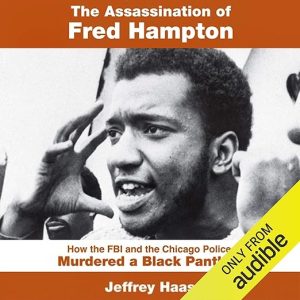
Can a legal case stretch fourteen years and still feel urgent? Listening to this audiobook version of Jeffrey Haas's account of Fred Hampton's murder, I found myself asking that question around hour three, somewhere between the first courtroom setback and the FBI's stonewalling tactics that would have broken lesser attorneys. The short answer: yes, absolutely. The Assassination of Fred Hampton is one of those rare works of true crime that refuses to let outrage curdle into despair. Instead, it channels fury into something rarer and more demanding: sustained moral clarity across years of institutional resistance.
George Newbern's narration anchors the audiobook from its first minutes. His measured, authoritative delivery suits this material without flattening it. Haas was one of the young lawyers from the People's Law Office who took on the case, and Newbern captures the voice of a man who lived these events without ever slipping into melodrama. He lets the facts carry the weight, and the facts are damning enough.
Jeffrey Haas structures this book around two parallel stories: Fred Hampton as the man he actually was, and the fourteen-year legal campaign to hold his killers accountable. The first strand is the more revelatory. Hampton, chairman of the Illinois Black Panther Party, was shot dead in his bed by Chicago police in December 1969, in a raid organized in cooperation with the FBI's COINTELPRO program. He was twenty-one years old. The popular image of Black Panther leadership at the time was shaped by government propaganda that painted Hampton as a threat. Haas strips that framing away and replaces it with evidence: Hampton was running free breakfast programs for children, organizing between rival gangs, and building cross-racial coalitions that genuinely frightened the Chicago political establishment. The man who emerges from this account is a dynamic community organizer who, had he lived, might have fundamentally altered the trajectory of Chicago politics.
The second strand is procedural in the best sense. Haas reconstructs the 18-month civil trial in impressive detail, tracing how the People's Law Office went up against the full resources of the federal government and the City of Chicago. What makes this account compelling is not just the eventual outcome but the texture of the resistance: evidence withheld, witnesses intimidated, FBI documents mysteriously incomplete. Haas never loses the thread of what the lawyers were actually fighting for, and the audiobook captures that commitment without turning it into propaganda.
What Makes The Assassination of Fred Hampton Worth Hearing
Newbern's narration deserves extended attention. He gives individual voice to Haas's many participants without resorting to exaggerated characterizations. When the book quotes testimony from the trial or recounts dialogue from Hampton's speeches, Newbern shifts register subtly enough that the transitions feel natural rather than theatrical. For a book this dense with legal procedural detail, that consistency of tone is essential. A less disciplined narrator would have let the courtroom sequences drag. Newbern keeps them alive.
The book also functions as a portrait of a certain kind of legal commitment. Haas and his colleagues at the People's Law Office were not simply representing a cause; they were shaped by it. Watching how the Hampton case transformed their understanding of American justice is one of the more quietly affecting threads running through the narrative. One reviewer described it as 'written as one part biography and two parts murder mystery,' and that framing is apt. Haas has a storyteller's instinct for pacing revelations, and Newbern serves that instinct well.
Things to Know Before Starting The Assassination of Fred Hampton
Listeners new to the Hampton case should be prepared for a significant amount of legal and procedural detail. This is not a weakness of the book; it is intrinsic to the argument Haas is making, which is that the cover-up was as deliberate as the killing. But the 18-month trial reconstruction requires attention. If you find your focus slipping during courtroom sequences, it is worth pausing and returning rather than skipping ahead. The full weight of the verdict, when it comes, depends on having followed the procedural obstacles that preceded it.
The audiobook also raises hard questions about what justice actually means in cases like this. The settlement reached, while significant, came more than a decade after Hampton's death. Haas does not pretend otherwise. His honesty about what the legal system can and cannot do is part of what gives the book its moral credibility. He is not writing a triumphalist narrative. He is writing an honest one, which is considerably harder and more valuable. Some listeners expecting the rapid pace of commercial true crime may need to adjust expectations. This is a work of investigative history that happens to be written with the urgency of a legal brief. The pacing is deliberate and purposeful, and the rewards scale accordingly with the attention brought to it.
Who It's For
This audiobook will hold the most interest for listeners drawn to civil rights history, political true crime, and accounts of legal activism. It rewards those willing to sit with procedural complexity over fourteen hours. Listeners who want a fast-paced thriller or a straightforward biography of Hampton will find this more demanding than those formats suggest. For anyone serious about understanding how the American government treated Black political leadership in the late 1960s, this account is as clear-eyed and rigorously documented as anything available on the subject. George Newbern's narration makes it accessible without making it easy, which is exactly the tone the material demands.