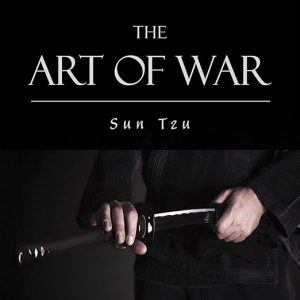
Eighty minutes is not much time for two thousand five hundred years of military philosophy, and this audiobook edition of The Art of War does not pretend otherwise. Composed by Sun Tzu around the fifth century BC, the text is famously compressed to begin with, aphoristic, dense, built for repetition and memorization rather than narrative expansion, so a short runtime here reflects the nature of the source material rather than an abridgment cutting corners. Narrator Jeffrey Ito reads the Lionel Giles translation, the same public-domain English version most reviewers specifically credit for the text's clarity.
Giles, a British sinologist, published his translation in 1910, and its public-domain status is exactly why so many budget print, ebook, and audio editions of The Art of War use his wording specifically rather than a newer, copyrighted translation. Reviewer Kent R. Spillner calls it 'widely considered one of the best' available in English, even while noting it isn't necessarily his own personal favorite translation.
Sam Scott Calls It Required Reading for All Adults
The text moves through planning, understanding an opponent, exploiting weakness, adaptability, and leadership in short, declarative bursts, covering tactics, intelligence gathering, and strategic thinking without ever slowing down to explain itself at length. That compression is the entire point, and it's exactly what has let the book migrate so completely out of military strategy and into business, politics, and general leadership thinking over the past century.
Reviewer Nitram G. describes the text as 'very filled with wisdom and Great passion behind it,' adding that this particular edition is easy to follow for young readers or older readers, a fair assessment of how accessible Giles' century-old translation still reads today. Sam Scott goes further, calling it required reading for 'ALL adults,' particularly anyone interested in tactical thinking, which tracks with how thoroughly the text has been absorbed into general strategic culture well outside any military context.
Framed in Universal Terms, Never Tied to One Battle
Nothing about the structure asks a listener to already know ancient Chinese history to follow along. Sun Tzu's arguments are framed in universal terms, an enemy, a terrain, a resource constraint, a moment of decision, rather than tied to specific battles or campaigns, which is a large part of why a business reader in one century and a general in another can both extract the same practical value from the identical lines.
The text's afterlife outside military contexts is well documented: business schools have assigned The Art of War alongside modern strategy texts for decades, sports coaches have cited it in press conferences, and negotiation trainers regularly borrow its language around knowing when to press an advantage and when to withdraw. That crossover didn't happen by accident. Sun Tzu's central insight, that most conflicts are won or lost before the first confrontation even begins, through preparation, positioning, and information, translates cleanly to boardrooms and courtrooms because it was never really only about literal warfare in the first place, even in its original context.
Ito Reads Faithfully Instead of Performing Gravitas
Jeffrey Ito's narration is a genuine strength, and it's not his first time in exactly this register: his reading here shares the calm, unhurried precision he's brought to other short, aphoristic classical texts, treating each line as a complete thought rather than rushing toward the next one. That pacing matters enormously for a text this dense; twenty-five centuries of compressed strategic wisdom needs room to breathe, or it collapses into an undifferentiated stream of maxims.
Ito doesn't over-perform the gravitas of ancient text either, which is a real risk with material this frequently quoted and this often treated as sacred. He reads faithfully, letting Sun Tzu's actual arguments, about deception, terrain, timing, and the cost of prolonged conflict, land on their own logic rather than dressing them up with unnecessary dramatic weight.
The audiobook's brevity is arguably a feature for this specific text in a way it wouldn't be for most nonfiction. The Art of War has survived twenty-five centuries specifically because it's built for rereading and repetition rather than a single linear pass, and an eighty-minute runtime makes that kind of repeat listening, returning to a specific chapter before a negotiation or a genuinely difficult conflict, practical in a way a fifteen-hour audiobook never could be.
Short classical texts like this one occupy a specific, useful niche in audio that longer books can't fill: a genuine primary source, not a summary or a modern interpretation, delivered at the length the original actually runs rather than padded out with added commentary just to justify a longer runtime. That's a meaningfully different use case than most nonfiction audiobooks serve, closer to keeping a reference text on a shelf than working through a single linear argument once and moving on, and The Art of War's eighty minutes make that reference-text use case genuinely practical.
Spillner Praises Clarity but Flags Other Translations
Translation choice matters more for this text than for almost any other classical work in audio, and listeners should know going in that Giles' 1910 English is not the only respected option. Kent R. Spillner's review makes this point directly, praising the clarity of this version while noting other translations exist that some readers prefer, and a listener with a strong opinion on translation fidelity should confirm this is the specific version they want before buying.
At just eighty minutes, this cannot function as a comprehensive military history course or a scholarly annotated edition; it is the base text alone, without the historical context, commentary, or case studies that longer academic editions typically add. Listeners wanting that surrounding scholarship should treat this as a starting point, the text itself in a clean, well-narrated form, rather than a complete education in either ancient Chinese warfare or modern strategic application.
Eighty Minutes Delivers the Text and Nothing More
Business leaders, students of strategy, and anyone curious about the single most-cited text in popular leadership thinking will get exactly what they're looking for here: the real source material, cleanly read, in less time than a single commute round trip.
Teachers introducing students to primary-source classical texts for the first time will also find this a clean, accessible entry point. It's also a genuinely good re-listen candidate. Because the text is organized in short, self-contained chapters of maxims rather than a single sustained argument, it's easy to return to a specific section, on deception, on terrain, on timing, without needing to replay the whole thing.
Runtime alone tells you what this can't be: readers wanting deep historical context about Sun Tzu's own era, extended modern case studies applying the text to business or politics, or a scholarly critical apparatus should look toward an annotated edition instead, since this audiobook delivers the concentrated original text and nothing more, which is exactly what its eighty minutes promise and exactly what it delivers.
Common Questions
Why is The Art of War audiobook only eighty minutes long?
Because the source text itself is short and aphoristic by design, built for memorization and repetition rather than narrative expansion. The runtime reflects the original, not an abridgment.
Does this audiobook include historical context or commentary on Sun Tzu's era?
No, this edition delivers the base text alone. Listeners wanting deeper historical context or modern case studies should look toward an annotated edition instead.