Key Details
- Performance: Cady North self-narrating brings an intimacy and personal authority to the material that a third-party narrator could not replicate. The journaling prompts feel like a direct conversation.
- What it covers: Planned work breaks as career strategy, financial planning for sabbaticals, identity beyond job title
- Feel: Warm and encouraging, with practical scaffolding beneath the inspiration
- Our call: A rare guide that addresses the fears stopping most people from taking a sabbatical, with real financial and logistical substance.
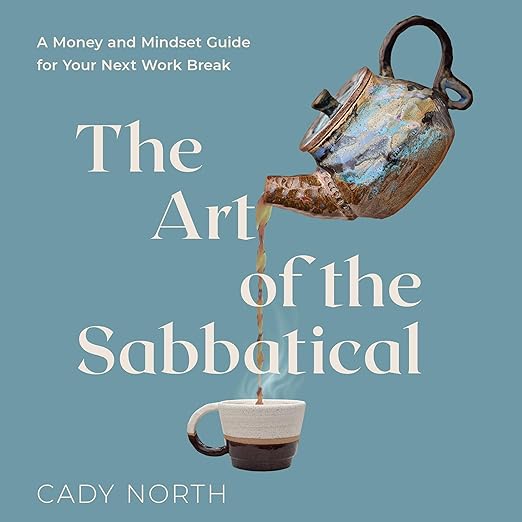
Sabbaticals occupy a strange space in career advice: widely recommended in theory, seldom addressed in practice. Cady North's The Art of the Sabbatical, which she also narrates herself, exists to close that gap. It is not a manifesto against hustle culture, though it positions itself clearly as a response to it. At four hours and forty-nine minutes, this is a structured guide to designing, financing, executing, and exiting a sabbatical in a way that actually serves both your life and your career. The self-narration makes a meaningful difference. This audiobook sounds like someone who has done it, not someone describing it from a distance.
The book draws on case studies, personal experience, and interviews with what reviewers have described as "titans of industry speaking honestly of their burnout stories." That framing matters. This is not a book about quitting your career. It is a book about managing the intervals between chapters of a working life with the same intentionality you would bring to the chapters themselves, and North argues that those intervals are not pauses in your career but part of its architecture.
Four Questions That Actually Stop People
North's structural choice is to organize the audiobook around the questions that actually stop people from taking sabbaticals. Can I afford this? What will my family think? How do I explain this to future employers? What do I do with myself when there is no job title defining me? These are not abstract concerns. They are the friction points where good intentions stall, and North addresses each one with specificity rather than reassurance. The book's most useful work is not inspirational. It is diagnostic, naming the specific fears and then providing concrete responses to each.
The financial planning sections are genuinely substantive. North does not assume her listeners have trust funds or severance packages. She works through how sabbaticals can be funded through savings, side income, or negotiated terms with current employers. The case studies function as proof-of-concept rather than inspiration. One reviewer described these vignettes as so resonant they found themselves returning to specific passages, which in audio terms means replaying particular sections to absorb them fully. That is the right engagement for this kind of material.
The inclusion of journal prompts throughout the audiobook is a notable structural choice. In print, prompts can be skipped. In audio, North reads them in a way that actually invites the listener to pause and engage. Her self-narration carries the tone of someone who has done the work herself and wants the listener to do the same rather than simply listen through as passive audience.
For People Who Need to Solve It First
North's self-narration is the primary argument for audio over print. The material is intimate, built on personal disclosure and the assumption that the listener is genuinely considering a sabbatical rather than just reading about them abstractly. Hearing North walk through the fears and logistics in her own voice creates a different relationship with the content than a third-party narrator would. The emotional credibility of having done this herself comes through in the delivery, not just the text, and that credibility is what distinguishes The Art of the Sabbatical from the many career books that tell you to take breaks without telling you how.
The review describing this as "an antidote to hustle culture" is accurate but slightly undersells what the book accomplishes. Hustle culture critiques are common in career writing. What is less common is a guide that accepts that most people cannot simply walk away from financial obligations and institutional expectations, and then tells them how to plan accordingly. The sabbatical North describes is not for people who have already solved the financial problem. It is for people who need to solve it first, and the book gives them the tools to do that.
At under five hours, the audiobook fits naturally into a focused single-day session or a few shorter sessions across a week. The journal prompts work best when the listener has time to sit with them, which suggests a slightly slower pace than a purely narrative listen would require.
26 Reviewers, a Practitioner Not a Researcher
The book is oriented toward professionals with established careers who are considering a break of months rather than weeks. Listeners in early career stages, in gig or freelance work, or in fields where sabbaticals are genuinely uncommon may find some of the structural advice less directly applicable. The case studies draw heavily from corporate and entrepreneurial contexts, and the returning-to-the-workforce section assumes a degree of institutional leverage that not all workers have.
The 4.4 rating from 26 reviewers signals strong satisfaction from a focused audience. This is a niche title addressing a genuinely underserved topic, and its reach reflects that niche. The quality is high within its scope, but listeners looking for academic or data-heavy career research will find this more experiential than empirical. It is a practical guide informed by real cases, not a research synthesis, and the tone of the self-narration reflects that. North is a practitioner sharing what she learned, not a researcher presenting findings.
Better as Active Listening Than as Background Audio
This audiobook is most useful for mid-career professionals who have been considering an extended work break and have never gotten past the fear stage. It is particularly well suited to people who have not yet articulated what they are afraid of, because North's structure walks through each fear and offers a concrete response. Listeners who are already committed to taking a sabbatical and need execution detail will also find value here. The self-narration and journal prompts make this better as an active listening experience than as background audio. Set aside focused time, have a notebook nearby, and engage with the prompts rather than pressing through continuously. That is the mode in which The Art of the Sabbatical works best.
Before You Listen
Does Cady North narrate The Art of the Sabbatical herself, and how does that affect the audiobook?
Yes, North narrates her own book. The self-narration significantly changes the tone of the content. The journal prompts in particular feel like direct conversation rather than instructions, and North's personal authority on sabbatical planning comes through in the delivery in a way that a third-party narrator could not supply.
Does this audiobook address the financial side of taking a sabbatical in practical terms?
Yes, in concrete terms. North covers funding strategies including savings planning, negotiated employer arrangements, and side income. She does not assume the listener has financial resources beyond a working salary and structures the financial guidance accordingly.
Is this audiobook appropriate for freelancers and self-employed listeners, or is it mainly aimed at salaried employees?
The case studies and structural advice lean toward corporate and entrepreneurial contexts. Self-employed listeners will find some sections less directly applicable, particularly the parts about negotiating with employers or explaining sabbaticals to future hiring managers. The financial planning and identity sections, however, apply broadly regardless of employment structure.