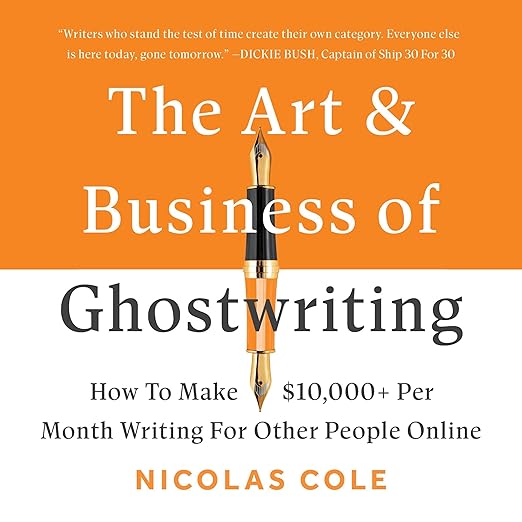
Nicolas Cole narrates his own The Art & Business of Ghostwriting in this audiobook, the second volume in the Art & Business of Writing series, and the self-narration matters more than it usually does. Cole's claim to authority rests on specific numbers: 300 industry leaders as clients over six years, more than 3,000 ghostwritten articles published under other people's names, an agency at its peak employing over 20 writers and editors and generating several million dollars in annual revenue. These figures don't come from a consultant analyzing other people's careers. They come from Cole's direct professional history, and hearing him deliver the specifics of how he built that career in his own voice carries a credibility that a third-party narrator would necessarily dilute. For a book whose central argument is about positioning yourself as an authority, the self-narration is part of the demonstration.
Calling Yourself a Freelance Writer Is the Error
The book's core argument is an assault on the category of freelance writing. Cole's position is explicit and stated early: calling yourself a freelance writer is a positioning error that guarantees lower fees, lower-quality clients, and constant price pressure from buyers who perceive your service as a commodity. Calling yourself a ghostwriter, by contrast, positions you as a premium service provider whose value is invisibility and voice, not just wordcount. This reframe is the intellectual heart of the book, and Cole builds the rest of the content around it: how to identify your niche as a ghostwriter, how to internalize a client's voice across five different archetypes he defines, and how to price your work in a way that reflects strategic value rather than time spent.
The chapter on client voice archetypes is the most practically useful material in the book. Cole defines five distinct types of clients with different communication styles, different fears about their public voice, and different relationships to the content being ghostwritten. Having a framework for this makes the initial client conversations significantly more structured, because you know what questions to ask and what concerns to anticipate before you've even started writing. The pricing chapter is equally direct: Cole doesn't hedge about the psychological barriers to charging more, he names the specific fears and explains why those fears are counterproductive to building the kind of practice the book describes. Reviewer Aaron Ameen, who had followed Cole's work for three years, described this book as hitting "exactly in the sweet spot" as "a true top-to-bottom guide."
Fluent in Impersonation as a Professional Skill
Reviewer Jose Dominguez described the book as "the answers and guidance you need" for anyone who wants to write for a living, and the assessment lines up with the structure Cole actually delivers: this is not a motivational book with a few practical appendices. Six hours and twenty-one minutes covers positioning, niche selection, client acquisition, voice internalization, pricing strategy, and scaling from solo freelance to agency operation. That is a tight package for that amount of ground, which means the pacing is efficient rather than padded, moving from concept to example to application without lingering on any single idea longer than it needs.
The ghostwriting focus also makes this book more specific than most writing-career guides available in audio. Cole is not advising writers to develop their personal voice or find their authentic story. He is advising writers to subordinate their voice entirely to someone else's, become fluent in impersonation as a professional skill, and build a sustainable business around that service. That specificity is what makes the book valuable to its intended audience, who already know they want to write for other people and need tactical guidance on how to structure that into a career rather than a side income.
Cole's Digital-Media Roots Shape Every Archetype
Cole's background is in digital media, opinion articles, and LinkedIn content, which shapes the examples and client types he describes throughout the book. His five voice archetypes are drawn from experience with executives and thought leaders producing content for online platforms, not from book publishing, speechwriting, or academic ghostwriting. The frameworks are broadly applicable across those other contexts, but listeners whose ghostwriting interests lie outside the digital content world will need to do some translation work when applying the specific tactics he describes.
The section on finding clients emphasizes content marketing and online visibility as the primary client acquisition strategy, which reflects how Cole built his own business. Ghostwriters who prefer to build through referral networks or traditional publishing relationships may find this approach less directly applicable, though the underlying logic about positioning and differentiation holds regardless of the acquisition channel. The book is also the second in a series, and while it reads completely as a standalone, listeners who have completed Cole's first volume in the Art & Business of Writing series will find the arguments here extend naturally from the positioning concepts introduced there.
Skip It If Craft and Prose Are Your Goal
This audiobook is targeted precisely: it is for writers who already understand they want to write for other people and need a systematic framework for turning that into a business. Reviewer Heidi Wolff noted that if you are "looking to start a ghostwriting business," the book lays out "the way he built his ghostwriting business, what worked, what didn't work," with specific guidance on client approach and working methods. Skip it if you want craft advice about writing quality, narrative structure, or prose development. Cole's concern is positioning, pricing, and client management, not the sentence itself. That narrowness is the book's value for its intended reader and its limitation for everyone else.
In Brief
- Performance: Nicolas Cole narrating his own work is an advantage here: he delivers client archetypes, pricing psychology, and agency-building advice with the directness of someone who has done the thing, not read about it.
- What it covers: Ghostwriting as a premium service profession, pricing psychology, building a writing business from scratch
- Feel: Practical, entrepreneurially charged, direct
- Our call: Cole packs a genuinely complete roadmap for building a ghostwriting career into six hours, and the self-narration ensures the voice matches the authority the content requires.
Common Questions
Does this audiobook assume you've read the first volume in the Art & Business of Writing series?
No, it works as a standalone. Cole introduces the core ghostwriting versus freelancing distinction from scratch. Listeners who have read his first volume will recognize some foundational positioning concepts, but nothing in this book requires prior familiarity with the series.
How current is the advice in this audiobook for someone looking to start ghostwriting today?
Cole's frameworks around client voice archetypes and pricing psychology are durable. Some of the platform-specific advice about LinkedIn and Quora will evolve as those platforms change their algorithms and user behavior, but the positioning strategy at the core of the book has not been undermined by shifts in the content industry since publication.