Quick Take
- Narration: Tanner Guzy reading his own work is the right call, his YouTube-trained directness translates to audio with minimal friction, and his conviction in the material is audible.
- Themes: Masculine identity through clothing, appearance as communication, style as self-expression
- Mood: Direct and philosophical, pitched somewhere between manifesto and manual
- Verdict: A short but substantive argument for why men should think carefully about how they dress, Guzy’s principles-first approach distinguishes this from most men’s style content.
Tanner Guzy is a YouTube personality first and a book author second, and that origin shapes The Appearance of Power in ways that are mostly productive. His videos have spent years making a specific argument: that men’s clothing is not trivial, not narcissistic, and not reducible to following fashion rules. It is a form of communication about identity, values, and social positioning, and most men navigate it unconsciously and poorly. The book is, as one reviewer accurately describes it, his YouTube ideas translated into literary form, more developed, more structured, and substantially more philosophical than a ten-minute video allows, but recognizably continuous with the project he has been building online.
At just over three hours, The Appearance of Power does not overstay its welcome, but it also does not have space to be exhaustive. Guzy has chosen to prioritize the principles over the specifics. This is a book about how to think about masculine appearance, not a capsule wardrobe guide or a seasonal trends breakdown. That distinction is the entire point of the thing, and it is worth taking seriously. Most men’s style content is either prescriptive (wear this, not that) or trend-focused (here is what is working right now). Guzy is doing something different: he is arguing from first principles about why appearance matters and what it does, and only then building out from that foundation toward practical implications.
Appearance as Communication, Not Performance
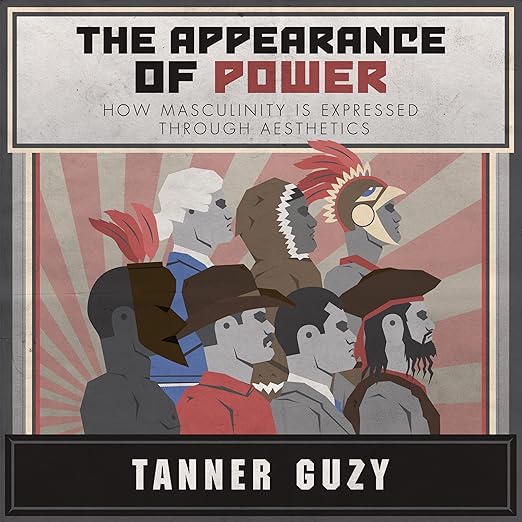
The central argument of the book is that every man, whether he knows it or not, is already communicating something through his clothing and physical presentation. The shaman, the Wall Street banker, the Pope, the gutter punk, Guzy’s point is that none of them are exempt from this communication, and none of them fail to be read by others according to what they wear. The question is whether you are communicating intentionally or by default, and whether what you are communicating aligns with who you actually are and want to be perceived as.
This framework is philosophically interesting in a way that most style content is not, and it positions the book closer to social psychology than to fashion journalism. Guzy draws on the idea of masculine archetypes, the concept that different men communicate different modes of strength, authority, or social positioning through their choices, and argues that understanding which archetype you are operating within, and whether it is authentic to your actual identity, is the prerequisite for dressing well. One reviewer describes this as thought provoking after years of receiving style advice they found flaccid, always directed toward what is safe or inoffensive rather than what is genuinely expressive. That frustration, and Guzy’s answer to it, is the engine of the book.
Self-Narration and the YouTube-to-Audio Translation
Guzy narrating his own work is the correct choice, and he does it well. His delivery has the slightly compressed, confident quality of someone used to recording themselves, less the elongated, performed cadence of professional audiobook narration, more the direct address of someone making a case to you personally. That quality suits the material. This is persuasion writing, and Guzy’s conviction in his argument is audible in ways that a neutral professional narrator might have smoothed over. The bite-sized format of his videos means he is practiced at conveying a complete idea in a short time, and that skill transfers to the audiobook format better than you might expect.
At three hours and twenty-five minutes, the runtime is honest about what this book is. It is not a comprehensive treatment of men’s style theory. It is a focused, principled argument that Guzy has refined through years of responding to objections from YouTube commenters and podcast listeners. The result has a clarity and internal consistency that more sprawling books on the subject lack.
The Limitation Worth Naming
The framework Guzy presents is genuinely useful but sits within a specific ideological space. His language around masculinity, good masculine men, the vocabulary of masculine archetypes, is not neutral, and some listeners will find it either clarifying or off-putting depending on their existing orientation toward discussions of gender and identity. This is not a political book and Guzy is not a polemicist, but the framing has a point of view, and it is worth knowing that before you start. Listeners who are interested in the communication and social psychology aspects of appearance without the masculine-archetype framework may find the argument useful but want to translate some of it mentally into more gender-neutral terms.
Who should listen: Men who want a principled framework for thinking about how they dress rather than rules to follow; existing Guzy YouTube followers who want the longer, more developed version of his ideas; listeners frustrated by style advice that always defaults to the generic safe choice. Who should skip: Anyone looking for specific wardrobe recommendations, outfit formulas, or seasonal style guidance; listeners who are uncomfortable with explicitly masculine-archetype framing around identity.
Frequently Asked Questions
Is The Appearance of Power essentially the same content as Tanner Guzy’s YouTube videos, or does the book add substantial new material?
The book extends and deepens the YouTube content rather than simply transcribing it. The core framework is consistent with his online work, but the book’s longer format allows him to develop the philosophical underpinnings more fully and address objections more systematically.
Does the book give specific style advice, like what clothes to buy or how to build a wardrobe?
Not primarily. Guzy explicitly prioritizes principles over prescriptions. The goal is to give you a framework for making your own decisions rather than a list of rules to follow. Listeners wanting specific wardrobe guidance should supplement with other resources.
Is the self-narration by Guzy an asset or a liability for the audio format?
An asset, for this particular book. His conviction in the argument is audible, and his YouTube background means he is practiced at direct-to-camera and by extension direct-to-listener communication. The delivery is slightly less polished than professional narration but more personally engaged.
How does The Appearance of Power compare to How to Be a Gentleman as a guide to masculine presentation?
They are doing different things. Bridges focuses on social etiquette and behavior; Guzy focuses on the semiotics of clothing and how physical appearance functions as communication. The two books complement each other rather than covering the same ground.