Quick Take
- Narration: Adi Jaffe narrates his own work, and for a book built around personal authority and lived experience, self-narration is the right call. His delivery is direct and confident without being preachy.
- Themes: Non-abstinence recovery pathways, shame as obstacle, individualized treatment frameworks
- Mood: Urgent and hopeful, with the compressed energy of a TEDx talk stretched into a short book
- Verdict: A genuinely useful challenge to abstinence-only thinking, though at under three hours it functions more as an extended argument than a complete program.
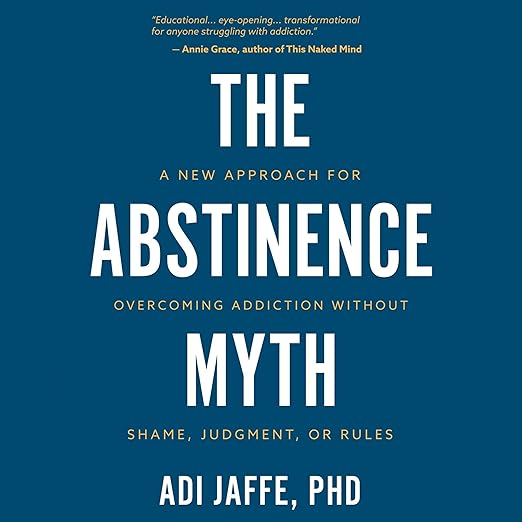
I came to The Abstinence Myth already skeptical of books that announce themselves as paradigm-shifting, and I want to be honest about that going in. What Adi Jaffe PhD actually delivers is something more modest and more useful than the title promises: a rigorous, accessible argument that abstinence-only recovery frameworks are not the only valid pathway, and that demanding them from everyone who struggles with substance use may in fact be getting in the way. That is a worthwhile argument. It is also, by now, not a new one, harm reduction has decades of research behind it. What distinguishes this audiobook is Jaffe’s particular synthesis of that research with his own story.
Jaffe was not just an addiction researcher who theorized from a distance. He overcame his own significant addiction and built the IGNTD recovery method partly from that experience. When he explains why shame functions as a barrier to change rather than a motivator, he is not summarizing someone else’s findings, he is describing something he lived through. That credibility matters, and it comes through clearly in the self-narration. At under three hours, the audiobook has the density and pace of a lecture from someone who genuinely believes what they’re saying and wants you to get there with them.
What the IGNTD Framework Actually Proposes
The book’s central contribution is the IGNTD recovery method, which Jaffe builds around three principles and nine customizable steps. The framework explicitly rejects the idea that abstinence is necessary for everyone at all times, instead arguing that recovery paths should be tailored to the specific psychological, biological, spiritual, and environmental factors that shaped a person’s relationship with substances. The four categories of mythology he identifies, spiritual, biological, psychological, and environmental assumptions, provide a useful diagnostic lens for understanding why a given person’s struggle takes the form it does.
Reviewer W. James Cleaver, writing from the perspective of someone with over a decade of sobriety, noted that when he first got sober it was either the 12 Step path or the expectation of failure. His point is not that 12 Step programs are wrong, but that the field has historically offered a binary where none should exist. Jaffe’s framework addresses this directly, and the argument is made clearly and without condescension toward programs that have genuinely helped millions of people.
The Scope Problem
At two hours and forty-one minutes, The Abstinence Myth is short enough that you could listen to it in a single afternoon. That brevity is both a strength and a genuine limitation. The three principles and nine steps of the IGNTD method are introduced but not developed in depth. The shame chapter, which reviewer becca described as life-changing, covers territory that deserves significantly more space than it receives. What you get is a compelling overview and a conceptual map, not a complete toolkit. Jaffe has additional resources through his program and website, and this book functions partly as an entry point to those.
That said, for listeners who have been in or adjacent to recovery communities and found that the dominant frameworks didn’t quite fit, this is a clarifying listen. The argument that there is more than one legitimate pathway out of addiction, and that demanding conformity to a single model may create the very shame that sustains addiction, is stated with enough specificity and personal authority to feel substantive rather than merely contrarian.
Who Will Get the Most Out of This
Listeners who have tried 12 Step programs and found them insufficient or incompatible with their circumstances will likely find this the most validating. Professionals working in addiction treatment who want a brief, accessible introduction to integral and non-abstinence frameworks will find it useful as a starting point. Listeners who need or want a complete, step-by-step program should know upfront that this is a framework introduction, not a guide.
The self-narration by Jaffe adds genuine value here, his voice carries the conviction of someone who is not performing expertise but has actually lived the subject. For a short, pointed argument about the limits of how we currently think about addiction recovery, it earns its place.
Frequently Asked Questions
Does The Abstinence Myth argue against Alcoholics Anonymous or 12 Step programs specifically?
No, Jaffe is careful not to dismiss 12 Step approaches. His argument is that abstinence-based models are not universally necessary and that demanding them from everyone can create shame that actually sustains addiction. He presents the IGNTD method as an additional pathway, not a replacement for programs that work for people.
At under three hours, is this audiobook long enough to actually deliver a complete recovery method?
Honestly, no. The IGNTD framework is introduced and outlined, but the nine steps and three principles are not developed in depth. This functions best as an extended argument and conceptual map that points you toward Jaffe’s broader program. Treat it as an introduction, not a standalone guide.
Is this appropriate for someone currently in early recovery, or is it better suited to people who have been in recovery for a while?
Reviewer becca described finding it during active crisis and crediting it with saving her life. However, the book is clear that it is not for people who may experience physical withdrawal, it addresses psychological and behavioral dimensions of addiction, not the medical management of withdrawal. Jaffe’s preface recommends consulting medical professionals for anyone with physical dependency.
Does Jaffe’s self-narration hold up over nearly three hours, or does it feel like a dry lecture?
It is more compressed and direct than warm, but Jaffe’s delivery carries authentic conviction. If you have heard his TEDx talk, the tone is similar, confident, evidence-grounded, and personal without being overly emotional. Listeners accustomed to performed audiobook narration may find it slightly flat, but those who value authority and directness will find it effective.