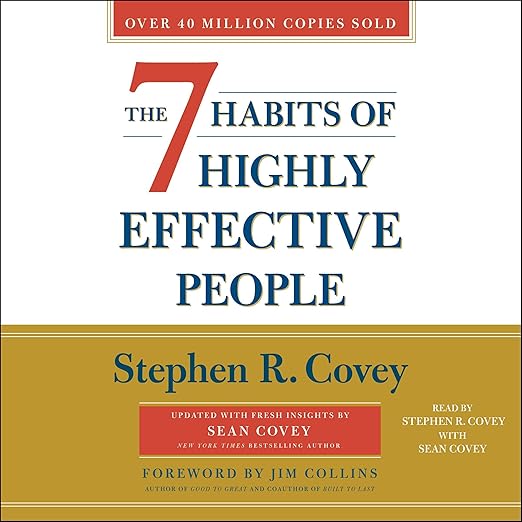
Stephen Covey reads his own book here, and that single production decision does more for the material than any framing device could. This audiobook runs fifteen hours and seven minutes across seven ideas, which is an extraordinary ratio by the standards of modern business writing, and the reason it works rather than sprawling is that Covey is not delivering seven tips. He is defending a whole theory of character, and the voice explaining it belongs to the person who spent decades building it.
Graduate Seminar and Fitness Challenge, Same Book
The seven habits themselves are stated plainly and the publisher lists them all: be proactive, begin with the end in mind, put first things first, think win win, seek first to understand then to be understood, synergise, and sharpen the saw. Written out like that they read as slogans, which is precisely the problem Covey spends the book solving. Each habit gets a full argumentative treatment, working from a principle down through the psychology to the practical consequence, and the length is a direct function of refusing to let any of them stay a slogan.
What distinguishes this from the shelf it sits on is the sequence. The first three habits concern private victory over yourself, the next three concern public victory with others, and the seventh is maintenance of the capacity that makes the other six possible. That architecture is the actual intellectual content, and it is why people who read this at twenty find it different at forty. Covey calls it a principle-centred approach to solving personal and professional problems, and the emphasis falls on principle rather than on technique.
The listener testimony reflects that seriousness. Alexander V Marriott encountered it academically: "I read this recently for a Personal Leadership graduate course in Management that I am taking", and describes "a wonderful book with lots of practical insights about the importance of principles and implementing them in one's life". Kiana J. came at it from the opposite direction, choosing it as the first read of a seventy-five-day discipline challenge, and reports that "It is definitely a game changer in terms of maintaining a strong mindset, not just for the challenge, but in multiple areas of my life." Graduate seminar and fitness challenge, same book.
Covey's Own Anecdote Carries the Argument
Self-narration by the author is the strongest reason to choose audio for this particular title. Covey's method depends on anecdote, and specifically on anecdotes drawn from his own family and consulting practice, where the emphasis he places on a phrase carries the argument. A hired narrator delivers those stories competently and neutrally. The author delivers them as someone who was there, and for material that asks you to change how you make decisions, the difference between a professional reading and a practitioner speaking is not cosmetic.
Fifteen hours is a great deal of time for seven ideas, and I want to defend the length rather than apologise for it. Business books that compress a framework into three hours give you the vocabulary and none of the reasoning, which is why so few of them change anything. Covey's structure gives each habit roughly two hours, enough to establish a principle, work through objections, and provide examples from more than one domain. Listened to at a habit per week, this becomes a two-month programme rather than a single consumption event, and that is how the material is designed to be used.
This edition is specifically the thirtieth anniversary version, which the publisher says commemorates the original with modern additions from Sean Covey. Those additions are pitched as takeaways on applying the habits in a contemporary context, refreshing the framework for a newer generation of leaders. Kiana J. begins a sentence about what this edition specifically offers before her review cuts off, so I cannot tell you what she concluded. What the copy establishes is that you are getting the original text plus supplementary commentary rather than a rewrite.
One Reviewer Is Unboxing a Printed Book
The review pool needs handling with care. This listing shows sixteen ratings, an absurd figure for a book the publisher describes as having sold over forty million copies, which tells you this is a specific edition posted recently rather than a reflection of the book's reception. More significantly, at least one of the visible reviews is about a physical copy: kemckins opens with "Arrived in perfect condition. No tears or rips. No defects whatsoever that I can see." Those are the words of someone unboxing a printed book, and they say nothing whatsoever about a recording.
That matters practically because it means the star average on this page is not evidence about the audio production. The same reviewer goes on to make a genuinely useful point about the text, describing a search for "self-development books to dive into, ones which are actually helpful AND enjoyable to read" and finding this to be one of them. Take the substance of these reviews seriously and the aggregate number much less so, since the pool mixes formats and is far too small to average meaningfully in any case.
Two further cautions about the material itself. Covey's examples come from a particular era of American corporate and family life, and while the principles are pitched as timeless, the illustrations are not; listeners allergic to that idiom will feel it. And the audio format works against the book's most-cited features, since the frameworks, matrices and diagrams that made the printed edition a fixture of management training cannot be seen. If you intend to actually work the system rather than absorb the argument, own it in print as well.
The Version Worth Having, Delivered by Its Author
Anyone approaching a career transition, taking on management for the first time, or trying to build a decision-making framework that survives contact with real pressure will get more out of fifteen hours here than from a shelf of shorter books. It suits students on leadership courses, where it remains a set text, and it suits listeners who prefer an argument they can push against to a list of tactics. Taking it a habit per week, as a two-month project, is how I would recommend approaching it.
Listeners wanting quick actionable tactics should choose something shorter and more recent, because Covey is building a philosophy of character and takes his time doing it. Anyone who bounces off mid-century American corporate idiom will find the examples dated even where the principles hold. And if diagrams and worksheets are how you learn, buy the print edition alongside this one. As an argument delivered by the person who made it, though, this remains the version of the book worth having.
Which edition of The 7 Habits is this audiobook?
The thirtieth anniversary edition, which pairs Covey's original text with additional takeaways from Sean Covey on applying the habits in a contemporary context. The publisher presents these as supplementary commentary rather than a rewrite, so the framework you get is the original one with a modern layer of application notes on top.
Does Stephen R. Covey narrate it himself?
Yes, and it is the main argument for choosing audio here. The book runs on anecdotes from his own family and consulting practice, and the emphasis he places on particular phrases carries part of the reasoning. A hired narrator would deliver those stories neutrally; the author delivers them as someone who was in the room.
Why does this listing show only sixteen ratings?
Because it is a specific edition posted recently rather than the accumulated response to a book the publisher says has sold over forty million copies. At least one visible review describes a printed copy arriving undamaged, which confirms the pool mixes formats. Read the individual reviews for substance and disregard the average.
Is this fifteen-hour audiobook too long for seven ideas?
Not if you intend to use them. Each habit gets roughly two hours, which is enough to establish the underlying principle, address objections and give examples from more than one domain. Shorter business books hand you the vocabulary without the reasoning. Approached at a habit per week, this becomes a two-month programme rather than a single listen.