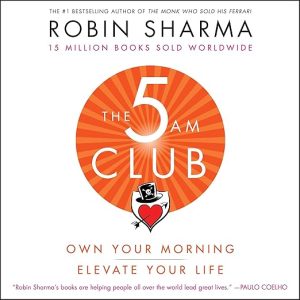
An eccentric tycoon mentors two struggling strangers, an entrepreneur and an artist, through the early-rising method Robin Sharma first introduced more than twenty years ago, and that fictional frame is the first thing a new listener to this audiobook needs to understand: The 5AM Club is not a straight nonfiction guide dressed up with anecdotes; it is a full narrative fable wrapped around a productivity framework Sharma spent four years rebuilding for this specific book.
Inside that story, the mentor walks the two strangers through a formula for waking early, a neuroscience-based approach to protecting the first hours of the day for exercise, self-renewal, and focused thinking, and tactics for defending that time against digital distraction. The synopsis does not undersell its own ambitions, promising the book will help readers accomplish 'epic results while upgrading their happiness, helpfulness and feelings of aliveness.'
Verner Balances a Mentor Who Could Tip Either Way
Narrator Adam Verner is asked to do genuinely different work across two registers within a single audiobook, voicing the fable's narrative scenes and delivering the instructional framework sections, and he keeps the eccentric-mentor character grounded enough to avoid tipping into caricature while still bringing enough amusement to the delivery that the earnestness of the self-help content never curdles into something cloying. That balance matters more than it might sound like it should, since a mentor figure played too straight risks feeling preachy, and one played too broadly risks undercutting the framework's actual usefulness.
A Four-Year Development Period for One Idea
Reviewer Maya writes candidly that she 'had no idea it would be told through a fictional storyline,' a genuine surprise that 'reignited a love' for reading she had not expected walking in, while reviewer haley gillen describes the book as 'like a little secret recipe for a magical morning.' Both reactions point to the same structural choice as the book's defining feature, for better or worse depending on what a given listener came expecting.
The four-year development period the synopsis cites is an unusually long runway for a self-help book revision, and it signals something worth noting: Sharma is not simply repackaging his original twenty-year-old 5am concept with a new cover, he rebuilt the entire presentation around a full fictional frame story, a substantially more ambitious undertaking than updating statistics or adding a new chapter. Whether that four-year investment produced a genuinely deeper work or simply a longer one wrapped in more narrative scaffolding is exactly the kind of question worth weighing while listening.
The Same Instinct as The Monk Who Sold His Ferrari
The fable structure genuinely does more work in audio than it might on the page, since a narrative scene with dialogue and character voice is exactly the kind of material spoken-word performance is built to carry, compared to a straight instructional bullet-point list that reads more naturally in print. Reviewer Matt Brown writes that the book 'captivated me from the first page,' with the journey through its ideas 'nothing short of extraordinary,' language that reflects genuine narrative engagement, not just agreement with the productivity advice underneath.
Robin Sharma has built a substantial career on exactly this kind of narrative-wrapped self-help, and listeners who know his earlier work will recognize the same instinct at work here, using story to make abstract discipline concrete rather than simply asserting it. A 4.4 rating across 37 reviews suggests a smaller but genuinely engaged audience for this particular fable-format entry in his catalog.
Sharma built his career on exactly this fable-driven approach, most famously with The Monk Who Sold His Ferrari, and listeners who know that earlier book will recognize the same underlying instinct at work in The 5AM Club: take an abstract discipline, in that earlier case simplicity and purpose, here specifically early rising and focus, and dramatize it through a mentor-and-student relationship rather than simply asserting the advice as a list of principles. This is a well-tested format for Sharma specifically, not a new experiment.
A concept surviving and getting actively rebuilt over more than two decades says something about its staying power that a brand-new framework cannot yet claim. Whatever a listener ultimately thinks of the specific tactics, the durability of the core five a.m. idea across twenty-plus years of Sharma's career, through changing technology and changing workplace norms, into a full rewrite of its own presentation, suggests it has proven sticky enough with real audiences to be worth revisiting rather than a passing trend repackaged for a new sales cycle.
A Claim With No Study or Researcher Named
Listeners expecting a direct, no-frills productivity guide, five habits, a checklist, done, should know upfront that a considerable portion of this audiobook's runtime is devoted to the fictional frame story itself, not the underlying advice stripped to its essentials. Maya's genuine surprise at the format is worth taking seriously as a preview: this is a story with a framework embedded inside it, not the reverse.
The book's own marketing language runs toward the maximalist, promising a work that will 'transform your life. Forever,' and listeners who find that register grating rather than motivating should know the tone stays consistently high-pitched throughout rather than settling into something more measured after the opening chapters.
A small irony is worth flagging here: a book promising insider tactics to defend attention against digital distraction is, for most buyers, itself consumed through the same phone or tablet that represents the distraction the book warns against. That is not a flaw specific to this title so much as a structural tension built into any digital-distraction-focused self-help audiobook, but it is worth listeners noticing rather than missing entirely.
The synopsis's promise of 'a neuroscience-based practice' is a common enough claim across the productivity genre that it is worth treating as a marketing signal more than a citation, since no specific study or researcher is named anywhere in the material available here. That does not necessarily mean the underlying advice is wrong, protected morning time has real, independently documented behavioral benefits, but listeners should distinguish between a book invoking neuroscience as a credibility marker and a book actually walking through the specific research behind its claims.
A Meaningful Share of the Eleven-Hour Runtime Is Story
Readers who enjoy narrative-wrapped business and self-help content, in the tradition of parable-driven bestsellers, and anyone specifically interested in early-rising routines explained through story rather than bullet points, will find Sharma's fable format genuinely effective here, helped considerably by Verner's ability to keep the mentor character believable rather than cartoonish. Listeners who have enjoyed other narrative-driven business fables in the past are especially well positioned to know quickly whether this specific structural choice will work for them.
Straight nonfiction instruction without a fictional wrapper is available elsewhere for readers who specifically prefer that format, since a meaningful share of this audiobook's eleven-hour runtime belongs to the story itself rather than distilled advice. Listeners who find maximalist self-help marketing language off-putting should also brace for a consistently high-energy promotional register throughout.
In Brief
- Voice: Adam Verner balances fable and instructional register well, keeping the eccentric-mentor character grounded rather than cartoonish.
- Big ideas: early-rising routines, narrative-wrapped productivity coaching, protecting focus against digital distraction.
- Atmosphere: Earnest and high-energy, softened by real narrative momentum rather than pure lecture.
- Worth it?: An effective, story-driven productivity audiobook for listeners who want their self-help wrapped in fiction rather than delivered as a checklist.
A Few Questions About The 5AM Club
Is The 5AM Club audiobook a nonfiction guide or a novel?
It is a hybrid. The productivity framework is delivered through a fictional story about two strangers mentored by an eccentric tycoon, which surprises some listeners expecting a straightforward nonfiction instructional format.
How does narrator Adam Verner handle the fictional story sections of this audiobook?
He voices the eccentric-mentor character with enough restraint to avoid caricature while still keeping a slight amusement in his delivery, which helps prevent the material's earnestness from tipping into something overly sentimental.
Is a companion resource included with this audiobook?
Yes, a supplemental Enhancement PDF accompanies the audiobook, in addition to the roughly eleven-hour narrated fable and framework content.