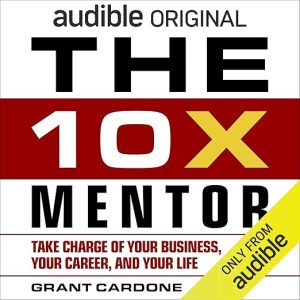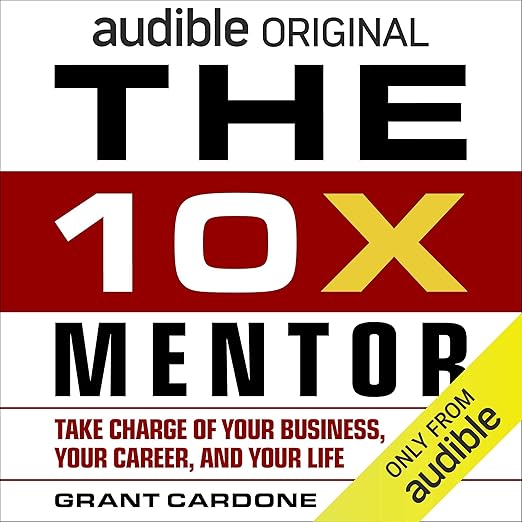
- Narrator: Grant Cardone self-narrates at full broadcast intensity for the entire runtime, exactly as fans and skeptics alike would expect.
- Subjects: Aggressive goal-setting, personal-brand building, wealth creation
- Tone: Relentlessly high-energy
- Bottom line: Worth a listen, ideally twice, for anyone who already responds to Cardone's coaching style; a hard pass for anyone who doesn't.
Grant Cardone's audio-exclusive mentorship pitch does not ease into its subject, and this audiobook opens with the same intensity Cardone brings to every stage he has ever stood on. Available only through Audible, The 10X Mentor runs nineteen distinct lessons, from committing and goal-setting through building multiple income streams and cutting loose the people who no longer serve a listener's ambitions, all delivered by Cardone himself across roughly eleven and a half hours.
The Same Math as The 10X Rule, Repackaged
The structure is closer to a curriculum than a narrative: commit, set goals, get known, create a narrative about yourself, connect, improve, motivate, build multiple income streams, go bigger, create wealth, market yourself, choose partners, cut ties with what no longer serves you, execute, follow up, handle setbacks, assess the business and team, turn liabilities into assets, give back. Cardone illustrates each stage with examples pulled from his own real estate and business career, positioning the entire audiobook as direct access to his personal playbook rather than a secondhand summary of it.
What separates this from a typical business audiobook is the sheer volume of Cardone's own case studies standing in for outside research or interviews with other entrepreneurs. Listeners get one voice and one worldview for the full runtime, which is either the whole appeal or the whole limitation depending on how a given listener already feels about Cardone's public persona.
Several items on the nineteen-point list reveal Cardone's underlying philosophy more than they first appear to: 'create a narrative about yourself' is really about controlling personal brand before anyone else defines it, and 'turn liabilities into assets' reframes setbacks as raw material rather than pure loss. Listeners familiar with Cardone's earlier, more famous framework in The 10X Rule will recognize the same underlying math here, just repackaged into a more personal, mentorship-driven delivery.
A Missed Point Has No Page to Flip Back To
Releasing exclusively through Audible rather than print reflects a broader shift in how personal-development content gets distributed now, treating the audiobook format itself as the primary product rather than a companion to a physical book. That choice puts real pressure on the narration to carry the entire experience, since a missed point has no page to flip back to.
The 10X Growth Conference, Cardone's real large-scale business event drawing tens of thousands of attendees, casts a long shadow over this audiobook's register even though the two products are formally separate. Cardone narrates at something close to that stage energy throughout, treating the microphone the same way he'd treat an arena floor, which explains both why converts find the experience immersive and why skeptics find eleven-plus hours of it exhausting.
'Go big or go bigger' is characteristic of the book's rhetorical style throughout, favoring escalating, almost sloganistic phrasing over measured qualification, and listeners should know that stylistic choice extends to the philanthropic material too; Cardone frames giving back as another arena for 10X thinking rather than a separate, quieter closing chapter.
The credential list the synopsis rattles off before the coaching even begins, real estate mogul, bestselling author, philanthropist, conference founder, functions as its own kind of extended pitch, establishing exactly why a listener should trust this particular voice before a single lesson starts.
This Feels Like Grant Talking Directly to YOU
Self-narration is essentially the entire product here. One listener described the effect precisely: it feels 'more like a conversation with Grant talking directly to YOU' than a lecture, and specifically recommended a second listen to let the coaching actually change behavior rather than just inform it. That kind of repeat-listening endorsement is rare and worth taking seriously as a signal of how the material is meant to be used.
The high-energy, broadcast-style delivery Cardone is known for stays remarkably consistent across the full runtime rather than flagging in the middle stretch the way some motivational audio does. For listeners who respond to that register, the intensity itself becomes part of the value, less a lecture to absorb passively than a push meant to be felt.
Shane Sanders's review captures the format's core appeal in a single image: Cardone 'right here, pushing and encouraging me the whole way', a description that gets at the parasocial coaching relationship an eleven-hour solo audiobook can create in a way a shorter book or a seminar clip never could. That sustained one-on-one illusion is precisely what the synopsis promises when it frames the book as getting Cardone's message 'directly from its source.'
Washington's Critique Is Worth Taking Seriously
Not every listener responds to that intensity the same way, and one reviewer pushed back hard on the content itself, arguing the material 'feels more for people who are struggling with their basic needs', that many points land as obvious, and that some of Cardone's claims read as contradictory across chapters. That critique is worth weighing seriously rather than dismissing as simple skepticism, since it points to a real tension between the book's aspirational framing and its actual practical specificity.
With only twenty-four ratings behind it, the audiobook has a thinner review base than its 4.4 average might suggest, and the two visible reactions in this data set run to genuine extremes, from evangelical enthusiasm to pointed disagreement. A cautious listener should treat that spread as useful information rather than noise.
Washington's critical review is worth engaging with specifically rather than dismissing as simple negativity: the complaint centers on points that read as 'obvious in most cases' alongside others that strike the reviewer as internally 'controversial' or contradictory across chapters. That's a fair craft critique of any curriculum-style audiobook built from one person's accumulated experience rather than externally validated research, and it's a useful counterweight to the more evangelical reviews sitting alongside it.
Nineteen Topics Average About Thirty-Six Minutes Each
Nineteen distinct topics stretched across eleven hours and thirty-seven minutes works out to a little over thirty-six minutes per subject on average, a pace that allows real elaboration on each item rather than a rushed bullet-point read-through, though it also means listeners hoping to skip straight to one specific topic, say, goal-setting alone, will need to navigate a fairly long runtime to isolate it.
The 'give back' lesson closing out the list stays true to the book's overall register rather than shifting into a quieter, more reflective tone the way a closing chapter sometimes does; philanthropy gets framed as another arena for ambitious thinking rather than a separate, humbler coda to everything before it.
Most Listeners Decide Within the First Hour
Entrepreneurs and salespeople who already respond to Cardone's high-intensity coaching style, or who specifically want direct access to his own business examples rather than a general leadership survey, are the clear audience, especially anyone willing to commit to a second listen as one reviewer recommended.
Hustle-culture intensity that exhausts rather than motivates, or a preference for a more measured, research-backed approach to business strategy, are both good reasons to expect a bounce off within the first hour rather than a slow warm-up over time.
Does Grant Cardone narrate The 10X Mentor audiobook himself?
Yes, and the self-narration is essentially the whole product, delivering his coaching in the same high-energy register he's known for on stage.
Is The 10X Mentor audiobook worth listening to more than once?
At least one reviewer specifically recommended a second listen to let the coaching change behavior rather than just inform it, suggesting the material rewards repetition.