Quick Take
- Narration: Judy Alice Lee brings the ensemble’s multicultural cast to life with genuine range, particularly strong in the action sequences and quieter moments of emotional reckoning.
- Themes: found family in space, Korean cultural identity, grief and exoneration
- Mood: Fast-paced and action-driven, with layered emotional undercurrents
- Verdict: A propulsive finale to Elaine U. Cho’s space opera duology that rewards listeners who came into it from Ocean’s Godori, built for those who want their sci-fi to feel lived-in and culturally specific.
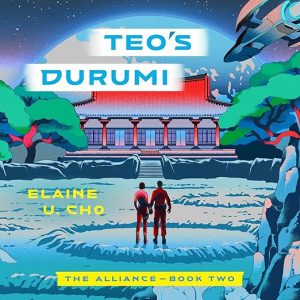
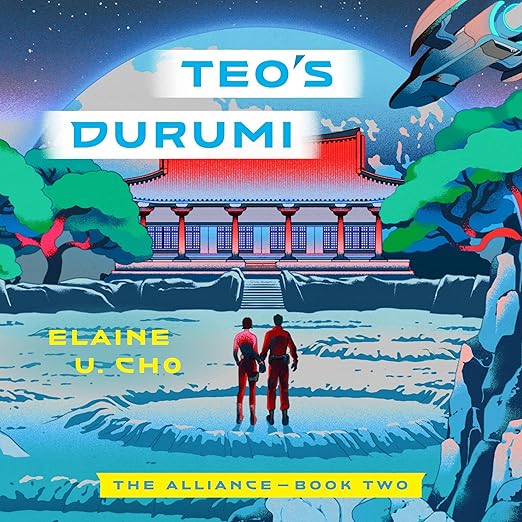
I listened to Ocean’s Godori last summer and found its slow opening a patience-tester before it clicked into something genuinely compelling. Teo’s Durumi does not have the same problem. Cho drops you into the action within minutes: Teo Anand, former wastrel son of the Anand Tech empire and current solar fugitive, has just crash-landed on the Moon after surviving another attempt on his life. The momentum established at the end of the first book carries directly into this one, and it does not let up.
The setting is one of the duology’s real achievements. Artemis, the Moon city where much of this book unfolds, is described as rich in Korean history and haunted by Teo and Ocean’s pasts in very different ways. Cho is a Seattle-based writer of Korean heritage, and the Korean cultural elements running through the series, from food to history to specific storytelling traditions, give this sci-fi universe a texture that feels like research crossed with personal investment rather than decoration.
Our Take on Teo’s Durumi
The ensemble is the duology’s greatest asset and also its most demanding element. Two crews thrown together by circumstances, multiple characters with overlapping loyalties, and a main antagonist whose reach extends across the solar system means there is a lot in the air at any given moment. One reviewer specifically appreciated the recap Cho provides at the start of this volume, which gives each character’s perspective on where things stand. On audio, that context is invaluable.
The queer elements of the series are distributed across the ensemble rather than centered on one relationship. Teo’s attraction to the dashing Phoenix, described as coming blazing into his life in more ways than one, runs alongside Ocean’s more complicated dynamic with the pensive medic Haven. Cho does not make either relationship a subplot. They are part of the fabric of the story.
Why Listen to This Audiobook Specifically
Judy Alice Lee is well-suited to this material. The ensemble cast requires differentiation across a wide range of characters, including several who share certain cultural registers, and she handles that without collapsing everyone into caricature. The action sequences, which come frequently, benefit from a narrator who maintains clarity rather than getting caught up in the excitement. Several reviewers noted the book flew by, and the narration is part of why: Lee keeps the momentum in the prose rather than fighting it.
At just under twelve hours, this is appropriately sized for a duology closer. The story does not overstay, and the pacing in the final act is noticeably tighter than the mid-section, which reflects good editorial instinct.
What to Watch For in the Artemis Sequences
The city of Artemis, and what it represents for the characters with Korean heritage, gives this book its most interesting thematic layer. The questions of identity and acceptance the synopsis flags are not abstract: they are worked through in specific cultural terms, through what characters remember of home, what the Moon city preserves and distorts of that heritage, and what it means to form new allegiances when old ones have been proven unreliable. The ghosts from Teo and Ocean’s pasts referred to in the synopsis are both literal and figurative, and Cho handles both registers with care.
The food descriptions, which reviewers of the first book specifically noted with affection, continue here. They are the small material details that make a world feel inhabited rather than constructed.
Who Should Listen to Teo’s Durumi
Anyone who completed Ocean’s Godori should come directly here. The emotional payoff of this finale is proportional to the investment in the first volume. New listeners should start with the first book: the character relationships and the political situation of the solar system are both too dense to absorb mid-stream. The duology as a whole is recommended for sci-fi listeners who want cultural specificity and ensemble warmth alongside their space opera action, and who are comfortable with a queer cast treated as unremarkable.
Frequently Asked Questions
Does Teo’s Durumi work as an entry point to the Alliance duology?
No. Cho provides a recap at the start, but the emotional weight of the finale depends entirely on knowing the characters and their situation from Ocean’s Godori. Start with Book 1.
Is the Korean cultural content accessible to readers unfamiliar with that background?
Cho writes for accessibility without sacrificing specificity. The cultural elements are contextualised within the narrative, and you do not need prior knowledge of Korean history to follow and appreciate them.
How prominent is the queer content in this volume?
The sapphic and queer relationships are woven throughout the narrative rather than isolated. Teo’s developing connection with Phoenix and Ocean’s complicated dynamic with Haven both affect plot decisions, not just emotional tone.
Is there a third book planned in the Alliance universe?
As of the book’s August 2025 release, the Alliance Duology is described as complete. Teo’s Durumi concludes the two-book arc.