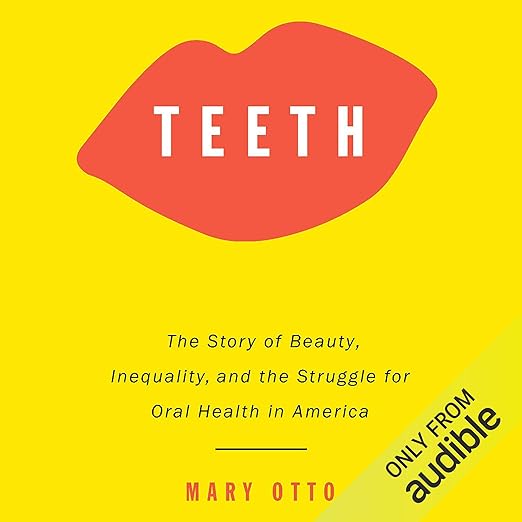
Quick Take
- Narration: Suehyla El’Attar brings clear diction and controlled urgency to Otto’s investigative prose, she shifts between measured analysis and genuine outrage without tipping into melodrama.
- Themes: Oral health inequality, public health failure, the historical separation of dentistry from medicine
- Mood: Urgent and unsettling, the kind of book that makes you reconsider something you thought you understood
- Verdict: Mary Otto has written the definitive account of oral health inequality in America, and El’Attar’s narration gives it the gravity the subject demands.
I was about twenty minutes into Teeth when I had to stop and recalibrate. I had expected a health policy audiobook with the usual mix of statistics and case studies. What I got instead was something closer to the tradition of Barbara Ehrenreich or Jonathan Kozol, journalism that uses specific human lives to make structural arguments that statistics alone cannot carry. By the time Mary Otto introduces Deamonte Driver, the twelve-year-old Maryland boy who died in 2007 from an untreated abscessed tooth, I had completely abandoned any expectation that this was a moderate book.
It is not a moderate book, and it is better for that.
The Boy, the Gap, and the Century That Created Both
The Deamonte Driver case is the book’s moral center, and Otto handles it with restraint that makes the account more devastating than it would be if she lingered. Driver’s death sparked congressional hearings and a short-lived wave of coverage, and then largely disappeared from public attention. Otto uses this as an entry point into the larger question she is investigating: why does America have a silent epidemic of tooth decay that falls disproportionately on the elderly, people of color, and those in poverty, and why does our healthcare system treat this as fundamentally separate from general medical care?
The answer involves history, specifically the 19th-century split between dentistry and mainstream medicine that Otto traces with the patience of a scholar and the clarity of a journalist. She shows how institutional decisions made over a century ago, about licensing, training, insurance coverage, and professional identity, calcified into a system where dental care remains a luxury good for tens of millions of Americans. The Medicaid sections are particularly damning: the marketing guru who advises dentists on how to attract high-value patients while legally and professionally sidelining Medicaid recipients is one of the book’s sharpest portraits.
How Georges Cuvier’s Maxim Becomes a Thesis
One of the book’s structural strengths is its willingness to move between scales, from the specific human story to the broad historical argument to the almost anthropological observation. The section on the Hollywood dentist who made Shirley Temple’s and Judy Garland’s teeth sparkle on screen is not a digression; it is Otto’s method of showing how the concept of pearly whites became a class marker, an American aspiration encoded into what counts as attractive and employable and trustworthy. Georges Cuvier’s maxim, show me your teeth and I will tell you who you are, is not treated as clever framing but as a genuine thesis that the book spends nine hours substantiating.
That the mouth functions as a site of social sorting is not a new observation, but Otto grounds it in specific institutional and economic mechanisms rather than vague cultural critique, which gives her argument genuine analytical purchase.
Suehyla El’Attar Carries the Weight
El’Attar is an excellent match for this material. Investigative health journalism tends toward one of two audio failure modes: narrators who sound too detached, rendering suffering as statistic, or narrators who perform emotion in a way that undercuts the journalistic credibility of the work. El’Attar avoids both. Her reading of the Deamonte Driver sections is careful and unshowy. Her handling of the historical chapters has the kind of measured emphasis that guides a listener through complicated institutional chronology without losing the thread. The book runs just under ten hours, and the pacing holds throughout, a genuine achievement across this length.
Who Should Listen and Who Should Know What They’re Getting Into
Listen if you are interested in public health, health policy, or the sociology of inequality in America, or if you are a dental professional who wants to understand the structural history of your own field. The book’s 4.7 rating with 336 reviews for a niche investigative health title is a meaningful signal, it is finding readers who feel it addresses something important and underexamined.
Understand before you start that this is a work of advocacy journalism, not a neutral policy survey. Otto is not trying to present both sides of whether American dental care inequality is a problem, she is prosecuting a case. Listeners looking for a balanced exploration of dental policy debates will find the book’s orientation frustrating. Those who want to understand why things are as bad as they are will find it clarifying.
Frequently Asked Questions
Does Teeth cover solutions and policy proposals, or is it purely diagnostic?
The book is primarily diagnostic and historical, it excels at explaining how the current system came to be and who it fails. It does address reform proposals and advocates for integrating oral health into general medical care, but the bulk of the argument is investigative rather than prescriptive. Readers looking for a detailed policy roadmap will need to supplement it.
Is the Deamonte Driver story a significant part of the narrative, and how is it handled?
Driver’s death functions as the book’s moral and structural center. Otto handles it with journalistic restraint rather than emotional amplification, which makes the account more effective, not less. It is referenced at multiple points throughout the book, not just in a single chapter.
How does Suehyla El’Attar handle the book’s combination of historical analysis and personal narrative?
Very well. She shifts between scales without losing pace, the historical sections have measured, almost academic deliberateness, while the personal story sections are warmer and more immediate. For a book that spans archival research and on-the-ground journalism, that tonal flexibility matters, and El’Attar deploys it consistently.
Is this book current enough, given that it was published in 2017?
The structural arguments about Medicaid access, the historical separation of dentistry from medicine, and the class dimensions of oral health remain accurate because they describe systemic conditions that have not fundamentally changed. Some specific policy details and statistics are dated, but the core analysis holds. It is not a guide to current policy specifics so much as an account of the long-term forces that produced the current situation.