- Narration: Michael Butler Murray keeps Hodge's policy arguments clear and the historical anecdotes engaging, navigating the shift between economic analysis and storytelling without losing the thread of either.
- Themes: Unintended consequences of tax policy, regulatory capture through the tax code, economic history of taxation
- Mood: Wry and informative, with the satisfying rhythm of someone who knows exactly why your electric car neighbor pays less than you think
- Verdict: A well-structured argument that tax policy shapes daily life in ways most people never track, made accessible through historical examples that are genuinely more interesting than the policy conclusions they illustrate.
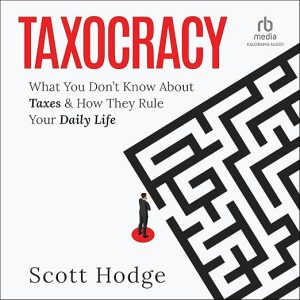
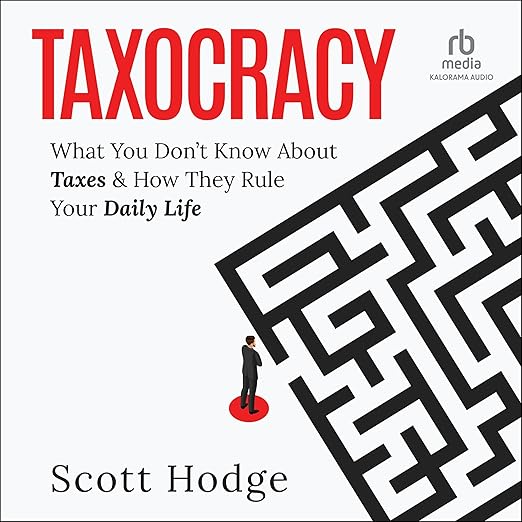
Scott Hodge opens Taxocracy with a question that most people would not immediately answer with the word "taxes": why do healthcare costs keep rising, why does your neighbor drive a subsidized electric car, and why has hard seltzer proliferated across every cooler in America? As the former CEO of the Tax Foundation, Hodge has spent decades cataloging the ways in which tax policy shapes behavior and markets in ways that the intended policy goals never anticipated. Michael Butler Murray narrates the 8.5-hour audiobook with enough editorial clarity to make the policy history entertaining, which is no small feat given that tax legislation is not, on the surface, riveting material.
Window Taxes and See-Through Buildings in England
The organizing principle of Taxocracy is unintended consequences. Hodge argues that the US tax code is not simply a revenue mechanism but a governing document that shapes almost every significant economic choice Americans make, from where they get their health insurance to what car they drive to when, literally, it makes financial sense to die. The historical examples Hodge deploys to make this case are the book's biggest asset. See-through buildings in England designed to maximize window tax avoidance, tax-free attics that became a standard architectural feature, three-wheeled cars built to exploit motor vehicle definitions, women wearing children's clothing to avoid garment taxes: these are the kinds of stories that make abstract policy concrete and demonstrate, with some dark humor, how reliably humans will restructure their behavior around tax incentives whether or not that restructuring aligns with any social good.
The baked chips argument, which Hodge apparently deploys alongside the hard seltzer example, fits a long tradition of tax policy analysis that finds absurdity at the intersection of commodity definition and tax categorization. These are not trivial examples. They illustrate a serious argument: that when you write a tax preference for a specific behavior, you do not simply incentivize that behavior, you change the entire system of choices around it in ways that ripple far beyond the original intent. One reviewer described the book's clarity on this point as making "unintended outcomes" feel like a structural feature of tax policy rather than an accident, which is exactly the argument Hodge is making.
Murray's Lightness Carries Policy Between Chapter Takeaways
The audiobook format suits Hodge's approach particularly well because the chapter structure, with takeaways at the end of each section that a reviewer specifically praised for ensuring firm understanding, translates naturally to audio pacing. A listener can absorb a chapter, process the takeaway in a natural pause, and carry the key point into the next section without the visual anchoring of a printed page. Michael Butler Murray's narration helps here: his delivery of the historical anecdotes has enough lightness to keep the pacing from becoming lecture-like, while the policy analysis sections maintain the clarity needed for comprehension.
One reviewer noted that the book "gives great insight on the why and how governments tax" without delivering day-to-day hacks or tax loopholes. That is an accurate description of the book's scope and a useful frame for managing expectations. Taxocracy is a structural analysis of how the tax code became the governing framework for American economic life, not a personal finance guide. Listeners who come looking for advice on their own tax situation will be disappointed. Listeners who want to understand the policy landscape they are operating in, and why so many seemingly unrelated features of American economic life trace back to tax decisions made decades ago, will find the book rewarding.
Hodge's Free-Enterprise Lens Shapes the Final Chapters
Hodge wrote this book as the former CEO of the Tax Foundation, an organization with specific ideological commitments to economic growth, free enterprise, and reduced government intervention in markets. The book's framing, which proposes a tax code that "promotes economic growth, free-enterprise, and takes the politics out of tax policy," reflects those commitments. Listeners who share those values will find the policy prescriptions in the final sections satisfying. Those who approach tax policy from different frameworks, who might see some of the "distortions" Hodge identifies as intentional redistributive choices rather than errors, will find the diagnosis more useful than the prescriptions. The historical analysis in the book's core sections is strong regardless of political orientation; the normative framing of what a good tax code should look like is more situated.
The 4.4 rating across 42 listener reviews is a solid signal of general satisfaction with the content, and the reviews that are available emphasize the book's clarity, accessibility, and the value of its chapter-ending summaries. For a policy book that could easily have become dry, Taxocracy maintains enough narrative energy through its historical examples to be a genuinely entertaining listen.
Curious About Everyday Life More Than Personal Advice
Listeners curious about why American economic life looks the way it does and who have never traced those features back to specific tax policy decisions. Anyone who has wondered why health insurance works the way it does, why electric cars receive specific subsidies, or why college tuition increases at the rate it does, and wants a structural explanation rather than a political one. Listeners who enjoy policy history delivered through anecdote rather than academic density will find Murray's narration of Hodge's examples a pleasant 8 hours. Those who want a politically neutral tax policy analysis should know the book has a specific free-market orientation that shapes its prescriptions. Anyone looking for personal tax advice or filing strategies should look elsewhere entirely. Listeners who already have strong backgrounds in tax policy may find the historical examples familiar, but the synthesizing argument about unintended consequences still provides useful framing.