Quick Take
- Narration: Liz Josefsberg self-narrates with the ease of someone who has delivered this material in coaching sessions for fifteen years, the warmth is real, the no-nonsense tone is consistent, and the celebrity anecdotes land better in her own voice.
- Themes: Behavior-based weight management, habit formation, personalized wellness
- Mood: Encouraging and practical, refreshingly free of diet-culture moralizing
- Verdict: Josefsberg’s six-guideline framework is genuinely simple without being simplistic, a welcome counterpoint to programs that require full-time attention to maintain.
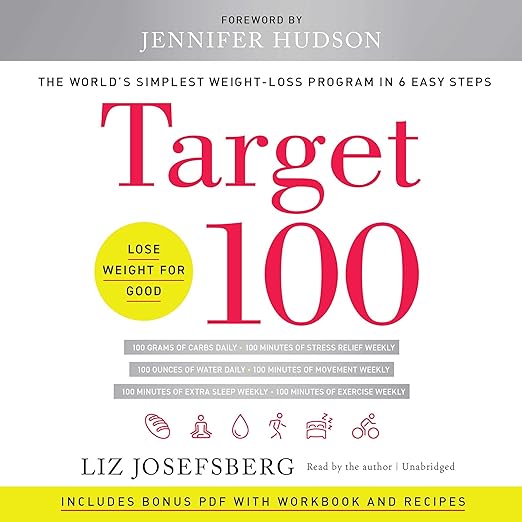
I put this one on during a midweek afternoon when I was already tired of reading about nutrition and wanted something that would actually change what I did rather than what I thought. Most weight loss audiobooks deliver information I already have. Liz Josefsberg opens by acknowledging this directly: the problem is not that we do not know vegetables are good for us. The problem is behavior, and behavior requires a different kind of intervention than information. Target 100 is organized around that premise from the first chapter.
Josefsberg spent fifteen years at Weight Watchers, eventually running their celebrity program, and the experience shows in useful ways. She has watched thousands of people lose weight and fail to maintain it, lose it and succeed at maintaining it, struggle for years and then find one small behavioral change that shifted everything. The book is the distillation of those patterns, not the success stories alone but the understanding of what actually makes sustainable change possible.
Six Guidelines Instead of a System
The book’s structural argument is in its name: Target 100 is about reaching six daily targets, each modest, each connected to a specific behavioral lever, rather than tracking everything or following rigid protocols. The targets include steps walked, water consumed, sleep achieved, fruits and vegetables eaten, alcohol managed, and daily exercise. None of these will surprise anyone who has ever read a health book. What Josefsberg does differently is explain specifically why these six were chosen over the hundreds of other things you could optimize, and what the research shows about the behavioral sequencing, which targets, when achieved, make the others easier rather than harder.
Self-narration serves this book exceptionally well. The Jennifer Hudson and Jessica Simpson stories, which could feel like celebrity namedropping in a hired narrator’s reading, come across as matter-of-fact professional references in Josefsberg’s own voice, the way a doctor might mention notable patients when the point is clinical rather than promotional. Charles Barkley and Katie Couric receive the same treatment: illustrations of how the same program works across very different bodies, lifestyles, and starting points.
The Self-Exploration Component
One of the more interesting aspects of the book that listeners may not anticipate is the degree of self-examination it asks for. Josefsberg is interested not just in what you eat and how you move but in why you eat the way you do, the emotional patterns, stress responses, and situational triggers that govern food behavior at a level below conscious decision-making. One reviewer described this as painful self-exploration that ultimately proved immensely useful. The audiobook handles these sections with appropriate sensitivity, Josefsberg does not over-dramatize the psychological dimensions of eating, but she does not minimize them either.
The worksheets embedded in the print version are referenced in the audio and can be approximated by pausing and engaging with the questions verbally or on paper. This is not a book that requires a written companion to be useful, but listeners who actually stop and answer Josefsberg’s reflection questions will get substantially more from the experience than those who absorb it passively.
Where Simple Is Not the Same as Easy
Josefsberg is admirably honest about the word she uses in the book’s subtitle: simple is not a synonym for easy. The six targets require daily consistency in an environment that actively works against that consistency, processed foods designed to override satiety signals, sedentary jobs, social schedules that complicate sleep. The book’s most useful contribution may be the chapter on navigating the practical obstacles rather than the targets themselves. Reviewer feedback from listeners who had already completed extensive weight loss journeys suggests the book functions as a recalibration tool as well as an initial program, new frameworks for refreshing habits that have gradually slipped.
For Listeners Who Are Done With Complicated Programs
Target 100 is the right audiobook for someone who has cycled through enough restrictive programs to know that restriction alone does not work and wants a behavior-based alternative that does not require constant tracking. Josefsberg’s self-narration makes the coaching dynamic feel direct and personal. The celebrity anecdotes are used sparingly enough to add rather than overwhelm. At seven hours and fifteen minutes, the runtime is perfectly suited to one extended listening session or a week of commutes.
Frequently Asked Questions
Does the audiobook work as a standalone program, or does it require the print book for worksheets?
The audio is functional as a complete program, Josefsberg guides you through the targets and reflection questions verbally. The print version’s worksheets add structure for listeners who prefer written tracking, but they are not required. Pausing to engage with the questions in real time is the audio equivalent.
Does the celebrity coaching background give the program credibility, or does it make it feel out of reach for non-celebrities?
Josefsberg uses the celebrity clients as illustrations rather than aspirational benchmarks, the point is that the same behavioral principles that worked for Jennifer Hudson’s weight loss apply to office workers and stay-at-home parents. Several reviewers from non-celebrity backgrounds describe finding the program immediately applicable.
How does this compare to Weight Watchers as a program, given Josefsberg’s fifteen-year background there?
Target 100 shares Weight Watchers’ behavioral orientation but removes the points system and external accountability structure. It is a self-directed version of the same fundamental insight, that sustainable weight management is about building consistent habits rather than following a temporary protocol, without the subscription model.
Is this suitable for someone who has already lost significant weight and wants to maintain it, or is it primarily for initial weight loss?
Both. One reviewer who had already lost 90 pounds over eight years describes Target 100 as providing new frameworks for refreshing habits rather than primarily new content. Josefsberg addresses maintenance as well as initial loss, and the behavioral approach applies to both phases.