Key Details
- Voice: Max Lucado reading his own work is a genuine asset - his pastoral warmth and lack of performative self-help energy make the biblical and neuroscientific content feel like a conversation rather than a lecture across the five-and-a-half hours.
- Big ideas: Thought management as spiritual discipline, anxiety and guilt reframed through Scripture, the neuroscience of mental renewal
- Atmosphere: Warm and quietly urgent, rooted in pastoral community
- Worth it?: A New York Times bestseller that delivers on its central promise - a practical, Scripture-anchored framework for managing anxious and negative thought patterns - narrated by the author with exactly the tone the material requires.
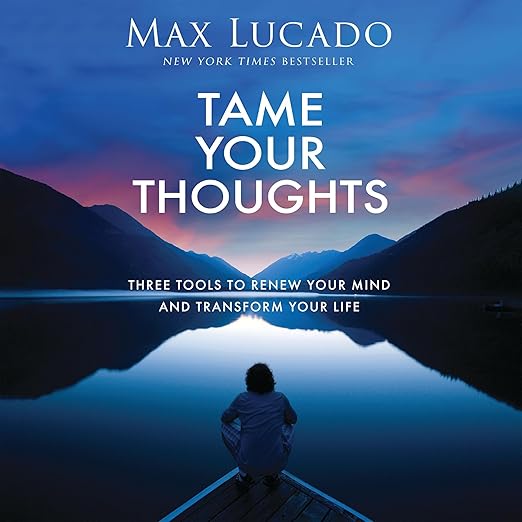
Max Lucado's Tame Your Thoughts, narrated by the author himself, arrives as a New York Times bestseller and represents Lucado in his most characteristic register: pastoral without being preachy, practical without being shallow, and personally present in a way that distinguishes his books from more generic Christian self-help. The audiobook's five-and-a-half hours cover a specific argument: that the way we manage our thoughts is not merely a psychological matter but a spiritual one, and that Scripture offers not just comfort but functional tools for interrupting and reorienting destructive mental patterns. Lucado draws on both neuroscience and biblical text to build a case that these two sources of insight are pointing at the same underlying reality rather than competing with each other.
Three Biblical Tools for an Anxious Mind
The book's central framework is built around three biblical thought management tools, applied to the most common categories of mental struggle Lucado identifies in his pastoral experience: anxiety, guilt, rejection, and a handful of related patterns. The structure is clear and the application is practical - he is not asking readers to simply think better thoughts but to employ specific interventions, including what he calls "taking thoughts captive," testing each thought against scriptural truth, and interrupting what he terms "poisonous thought threads" before they gain momentum. Each tool gets detailed treatment, with worked examples drawn from his pastoral experience and his own admitted struggles with anxious thinking.
What separates this from secular cognitive approaches is the theological grounding. Lucado draws on neuroscience genuinely and without overreach - one reviewer notes that the book is "full of detailed spiritual and scientific guidance" - but he is not trying to re-brand Scripture as a form of cognitive behavioral therapy. The claim here is that the mind's capacity for renewal described in Romans 12:2 and the neuroscientific evidence for neuroplasticity are pointing at the same real phenomenon, and that understanding both dimensions gives the Christian listener more than either framework alone. Whether that synthesis satisfies depends heavily on the listener's starting commitments, but Lucado handles it with more intellectual care than the genre typically delivers, and the result is a book that does not condescend to its readers about either the science or the Scripture.
Lucado's Narration and the Companion Study PDF
Lucado reading his own text is the right call for this material. His voice carries the pastoral authority of someone who has spent decades in congregational ministry, but without the performance-inflected warmth that can make Christian audio feel like an extended advertisement for the speaker's brand. One reviewer notes he does not talk down to the reader and presents himself as "living in the trenches" with the same weaknesses and struggles he addresses. That leveling quality comes through in his narration: the pauses are genuine, the inflections are unforced, and the sections where he admits his own experience with anxiety feel like disclosure rather than manufactured relatability designed to make the listener trust the framework.
The companion PDF - which includes the figures, reflection questions, and scripture database referenced throughout the text - is available as an audiobook download and adds real practical value. Several reviewers specifically mention using the PDF alongside the audio to deepen the reflective work, with one noting it as "an excellent tool for introspection and merging the audio and written material." For listeners who want to use this as an active study tool rather than a passive listen, the two-format approach is recommended: Lucado's spoken delivery for the framing and narrative, and the PDF for the structured application exercises that make the content actionable beyond the listening session.
A Framework That Presumes Christian Faith
The book assumes Christian faith as its foundation. Lucado does not argue for that faith; he assumes it and builds the practical framework on top of it. Secular listeners or those from outside the Christian tradition who are drawn to the psychological content will find some of the biblical framing alien, and the passages that lean most heavily on specific scriptural authority will not land the same way. This is a book for listeners already working within a Christian framework, and it makes no attempt to be otherwise - which is a clarity that serves readers well in setting expectations before they commit the five-and-a-half hours.
The book's treatment of anxiety, guilt, and rejection is consistently sympathetic and non-shaming, which is worth noting for listeners who have encountered Christian teaching on mental health that has felt condemning or that treated struggle as evidence of insufficient faith. Lucado's consistent position is that God "loves us too much to let us lead a life marked by poor thinking" - a pastoral stance that treats mental struggle as something God is actively interested in helping with rather than as a spiritual failure to be overcome through willpower alone.
For Christians Battling Anxiety Guilt and Rumination
Christian listeners dealing with anxiety, persistent guilt, rumination, or a sense of mental overwhelm will find Lucado's three-tool framework immediately applicable and his tone supportive rather than demanding. Longtime Lucado readers will find this consistent with his best work - practically grounded, scripturally anchored, and written at a level of craft that distinguishes it from the category average. Listeners outside the Christian faith tradition who want a purely psychological framework for thought management should look elsewhere; this is specifically and unapologetically a book for those working within a relationship with God as the foundation of the practice.