Before You Press Play
- Narrator: Candace Nelson reads her own book with the warmth and directness of someone who has told these stories many times and still means every word; the self-narration is essential to the book's authority.
- Subjects: Building a brand from scratch, entrepreneurship as personal identity, the cost of passion-driven business
- Tone: Energetic, candid, and genuinely motivating without being saccharine
- Bottom line: Sweet Success earns its place among the better founder memoirs in audiobook form because Nelson is honest about failure in a genre that prefers to skip past it.
The Woman Who Invented the Cupcake ATM
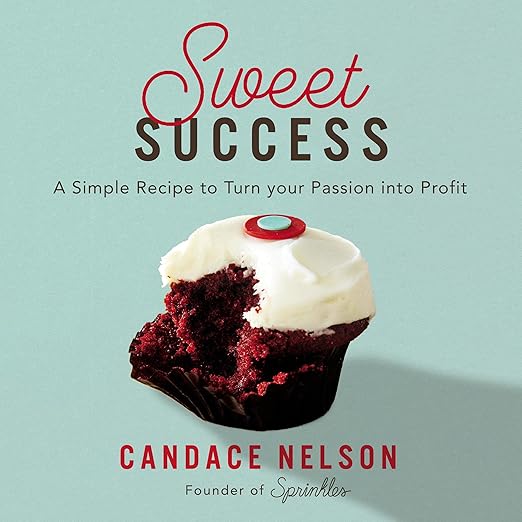
Candace Nelson narrates her own audiobook Sweet Success, and within the first few minutes of listening it becomes clear why the self-narration was the right choice. Nelson is the founder of Sprinkles Cupcakes, the first dedicated cupcake bakery in the world and the inventor of the Cupcake ATM. When she describes the moment she decided to pour her life savings into a bakery concept that everyone around her considered impractical, the restraint in her voice is more persuasive than any amount of performed triumph would have been. She has earned the right to be matter-of-fact about it. The audiobook runs seven hours and twenty-two minutes, which is the right length: enough room to be genuinely substantive without the padding that weighs down many entrepreneurship memoirs in this format.
The book's structure follows Nelson from her decision to forgo business school in favor of her own instincts, through the founding and scaling of Sprinkles, and out into the broader lessons she has drawn for anyone wanting to build a brand rather than just a business. That progression sounds like many founder memoirs. What distinguishes Sweet Success is the specific texture of Nelson's candor about what went wrong. She does not sugarcoat the mistakes, the misses, and the lessons learned the hard way, which is a phrase from her own synopsis that turns out to be accurate rather than promotional. She is describing actual content, not a tone.
A Social Currency and a Workplace Celebration Staple
Reviewer Jenny Hill noted that Sprinkles Cupcakes became genuinely infused into Southern California culture in a way that turned the brand into a social currency, a coveted gift, a workplace celebration staple. That cultural embedding is not an accident Nelson fell into; it is the result of deliberate brand architecture decisions that the audiobook unpacks in useful detail. The section on building a community of brand evangelists is particularly worth attention for anyone trying to understand how a bakery became a globally recognized phenomenon rather than just a successful local business.
Reviewer Abby Richards, a startup advisor who recommends the book to clients and mentees, identified what makes Sweet Success professionally useful: it delivers both theory and practical advice in proportion, moving between how to think about a problem and how to actually accomplish a task. That balance is rarer than it should be in business audiobooks, which tend to favor one register or the other. Nelson covers marketing allocation, product packaging for profit, and the construction of a personal brand, but she frames all of it through specific decisions she faced, which keeps the advice grounded in something observable rather than floating in abstraction.
Reviewer LPB captured the book's emotional effect accurately: it motivates you to start acting on your passion rather than merely thinking about it. That is the legitimate goal of a book like this, and Nelson achieves it not by maximizing inspirational rhetoric but by showing, in concrete terms, what it looks like to take an idea seriously enough to bet your savings on it and then solve the problems that follow. The audiobook's energy is the energy of someone who has solved those problems and wants to help you solve yours, which is a different and more useful energy than the stage-performance enthusiasm of many entrepreneurship titles.
Written From the Position of Having Succeeded
The book is rooted in the physical retail food business, and some of its most specific advice, about production scaling, distribution, and the logistics of a perishable product, applies most directly to that context. Listeners from service industries or digital businesses will need to do some translation work to apply Nelson's frameworks to their own situations. The underlying principles around brand identity, community building, and personal brand amplification transfer readily; the implementation details sometimes do not.
Nelson is also writing from the position of someone whose business succeeded. The book is honest about the difficulties and near-failures along the way, but it is ultimately a success story, and the perspective that entails is worth acknowledging. Entrepreneurship memoirs written by founders whose businesses failed or stalled before success are rarer and sometimes more instructive for listeners who are earlier in the process. Sweet Success is most useful for people who want a model of how to build toward scale; it is less useful as a guide to surviving the years before any signal of success is visible.
Nelson's Vocal Register Reveals Real-Time Uncertainty
This audiobook is for aspiring entrepreneurs, particularly those building consumer brands in competitive markets, who want a founder's account that is honest about the gap between passion and execution. Nelson's experience in food, media, and television gives the book unusual breadth for a single-brand story, and her voice in the narration makes the listening experience feel like a conversation with someone who genuinely wants you to succeed. The self-narration also does something that third-party narration rarely can: it lets you hear when Nelson is still working through the implications of a decision versus when she has arrived at settled certainty. Those differences in vocal register are genuinely informative, and they are only available in audio. Skip it if you are looking for a comprehensive business school curriculum; Nelson's approach is instinctive and experience-based rather than theoretical, and the book does not replace foundational frameworks so much as it illustrates what those frameworks look like when applied by someone building a real business from zero.
Does Candace Nelson narrate her own audiobook, and does that affect the listening experience?
Yes, Nelson reads Sweet Success herself, and the self-narration significantly enhances the book. Her voice carries the specific authority of someone who lived every decision she describes, and the moments where she reflects on near-failure or hard-won lessons land with a weight that a third-party narrator could not replicate. For founder memoirs in particular, self-narration is often essential.
Is the Sweet Success audiobook primarily about the cupcake business, or does it cover broader entrepreneurship principles?
Both. Nelson uses the Sprinkles Cupcakes story as the structural spine, but the book extracts general principles about brand building, community cultivation, marketing allocation, and personal brand development that apply across consumer businesses. Listeners from industries outside food will find most of the strategic content transferable.