Quick Take
- Narration: Matthew Boston’s clear, assured delivery suits Enyart’s military-systems approach, making dense procedural content accessible without losing its authority.
- Themes: Wilderness survival, Special Forces methodology, bushcraft fundamentals
- Mood: Focused and systematic, like a detailed briefing before a field exercise
- Verdict: A genuinely authoritative wilderness survival guide from a former Green Beret, with strong structural logic and broad enough scope to serve beginners and experienced practitioners, among the best-validated titles in this category on Audible.
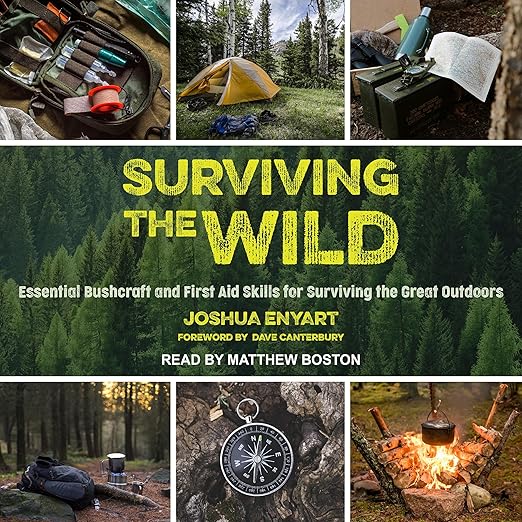
I have read enough survival books to recognize the difference between someone who knows the theory and someone who has tested it under conditions that made the outcome uncertain. Joshua Enyart’s Surviving the Wild falls in the second category, and that difference registers on every page. He is a former Army Ranger and Green Beret who transitioned into survival instruction, and the approach he brings to the subject carries the specific economy of thought that serious military training instills: prioritize correctly, act in sequence, know what failure looks like before you encounter it.
The 624 ratings averaging 4.7 make this one of the most validated titles in the preparedness space on Audible, and the reviews reflect genuine field utility rather than theoretical appreciation. A reader who works in wilderness safety calls it an exceptional resource for both beginners and experienced practitioners. A verified customer praises the no-nonsense style as evident throughout. These are the responses of people who take outdoor survival seriously and found the book measuring up to that standard.
The Systems-Based Approach and Why It Matters
What distinguishes Surviving the Wild from most bushcraft and survival guides is not the individual techniques, the fire-starting methods, the water purification protocols, the shelter configurations, but the logical sequence that organizes them. Enyart applies what he calls a systems-based approach to survival, which means he is not just giving you a list of things to do. He is teaching you a decision architecture that works when you are exhausted, scared, and operating with incomplete information.
This systems framing comes directly from Special Forces training methodology, where the value of procedure is precisely that it survives cognitive degradation. When you cannot think clearly, you follow the system. Enyart’s survival framework is designed to be operable under that kind of pressure, and that design intention is visible in how the book is structured and sequenced.
Navigation, First Aid, and the Tactical Mindset
The navigation chapter is among the book’s strongest. Enyart’s military background means he approaches land navigation with more rigor than most civilian survival authors, covering map and compass fundamentals, terrain association, and dead reckoning in ways that are genuinely useful rather than aspirationally thorough. The first aid content reflects similar grounding, he covers wilderness first aid with the specificity of someone who has had to improvise medical care far from professional support, not someone who has read about doing so.
The sections on threat awareness and personal security are handled with appropriate restraint for a civilian wilderness survival context. Enyart does not import military force doctrine into a hiking context. He is clear about the difference between situational awareness as a survival tool and the tactical applications of the same skills in operational environments, a distinction that many authors in this space fail to observe.
Matthew Boston and the Technical Narration Challenge
Matthew Boston has a practiced, clear narration style that handles technical content well. Survival books present a particular challenge for narrators: the vocabulary is specialized, the sequences must be precise to be useful, and the pacing needs to allow listeners to absorb procedural information rather than consuming it as narrative. Boston manages all three, giving the more complex passages appropriate time without losing the forward momentum of the text.
At seven hours and forty-nine minutes, this is a full commitment to the subject, and Boston sustains the listen without making it feel like a series of lectures. A reviewer describes the book as not boring like other survival books, which is a function of Enyart’s writing style but is reinforced by Boston’s performance.
How This Compares to Stroud’s Survive
Both are authoritative field-tested resources in the safety and emergency preparedness genre. Stroud’s book draws from a broader range of global environments and benefits from the irreplaceable authority of self-narration. Enyart’s book is more systematically organized, with a clearer logical architecture that makes it easier to use as a reference framework. Stroud is the better companion for understanding how survival thinking develops across different terrain types. Enyart is the better guide for building a reliable decision sequence you can deploy under pressure. The two complement each other for serious outdoor preparedness learners.
Who Should Listen and Who Should Skip
Anyone with outdoor activities in their life, hiking, camping, backpacking, hunting, will find this valuable regardless of experience level. The systems approach makes it accessible to beginners while the depth makes it worth the time for more experienced practitioners. There is no prerequisite knowledge, and the military framing is never exclusionary. Skip it only if your survival interest is primarily urban or domestic, Enyart’s expertise is specifically wilderness-oriented.
Frequently Asked Questions
Is Surviving the Wild specifically for hikers and campers, or does it cover broader outdoor scenarios?
It covers a range of wilderness scenarios including caving, camping, hiking, and what Enyart describes as situations where you are suddenly without modern infrastructure. The focus is wilderness and outdoor environments rather than urban preparedness.
How does the Special Forces background actually show up in the content, beyond being a credential?
Most visibly in the systems-based structure. Enyart organizes survival priorities and decision sequences the way military training organizes tactical procedures, so that the sequence works under cognitive stress, not just under ideal conditions. The navigation and first aid sections also reflect operational precision rather than theoretical coverage.
Does the audiobook work as a standalone resource, or should you have the physical book alongside it?
Matthew Boston’s narration makes it more accessible than many survival audiobooks, and the content is well-organized enough to follow aurally. For visual techniques like shelter construction or snare setting, supplementary print or video resources help. For the conceptual framework and most procedural content, the audio stands alone.
At 624 ratings and 4.7 average, how does this compare to other wilderness survival audiobooks?
Within the specific wilderness bushcraft category, the combination of review count and average rating is stronger than most comparable titles on Audible. The reviews reflect practical field utility rather than casual appreciation, suggesting the people most likely to need it are the ones most satisfied with it.