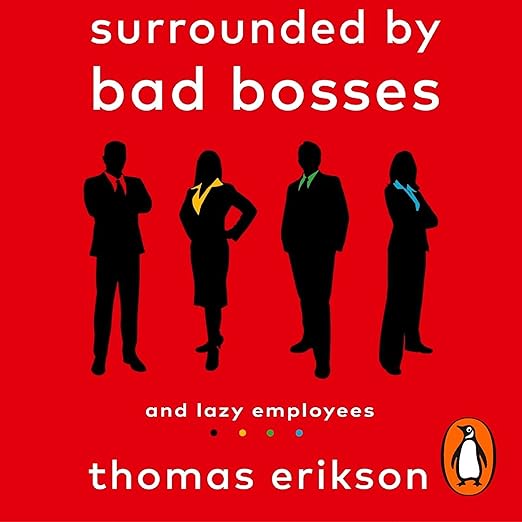
Thomas Erikson built his career on a single, memorable premise: most workplace friction comes down to four colliding personality types, and once you can name them, you can navigate around them. Surrounded by Bad Bosses and Lazy Employees is the nearly thirteen-hour audiobook extension of that premise from Surrounded by Idiots, aimed squarely at the specific frustration of dealing with a micromanaging boss or an unmotivated colleague rather than personality clashes in general. Reviewer Kates sums up the appeal in two words: truthful, and no surprises, which for a workplace-behavior book is closer to a genuine compliment than it sounds.
A Promotion, Then a Different Way to Manage
The book's practical case rests less on theory than on what it actually did for real working listeners. Reviewer Empiri Vasquez reports reading it right after a promotion and crediting it with a huge difference in how they now manage their own team, exactly the kind of concrete before-and-after result a career-advice audiobook needs to justify its existence. That result matters more than the blurb chorus stacked on the cover, Publishers Weekly calling the book outstanding, Business Insider recommending it broadly, a fellow author calling it gut-wrenchingly funny, because it demonstrates the four-color framework surviving contact with an actual workplace rather than staying comfortable in the abstract.
Erikson's four-color model, the same behavioral framework from his earlier bestseller, gets specifically retooled here around power dynamics rather than general personality description: decoding a boss's or a team's behavior, managing up, handling difficult feedback, and communicating across frustrating environments. That narrower application is the book's real value proposition over its predecessor, less a new theory than a sharper, more situational deployment of one already-proven idea.
The four-color model underneath this book is the same behavioral system that made Surrounded by Idiots a bestseller, sorting communication and work styles into four broad types rather than the more clinical, dozen-plus categories a full personality inventory might use. That relative simplicity is a deliberate trade-off: a framework only four colors deep is fast to learn and easy to apply mid-meeting, which is exactly the use case this book is built around, real-time workplace navigation rather than a slow, reflective self-assessment process.
Penguin's own positioning of Erikson as a Sunday Times bestselling author carries specific weight in a crowded workplace-advice market, distinguishing this from the flood of self-published management books competing for the same anxious-employee audience. That commercial pedigree does not guarantee quality on its own, but it does mean this book arrives with an existing readership already primed by Surrounded by Idiots rather than needing to build trust entirely from a cold start.
David John Narrates a Fine Line on Energy
David John narrates, and workplace behavioral nonfiction like this lives or dies on a specific vocal quality: enough energy to keep a subject this potentially dry moving, without tipping into the kind of forced enthusiasm that undercuts a book explicitly promising humor and warmth. Erikson's own reputation for making research-based material accessible and entertaining, per the Publishers Weekly blurb quoted in the synopsis, sets a real bar for the narration to clear.
Reviewer Scott Salamoff offers a genuinely candid endorsement, describing himself, at forty-three, as someone who should not be sounding as bitter about incompetent leadership as he does, and crediting the book specifically with helping him work around, rather than fight, ineffectual people above him. That kind of self-aware, slightly weary honesty from a working professional carries more weight than a purely enthusiastic review would, since it suggests the book's value is coping and clarity rather than a magic fix for a genuinely difficult situation.
The specific praise stacked around this book is worth reading as more than jacket-copy noise. Jim McPartlin, blurbing as a fellow author in the same behavioral-framework space with The Enneagram at Work, is effectively vouching for Erikson's model from inside the same genre rather than as a generic celebrity endorsement, and Business Insider's framing, that everyone should read it, extends the audience beyond people with an obviously difficult boss to anyone managing workplace relationships generally.
Resonating Hardest With Already-Frustrated Listeners
Scott Salamoff's review is worth reading closely for what it reveals about who gets the most out of this book: it resonates hardest with listeners already frustrated by workplace dysfunction, which means the audience most likely to buy it is also the audience most primed to agree with it. That is not a flaw exactly, but it is worth naming as a real dynamic before assuming the book will change a skeptic's mind rather than validate an already-held frustration.
Listeners who have recently finished Surrounded by Idiots should expect the same four-color framework applied to a new, narrower context rather than an entirely new theory of workplace behavior. The value here is in the specific application, bosses and lazy employees rather than personality types broadly, not in a fundamentally different intellectual toolkit.
Workplace-behavior books built around a memorable personal anecdote of dysfunction, Scott Salamoff's specific account of feeling unfairly bitter at forty-three, tend to sell hardest to readers already primed to relate, which is both this genre's greatest strength and its most predictable limitation. A reader with a genuinely easy, low-conflict workplace may find less here to hold onto than someone actively navigating friction right now.
For Team Leads Inheriting Someone Else's Group
This suits anyone currently managing up against a difficult boss, or managing a team that includes at least one disengaged member, along with newly promoted managers like Empiri Vasquez looking for a practical framework rather than abstract leadership theory. HR professionals and team leads navigating mixed-personality environments will find the four-color lens genuinely applicable to real meetings rather than just satisfying in the abstract.
Team leads inheriting a group they did not hire themselves, and therefore navigating personalities they had no say in selecting, are a specific subset of manager likely to find the boss-and-team decoding framework here more immediately useful than a founder building a team from scratch.
Skip this one if Surrounded by Idiots was read recently and a genuinely new framework, rather than a fresh application of the same one, is what's wanted. Skip it too if workplace-behavior books in general already feel over-familiar; nothing here reinvents the genre. For listeners in the middle of an actual difficult-boss or difficult-colleague situation right now, though, this is a specific, practical audiobook rather than a generic pep talk.
- Narrator: David John balances the energy a workplace-behavior book needs against the risk of overselling material that promises humor without becoming a forced-enthusiasm performance.
- Subjects: Workplace personality dynamics, managing difficult bosses, motivating disengaged teams
- Tone: Practical, wry, occasionally cathartic
- Bottom line: A narrower, more situational follow-up to Surrounded by Idiots that real listeners credit with concrete workplace results, best for anyone in an active difficult-boss or difficult-colleague situation.
Before You Listen
Do I need to have read Surrounded by Idiots before this audiobook?
No, but it helps set expectations. This audiobook applies the same four-color personality framework from that earlier book to a narrower context, difficult bosses and disengaged employees specifically, rather than introducing an entirely new theory.
Does this audiobook use the same four-color personality model as Erikson's earlier books?
Yes. It relies on the same behavioral framework, retooled here around decoding a boss's or team's behavior and managing up rather than general personality description.
Is this audiobook more useful for managing a bad boss or managing lazy employees?
Both, according to the synopsis, which promises guidance on decoding a boss's behavior and managing up as well as boosting motivation and productivity across a team, so the value applies in either direction depending on which frustration is more pressing.